
Table of Contents
To successfully crack SSC CGL 2026, candidates should have a clear understanding of the latest syllabus and exam pattern for both Tier 1 and Tier 2 as prescribed by the Staff Selection Commission. This section provides a detailed subject-wise breakdown of topics, including Quantitative Aptitude, Reasoning, English Language, General Awareness, and Computer Knowledge.
It also covers the Tier 2 syllabus, DEST typing test requirements, and post-specific papers for JSO and AAO posts. Additionally, the SSC CGL syllabus PDF can be downloaded from the end of the page for quick reference
SSC CGL Syllabus 2026
The marking scheme for Tier 1 and Tier 2 differs, with negative marking of 0.50 marks in Tier 1 and 1 mark in Tier 2 for each wrong answer. Therefore, candidates should carefully plan their attempts during the exam.
Tier 2 requires more detailed and advanced preparation compared to Tier 1, along with good typing speed as it is assessed in the DEST test.
SSC CGL Syllabus and Exam Pattern 2026 – Highlights
| Particular | Details |
| Conducting Body | Staff Selection Commission |
| Exam Name | SSC CGL 2026 |
| Selection Process | Tier 1 and Tier 2 |
| Total Questions |
|
| Total Marks |
|
| Questions Type | MCQ-based |
| Exam Medium | Hindi and English |
| Negative Marking |
|
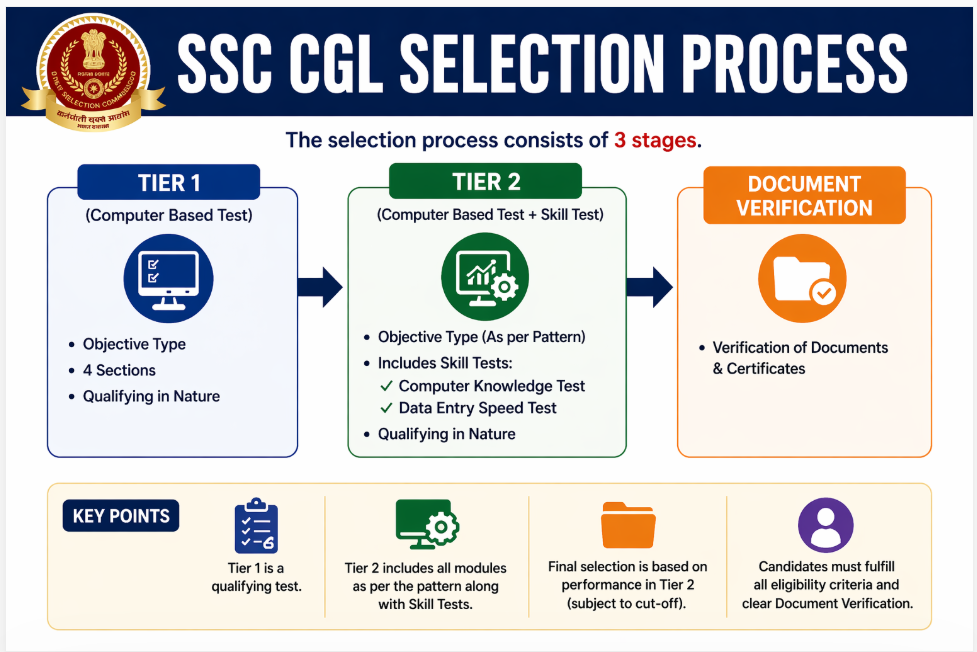
SSC CGL Selection Process
There are 3 stages in the SSC Combined Graduate Level Examination:
- Tier 1 (CBT)
- Tier 2 (CBT + Skill Test)
- Document Verification
SSC CGL Tier 1 Exam Pattern 2026
The Tier 1 is the first stage of the CGL exam and it is qualifying in nature and total marks allotted is 200.
- The exam is divided into four sections. Each section has 25 questions for 50 marks.
- You will get 60 minutes to complete the entire paper. Candidates who need a scribe will be given 1 hour 20 minutes.
- There is a negative marking of 0.50 marks for every wrong answer. So be careful while guessing.
|
Section
|
No. of Questions
|
Marks
|
Duration |
|
English Comprehension
|
25
|
25×2 = 50 | 15 Mins |
|
General Awareness
|
25
|
25×2 = 50 | 15 Mins |
|
General Intelligence & Reasoning
|
25
|
25×2 = 50 | 15 Mins |
|
Quantitative Aptitude
|
25
|
25×2 = 50 | 15 Mins |
|
Total
|
100
|
200
|
1 hour
|
SSC CGL Tier 2 Exam Pattern 2026
The Tier 2 pattern consists of Paper I, Paper II, and Paper III. Check the details here:
|
Tier 2 Paper I Exam Pattern (Compulsory for All Posts)
|
|||||
|
Sessions
|
Section
|
Subject
|
No. of Questions
|
Marks
|
Duration
|
|
I (2 Hour 15 Mins)
|
Section I
|
A: Mathematical Abilities
|
30
|
30×3=90 | 30 Mins |
|
B: Reasoning and General Intelligence
|
30
|
30×3=90 | 30 Mins | ||
|
Section II
|
A: English Language & Comprehension
|
45
|
45×3=135
|
40 Mins | |
|
B: General Awareness
|
25
|
25×3=75
|
20 Mins | ||
|
Section III
|
Computer Knowledge Test
|
20
|
20×3=60
|
15 Minutes
|
|
| II |
Section IV
|
Data Entry Speed Test
|
1 Task
|
–
|
15 Minutes
|
|
Total
|
–
|
450
|
2 Hours 30 Mins
|
||
SSC CGL Tier 2 Paper II Exam Pattern 2026
Paper-II is conducted only for candidates who have applied for the posts of Junior Statistical Officer (JSO) and Statistical Investigator Grade-II.
|
Paper II
|
Subject
|
No. of Questions
|
Maximum Marks
|
Duration
|
|
For JSO Only
|
Statistics
|
100
|
100×2=200 |
2 Hours (2 hours and 40 minutes for the candidates eligible)
|
SSC CGL Tier 2 Paper III Exam Pattern 2026
Paper-III is conducted only for candidates shortlisted for the posts of Assistant Audit Officer (AAO) and Assistant Accounts Officer (AAO) after Tier-I.
|
Paper III
|
Subject
|
No. of Questions
|
Maximum Marks
|
Duration
|
|
For AAO only
|
General Studies (Finance and Economics) |
100
|
100×2=200 |
2 Hours (2 hours and 40 minutes for the candidates eligible)
|
SSC CGL Tier 1 Syllabus
The subject-wise Syllabus for SSC CGL Tier 1 is discussed here.
Quantitative Aptitude Syllabus
- Whole numbers, Decimals, and fractions
- Percentage
- Ratio & Proportion
- Averages
- Profit and Loss, Discount, Interest
- Partnershi
- Mixture and Alligation
- Time and Distance
- Time & Work
- Square/Cube Roots
- Elementary Surds
- Arithmetic Number Series
- Graphs of Linear Equations
- Triangle and its centres
- Quadrilaterals
- Regular Polygons
- Circle (chords, tangents, angles, common tangents)
- Right Prism, Right Circular Cone, Right Circular Cylinder
- Sphere, Hemispheres, Rectangular Parallelepiped, Regular Right Pyramid
- Heights and Distances
- Trigonometric Ratio, Degree and Radian Measures, Standard Identities, Complementary Angles
- Histogram, Frequency Polygon, Bar Diagram, Pie Chart
General Intelligence & Reasoning Syllabus
- Analogies
- Space Visualisation
- Problem-solving, Analysis,
- Decision Making
- Visual Memory
- Blood Relations
- Arithmetical Reasoning
- Figural Classification
- Non-verbal Series
- Coding and Decoding
- Statement Conclusion
- Syllogism
- Number Series
English Language Syllabus
- Idioms and Phrases
- One Word Substitution
- Sentence Correction
- Sentence Improvement
- Error Spotting
- Fill in the Blanks
- Spelling Correction
- Synonyms and Antonyms
- Active and Passive Voice
- Sentence Rearrangement
- Cloze Test
- Reading Comprehension
General Awareness Syllabus
- India and its neighbouring countries
- Science & Technology
- Current Affairs
- Books and Authors
- Sports
- Important Schemes
- Important Days
- People in the News
- Portfolio
- Static GK
- History and Culture
- Geography
- Polity
- Economy
SSC CGL Tier 2 Syllabus
Now, let’s go through the module-wise Tier 2 syllabus that candidates need to prepare along with Tier 1. It is a common misconception that Tier 2 preparation can be started only after Tier 1, but this approach may create gaps in preparation. Since there is limited time between both stages, it is advisable to prepare for Tier 2 alongside Tier 1 to ensure better understanding and performance.
Section 1 Mathematical Abilities Syllabus
The topic-wise syllabus for Quantitative Aptitude under SSC CGL is provided below, covering both Tier 1 and Tier 2 examinations.
Number System & Arithmetic
- Whole numbers, decimals, and fractions
- Relationships between numbers
- Percentage
- Ratio and proportion
- Square roots
- Averages
- Simple and compound interest
- Profit, loss, and discount
- Partnership business
- Mixture and allegation
- Time and distance
- Time and work
Algebra
- Basic algebraic identities
- Elementary surds
- Graphs of linear equations
Geometry & Mensuration
- Triangles and their centres
- Congruence and similarity of triangles
- Quadrilaterals and polygons
- Circles (chords, tangents, angles, common tangents)
- 3D figures: Prism, Cone, Cylinder, Sphere Hemispheres, Parallelepiped, Pyramid
Trigonometry
- Trigonometric ratios
- Complementary angles
- Standard identities (e.g., sin²θ + cos²θ = 1)
- Heights and distances
Data Interpretation & Statistics
- Tables and graphs (Histogram, Frequency Polygon, Bar Chart, Pie Chart)
- Mean, Median, Mode
- Standard Deviation
- Basic probability
Section 1 General Intelligence and Reasoning Syllabus
This section comprises of questions from General intelligence and reasoning for both Tier 1 and Tier 2. Candidates need to prepare each topic thoroughly and practice as much as they can:
- Semantic analogy
- Number/symbolic analogy
- Figural analogy
- Semantic classification
- Number/symbolic classification
- Figural classification
- Semantic series
- Number series
- Figural series
- Letter and number coding-decoding
- Small & capital letter classification
- Symbolic operations
- Syllogism
- Statement and conclusion
- Drawing inferences
- Analytical reasoning
- Judgment and decision making
- Problem solving
- Arithmetical reasoning
- Numerical operations
- Trends and patterns
- Space visualisation and orientation
- Visual memory and observation
- Embedded figures
- Punched hole / paper folding & unfolding
- Figural completion and pattern folding
- Venn diagram-based questions
- Indexing
- Address, date, and city matching
- Classification of roll numbers/centre codes
- Word building
- Discrimination
- Relationship concepts
- Critical thinking
- Emotional intelligence
- Social intelligence
Section 2 English Language & Comprehension Syllabus
The English language syllabus for Tier 1 and Tier 2 exam consists of the following topics. A useful tip for candidate is to read English newspaper, editorials, watch english series to enhance this part:
- Passages based on literature and current affairs
- Inference and understanding-based questions
- Synonyms and antonyms
- One word substitution
- Idioms and phrases
- Homonyms
- Word usage
- Error spotting
- Sentence correction
- Fill in the blanks
- Spelling errors
- Sentence improvement
- Sentence rearrangement/reordering
- Active and passive voice
- Direct and indirect speech
- Passage-based fill-in-the-blanks
Section 2 General Awareness Syllabus
This CGL GA Syllabus comprises of Current Affairs, Static GK, Science, and other fields of our daily life:
Current Affairs
- National and international current events
- Important days and events
- People in news
- Recent government schemes
Static GK
- India and its neighbouring countries
- History and culture
- Geography
- Economic scene
- General policy
Science & Research
- Basic science awareness
- Scientific research and developments
- Environmental awareness and its application to society
Miscellaneous
- Books and authors
- Sports
- Important portfolios
- Daily observations and practical knowledge
Section 3 Computer Knowledge and Proficiency Syllabus
The Computer knowledge section includes the basics of computers, Software, Internet & Email Usage, and Networking & Cyber Security. Sub Topics to be covered under this part are given below.
- CPU, I/O Devices
- Memory & Storage
- Backup Devices
- Ports
- Windows Explorer
- Keyboard Shortcuts
- Microsoft Word, Excel, PowerPoint
- Web Browsing & Searching
- File Downloading/Uploading
- Email Account Management
- e-Banking Basics
- Network Devices & Protocols
- Information Security Threats (Viruses, Worms, Trojan, etc.)
- Prevention Measures
Check Number of Attempts Allowed in SSC CGL Exam
SSC CGL Paper 2 Statistics Syllabus (For JSO Post Only)
Paper 1 focuses on Statistics and is applicable only to candidates who have applied for the Junior Statistical Officer (JSO) post. Such candidates are required to attempt this paper in addition to Paper 1. The syllabus for this section includes the following topics:
1. Collection, Classification and Presentation of Data
- Primary and Secondary data
- Methods of data collection
- Tabulation of data
- Graphs and charts
- Frequency distributions
- Diagrammatic presentation of frequency distributions
2. Measures of Central Tendency
- Mean, Median, Mode
- Quartiles, Deciles, Percentiles
3. Measures of Dispersion
- Range
- Quartile deviation
- Mean deviation
- Standard deviation
- Relative dispersion
4. Moments, Skewness and Kurtosis
- Types of moments
- Meaning of skewness and measures
- Meaning of kurtosis and measures
5. Correlation and Regression
- Scatter diagram
- Simple correlation coefficient
- Regression lines
- Spearman’s rank correlation
- Association of attributes
- Multiple regression
- Multiple and partial correlation (for 3 variables)
6. Probability Theory
- Meaning and definitions of probability
- Conditional probability
- Compound probability
- Independent events
- Bayes’ theorem
7. Random Variable and Probability Distributions
- Random variable
- Probability functions
- Expectation and variance
- Higher moments
- Binomial distribution
- Poisson distribution
- Normal distribution
- Exponential distribution
- Joint distribution of two discrete variables
8. Sampling Theory
- Population and sample
- Parameter and statistic
- Sampling and non-sampling errors
- Probability and non-probability sampling techniques:
- Simple random sampling
- Stratified sampling
- Multistage sampling
- Multiphase sampling
- Cluster sampling
- Systematic sampling
- Purposive sampling
- Convenience sampling
- Quota sampling
- Sampling distribution (statement only)
- Sample size decisions
9. Statistical Inference
- Point estimation and interval estimation
- Properties of a good estimator
- Methods: Moments, Maximum likelihood, Least squares
- Hypothesis testing basics
- Small and large sample tests
- Z-test, t-test, Chi-square test, F-test
- Confidence intervals
10. Analysis of Variance (ANOVA)
- One-way classified data
- Two-way classified data
11. Time Series Analysis
- Components of time series
- Trend measurement methods
- Seasonal variation measurement methods
12. Index Numbers
- Meaning of index numbers
- Problems in construction
- Types of index numbers
- Different formulae
- Base shifting and splicing
- Cost of living index numbers
- Uses of index numbers
SSC CGL Paper 3 General Studies: Finance & Economics (For AAO Post Only)
Paper 3 is included in the Tier 2 examination and is applicable only to candidates who have applied for the Assistant Audit Officer (AAO) post. However, since no vacancies have been announced for this post this year by SSC, Paper 3 will not be conducted as part of the Tier 2 exam this time.
Part A: Finance and Accounts (80 Marks)
• Nature and scope
• Limitations of Financial Accounting
• Basic concepts and Conventions
• Generally Accepted Accounting Principles
• Basic concepts of accounting
• Single and double entry
• Books of Original Entry
• Bank Reconciliation
• Journal, ledgers
• Trial Balance
• Rectification of Errors
• Manufacturing, Trading, Profit & Loss Appropriation Accounts
• Balance Sheet
• Distinction between Capital and Revenue Expenditure
• Depreciation Accounting
• Valuation of Inventories
• Non-profit organisations Accounts
• Receipts and Payments and Income & Expenditure Accounts
• Bills of Exchange
• Self Balancing Ledgers
Part B: Economics and Governance (120 Marks)
1. Comptroller & Auditor General (CAG) of India
- Constitutional provisions
- Role and responsibilities
2. Finance Commission
- Role and functions
3. Basic Concepts of Economics and Micro Economics
- Definition of Economics
- Scope and nature of Economics
- Methods of economic study
- Central problems of an economy
- Production possibilities curve
4. Theory of Demand and Supply
- Meaning and determinants of demand
- Law of demand and elasticity of demand
- Price, income and cross elasticity
- Theory of consumer behaviour
- Marshallian approach
- Indifference curve approach
- Meaning and determinants of supply
- Law of supply
- Elasticity of supply
5. Theory of Production and Cost
- Meaning and factors of production
- Law of variable proportions
- Laws of returns to scale
6. Forms of Market and Price Determination
- Perfect competition
- Monopoly
- Monopolistic competition
- Oligopoly
- Price determination in different markets
7. Indian Economy
- Nature of the Indian economy
- Role of agriculture, industry, and services – problems and growth
- National Income – concepts and methods of measurement
- Population – size, growth rate, impact on economic growth
- Poverty and unemployment – types, causes, extent
- Infrastructure – energy, transportation, communication
8. Economic Reforms in India
- Economic reforms since 1991
- Liberalisation
- Privatisation
- Globalisation
- Disinvestment
9. Money and Banking
- Monetary and fiscal policy
- Role and functions of Reserve Bank of India (RBI)
- Functions of commercial banks, Regional Rural Banks (RRB), Payment Banks
- Budget and fiscal deficits
- Balance of payments
- Fiscal Responsibility and Budget Management (FRBM) Act, 2003
10. Role of Information Technology in Governance
- Use of IT in administration and governance
SSC CGL Official Syllabus 2026 PDF
Candidates can download the official Syllabus here, which was released by SSC along with the official notification. Download the syllabus and take a printout of it, and keep it with your study books/notes.
SSC CGL Syllabus: Topic-wise Weightage
| General Awareness Syllabus | |
| Topics |
No. of Questions
|
| Current Affairs (National and International) | 5 to 7 |
| History of India and World | 2 to 3 |
| Geography of India and World | 2 to 3 |
| Polity and Constitution | 2 to 3 |
| Economics | 1 to 2 |
| General Science | 4 to 6 |
| Static GK | 3 to 5 |
| Miscellaneous (Computer Basics, Abbreviations, etc.) | 1 to 2 |
| General Intelligence & Reasoning Syllabus | |
| Topics | Questions |
| Mathematical Operations | 1 to 2 |
| Syllogism | 1 to 2 |
| Direction Sense | 1 to 2 |
| Venn Diagram | 1 to 2 |
| Odd One Out | 1 to 2 |
| Analogy | 2 to 4 |
| Coding-Decoding | 3 to 4 |
| Number Series / Alpha-Numeric Series | 2 to 3 |
| Seating Arrangement | 2 to 3 |
| Non-Verbal Reasoning | 1 to 2 |
| Blood Relations | 1 to 2 |
| Quantitative Aptitude Syllabus | |
| Topics |
No. of Questions
|
| Ratio & Proportion | 1 to 2 |
| Algebra | 2 to 3 |
| Geometry | 2 to 3 |
| Mensuration | 1 to 2 |
| Trigonometry | 1 to 2 |
| Data Interpretation | 1 to 2 |
| Number System | 1 to 2 |
| Miscellaneous (Simplification, Surds, Indices) | 1 to 2 |
| Profit & Loss | 2 to 3 |
| Time and Work | 1 to 2 |
| Percentages | 1 to 2 |
| Simple & Compound Interest | 1 to 2 |
| Time, Speed & Distance | 1 to 2 |
| Averages | 1 to 2 |
SSC CGL Tier 2 Typing Speed Test Syllabus
In the SSC CGL exam, the typing test is officially called the Data Entry Speed Test (DEST). DEST is mandatory for all candidates, but it is qualifying in nature.
In this test, candidates are required to type a passage of about 2000 key depressions within 15 minutes. The test checks your typing speed and accuracy. PwBD (Persons with Benchmark Disabilities) candidates belonging to the OH category can get exemption from DEST only if they submit a medical certificate from a Government Civil Surgeon stating that they are permanently unfit for typing.
Candidates who are eligible for a scribe will be given 5 minutes of extra time in the DEST. Visually handicapped candidates who used a scribe in the written exam will also be provided a passage reader during the typing test.



 SSC CHSL Syllabus 2026 (Official PDF) Fo...
 PNB SO Syllabus 2026 and Exam Pattern, D...
 IBPS PO Syllabus 2026 For Prelims, Mains...