
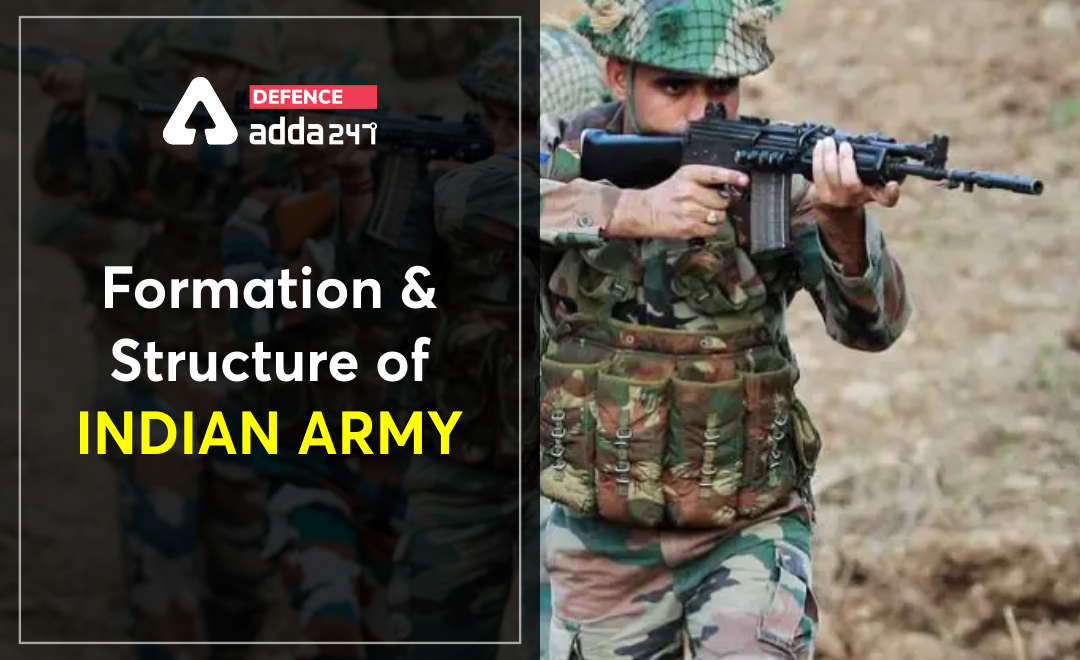
Formation and Structure of Indian Army
The Second Largest standing army in the world and the largest component of Indian Armed Forces. The Indian Army is Undoubtedly the pride of India. The Indian Army has 1.2 million active troops and 1 million reserve troops right now. In this article, we will discuss the structure and Formation of Indian Army.
The Headquarter of Indian Army is in New Delhi and and is under the overall command of COAS , Chief of Army Staff. Currently COAS of India is General Manoj Mukund Narvane.
Field Formations of Army
The Basic Field Formations of Army are Discussed below:
Command: Two or three corps together form a command , Indian Army has six operational commands and one training command. Each command is headed by a general officer commanding-in-chief (GOC-in-C), known as the army commander.
Corps: Three or Four Division together make a Corp, Indian Army has 14 Corps each one commanded by a general officer commanding (GOC), known as the corps commander, who holds the rank of Lieutenant General. In Indian Army there are three types of corps : Strike, Holding and Mixed.
The Corps HQ is the highest field formation in the army.
Division: A Division is made up of three or four Brigades, each division is headed by GOC (division commander) in the rank of major general. Currently, the Indian Army has 40 Divisions including four RAPIDs (Re-organised Army Plains Infantry Division), 18 Infantry Divisions, 12 Mountain Divisions, three Armoured Divisions and three Artillery Divisions.
Brigade: Around 3,000 combat troops with supporting elements make a Brigade. In addition to the Brigades in various Army Divisions, the Indian Army also has five Independent Armoured Brigades, 15 Independent Artillery Brigades, seven Independent Infantry Brigades, one Independent Parachute Brigade, three Independent Air Defence Brigades, two Independent Air Defence Groups and four Independent Engineer Brigades. These Independent Brigades operate directly under the Corps Commander (GOC Corps).
Battalion: Four rifle companies together make a Battalion. it is Commanded by a battalion commander who is a Colonel and is the Infantry’s main fighting unit. Every infantry battalion also possesses one Ghatak Platoon.
Company: A Company is Composed of three platoons. it is Commanded by a company commander who is a major or lieutenant-colonel.
Battery: A Battery Comprises of either 3 or 4 sections, in artillery and air defence units. Every battery has two officers, the senior of which is the Battery Commander.
Platoon: A Platoon is Composed of three sections. it is Commanded by a platoon commander who is a JCO.
Section: A Section is the Smallest military outfit, with a strength of 10 personnel. it is Commanded by a section commander of the rank of Havaldar.
Indian Army Command Structure
Indian Army has a total of 7 commands including one training command, Each command is headed by a general officer commanding-in-chief (GOC-in-C), known as the army commander. Each command directly reports to the army headquarter at New Delhi.
Here we will learn about all seven commands.
1. Central Command
Headquarter-Lucknow, Uttar Pradesh
Sub-ordinate Unit-I Corps — Currently assigned to South Western Command
2. Eastern Command
Headquarter- Kolkata
Sub-ordinate Unit-
- 23rd Infantry Division headquartered at Ranchi
- III Corps, headquartered at Dimapur, Nagaland
- IV Corps, headquartered at Tezpur, Assam
- XXXIII Corps, headquartered at Siliguri, West Bengal
3. Northern Command
Headquarter- Udhampur
Sub-ordinate Unit-
- XIV Corps, headquartered at Leh, Jammu and Kashmir
- XV Corps, headquartered at Srinagar, Jammu and Kashmir
- XVI Corps, headquartered at Nagrota, Jammu and Kashmir
4. Southern Command
Headquarter- Pune
Sub-ordinate Unit-
- 41st Artillery Division, headquartered at Pune, Maharashtra
- XII Corps, headquartered at Jodhpur, Rajasthan
- XXI Corps, headquartered at Bhopal, Madhya Pradesh
5. South Western Command
Headquarter- Jaipur
Sub-ordinate Unit-
- 42nd Artillery Division headquartered at Jaipur
- I Corps, headquartered at Mathura, Uttar Pradesh
- X Corps, headquartered at Bhatinda, Punjab
6. Western Command
Headquarter- Chandimandir
Sub-ordinate Unit-
- 40th Artillery Division headquartered at Ambala
- II Corps, headquartered at Ambala, Haryana
- IX Corps, headquartered at Yol, Himachal Pradesh
- XI Corps, headquartered at Jalandhar, Punjab
7. Army Training Command
Headquarter- Shimla
Basic Organizational Structure
To understand the structure better, we need to know that Indian army is broadly divided into three Groups, that are
- Combat Arms
- Combat support Arms
- Supporting arm
Combat Arms
- Infantry
- The Armoured Corp
- The Mechanized Infantry
- The Regiment of Artillery
- Corps of Army Air Defence
- Army Aviation Corps
Combat Support Arms
- Corps of Engineers
- Corps of EME
- Corps of Signals
- Army Ordnance Corps
- Army Supply Corps
- Army Medical Corps
Supporting Arms
- Intelligence Corps
- Corps of Military Police
- Territorial Army
- Judge Advocate General’s Department
- Remount and Veterinary Corps
- Army Education Corps
- Army Dental Corps
- Military Nursing Service
- Army Postal Service Corps
- Pioneer Corps
- Defence Security Corps
- Military Farms Services
Queen of the Battle: Infantry
The most Pivotal role in a war is played by the Infantry. Infantry is the soul of whole army organization. The Indian Army’s Infantry consist of many regiments, each of which further comprises many battalions / units. The battalions are sequenced in a particular fashion, generally in order of when they were raised. Below we are providing names of all infantry Regiment with their regiment headquarters and all other related information.
| Regiment | Active From | Regimental Center | Motto | War Cry |
|---|---|---|---|---|
| The Brigade of the Guards | 1948 | Kamptee, Maharashtra | “Pahla hamesha pahla” (“first always first”) | “Garud ka hun bol pyare” (“I am the son of Garuda, Say O my friend”) |
| Madras Regiment | 1758 | Wellington, Tamil Nadu | “Swadharme nidhanam shreyaha” (“it is a glory to die doing one’s duty”) | “Veera Madrassi, Adi Kollu, Adi Kollu” (“Brave Madrassi, Strike and Kill, Strike and Kill!”) |
| Rajputana Rifles | 1775 | Delhi Cantonment, Delhi | “Veer bhogya vasundhara” (“the brave shall inherit the earth”) | “Raja Ramachandra ki jai” (“victory to King Ramachandra”) |
| Sehrawat Regiment | 1778 | Haryana | “Sarvatra vijay” (“victory everywhere”) | “Bol Bajrang Bali Ki jai” (“say victory to Lord Hanuman”) |
| Dogra Regiment | 1877 | Faizabad, Uttar Pradesh | “Kartavyam anvatma” (“duty before death”) | “Jawala Mata ki jai” (“victory to Goddess Jawala”) |
| Sikh Regiment | 1846 | Ramgarh Cantonment, Jharkhand | “Nischay kar apni jeet karon” (“with determination, I will be triumphant”) | “Jo bole So Nihal, sat sri akal” (“he who cries ‘God is truth’ is ever happy”) “Wahe Guruji Da Khalsa, Wahe Guruji Di Fateh” (“The Khalsa of Waheguru is victorious”) |
| Jat Regiment | 1795 | Haryana,Bareilly, Uttar Pradesh | “Sangathan va veerta” (“unity and valour”) | “Jat balwan, jai bhagwan” (“the Jat is strong, victory to God”) |
| Parachute Regiment | 1945 | Bengaluru, Karnataka | “Shatrujeet” (“the conqueror”) | “Balidan Param Dharma” (“Sacrifice Supreme Duty”) |
| Punjab Regiment | 1757 | Ramgarh Cantonment, Jharkhand | “Sthal wa jal” (“by land and sea”) | “Jo bole So Nihal, sat sri akal” (“he who cries ‘God is truth’ is ever happy”); “Bol Jawala Ma ki jai” (“say victory to Goddess Jawala”) |
| The Grenadiers | 1778 | Jabalpur, Madhya Pradesh | “Sarvada shaktishali (“always strong”) | “Sarvada shaktishali” (“always strong”) |
| Sikh Light Infantry | 1944 | Fatehgarh, Uttar Pradesh | “Deg teg fateh” (“prosperity in peace and victory in war”) | “Jo bole So Nihal, sat sri akal” (“he who cries ‘God is truth’ is ever happy”) |
| Maratha Light Infantry | 1768 | Belgaum, Karnataka | “Duty, honour, courage” | “Bola Shri Chhatrapati Shivaji Maharaj ki jai, Temlai Mata ki jai” (“say victory to Emperor Shivaji, victory to Goddess Temlai”) |
| The Garhwal Rifles | 1887 | Lansdowne, Uttarakhand | “Yudhaya krit nischya” (“fight with determination”) | “Badri Vishal Lal ki jai” (“victory to the Great Lord Badri Nath”) |
| Kumaon Regiment | 1813 | Ranikhet, Uttarakhand | “Parakramo vijayate” (“valour triumphs”) | “Kalika Mata ki jai” (“victory to Goddess Kali”); “Bajrang Bali ki jai” (“victory to Lord Hanuman”); “Dada Kishan ki jai” (“Victory to Dada Kishan”) |
| Assam Regiment | 1941 | Shillong, Meghalaya | “Assam vikram” (“unique valour”) | “Rhino charge” |
| Bihar Regiment | 1941 | Danapur, Bihar | “veerta se yudh par” (“To war with valour”) | “Bajrang Bali Ki Jai” (Victory to Lord Hanuman); “Birsa Munda ki jai” (“victory to Birsa Munda”) |
| Mahar Regiment | 1941 | Saugor, Madhya Pradesh | “Yash sidhi” (“success and attainment”) | “Bolo Hindustan ki jai” (“say victory to India”) |
| Jammu & Kashmir Rifles | 1821 | Jabalpur, Madhya Pradesh | “Prashata ranvirta” (“valour in battle is praiseworthy”) | “Durga Mata ki jai” (“victory to Goddess Durga”) |
| Jammu and Kashmir Light Infantry | 1947 | Awantipora, Jammu and Kashmir | “Balidanam vir lakshanam ” (“sacrifice is a characteristic of the brave”) | “Bharat Mata ki jai” (“victory to Mother India”) |
| Naga Regiment | 1970 | Ranikhet, Uttarakhand | “Parakramo vijayate” (“valour triumphs”) | “Jai Durga Naga” (“victory to Durga Naga”) |
| 1 Gorkha Rifles (The Malaun Regiment) | 1815 | Subathu, Himachal Pradesh | “Kayar hunu bhanda marnu ramro” (“better to die than live like a coward”) | “Jai Ma Kali, ayo Gorkhali” (“hail Goddess Kali, here come the Gorkhas”) |
| 3 Gorkha Rifles | 1815 | Varanasi, Uttar Pradesh | “Kayar hunu bhanda marnu ramro” (“better to die than live like a coward”) | “Jai Ma Kali, ayo Gorkhali” (“hail Goddess Kali, here come the Gorkhas”) |
| 4 Gorkha Rifles | 1857 | Sabathu, Himachal Pradesh | “Kayar hunu bhanda marnu ramro” (“better to die than live like a coward”) | “Jai Ma Kali, ayo Gorkhali” (“hail Goddess Kali, here come the Gorkhas”) |
| 5 Gorkha Rifles (Frontier Force) | 1858 | Shillong, Meghalaya | “Shaurya evam nistha” (“courage and determination”) | “Jai Ma Kali, ayo Gorkhali” (“hail Goddess Kali, here come the Gorkhas”) |
| 8 Gorkha Rifles | 1824 | Shillong, Meghalaya | “Kayar hunu bhanda marnu ramro” (“better to die than live like a coward”) | “Jai Ma Kali, ayo Gorkhali” (“hail Goddess Kali, here come the Gorkhas”) |
| 9 Gorkha Rifles | 1817 | Varanasi, Uttar Pradesh | “Kayar hunu bhanda marnu ramro” (“better to die than live like a coward”) | Jai Ma Kali, Ayo Gorkhali (“hail Goddess Kali, here come the Gorkhas”) |
| 11 Gorkha Rifles | 1918-1922; from 1948 | Lucknow, Uttar Pradesh | “Yatraham vijayastatra” (“Victory resides where I reside”) | “Jai Ma Kali, Ayo Gorkhali (“hail Goddess Kali, here come the Gorkhas”) |
| Ladakh Scouts | 1963 | Leh, Ladakh | “Ki ki so so Lhargyalo” (“Victory to God”) | |
| Arunachal Scouts | 2010 | Rayang, Pasighat, Arunachal Pradesh | ||
| Sikkim Scouts | 2013 |
We Tried Our best to equip you with all the important facts regarding Formation of Indian Army. Hope you find your Answers.
Structure of Indian Army: FAQs
Q1. How many soldiers are in a platoon?
Ans. Three or four squads make up a platoon, which has 20 to 50 soldiers.
Ans. General Manoj Mukund Naravane is the Chief of Indian Army.
Q3. What is the highest rank of Indian Army?








 Indian Army Agniveer Previous Year Paper...
 CDS Previous Year Question Papers, Downl...
 CRPF Constable Tradesman Previous Year Q...