Table of Contents
The RBI Grade B Exam is considered toughest of all Bank exams, and still, every year lakhs of candidates appear for the exam. Due to high competition, the difficulty level of the exam is getting tougher each year, so dedicated and consistent preparation is required. Therefore, in this article, we have shared the detailed subject-wise RBI Grade B Syllabus 2026 for Phase 1 and Phase 2 (General/DEPR/DSIM posts).
In order to qualify for each stage, candidates should have a proper understanding of the overall Grade B Syllabus and Exam Pattern for Phase 1 and Phase .
RBI Grade B Syllabus 2026
RBI has released the official Syllabus and exam pattern for both Phase 1 and Phase 2, and it differs for Grade B (General), DEPR, and DSIM posts. Phase 1 Syllabus consists of GA, Reasoning, English, and Quants, and Phase 2 syllabus consists of ESI, Finance & Management, English Descriptive, and stream-specific subjects. Compared to other banking exams such as SBI and IBPS, the RBI Grade B exam demands greater conceptual clarity and in-depth understanding of subjects.
RBI Grade B Syllabus and Exam Pattern – Highlights
|
RBI Grade B Syllabus and Exam Pattern Highlights
|
|
|
Exam Name
|
|
|
Name of Authority
|
Reserve Bank of India
|
|
Post
|
Grade B Manager General, DEPR, DSIM
|
|
Category
|
Syllabus
|
|
RBI Grade B Selection Process
|
|
|
Exam Mode
|
Online
|
|
Examination Language
|
English
|
|
Job Location
|
PAN Indian
|
|
Official Website
|
rbi.org.in
|
RBI Grade B Selection Process 2026
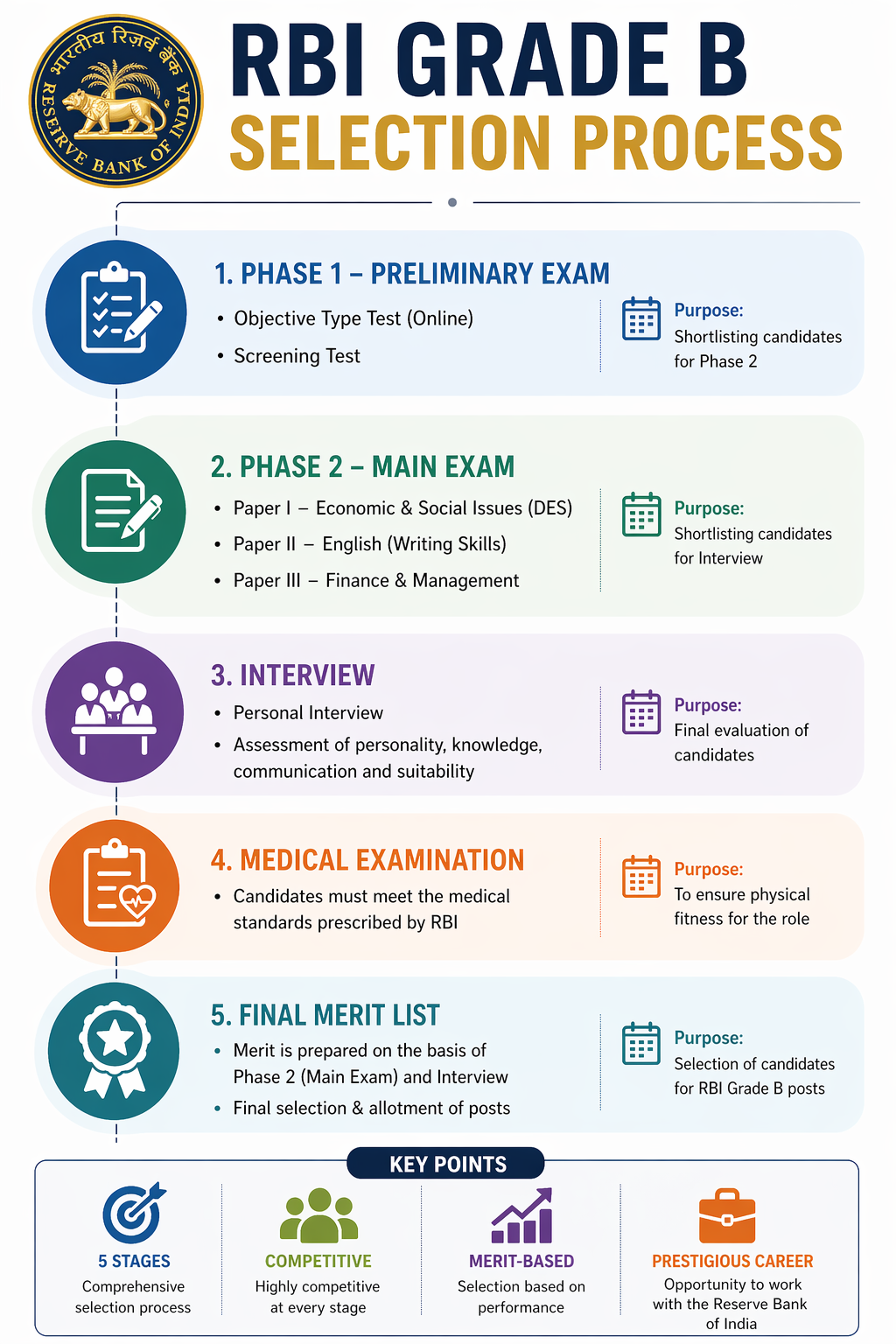
RBI Grade B Exam Pattern New (General Stream)
The RBI Grade B Prelims Exam has only multiple-choice questions (MCQs), while the Mains Exam includes both MCQs and descriptive questions. Both exams are held online, and candidates need to type their answers on the computer provided.
Phase 1 consists entirely of objective-type questions, while Phase 2 includes both objective and descriptive questions. It is important to note that each correct answer carries +1 mark, and each incorrect answer incurs a penalty of -0.25 marks.
RBI Grade B Phase 1 Exam Pattern for General (Prelims)
|
Subject
|
Questions
|
Marks
|
Duration
|
|
General Awareness
|
80
|
80
|
25 Mins
|
|
Reasoning
|
60
|
60
|
45 Mins
|
|
English
|
30
|
30
|
25 Mins
|
|
Quantitative Aptitude
|
30
|
30
|
25 Mins
|
|
Total
|
200
|
200
|
2 Hours
|
Note:
- Exam Mode – Online computer-based test (CBT)
- Total Questions – 200 MCQs, 1 mark each
- Total duration – 2 hours with sectional timing
- Must clear sectional as well as overall cut-off
- Negative marking: 0.25 mark for each wrong answer
RBI Grade B Phase 2 Exam Pattern for General (Mains)
|
Paper
|
Sections / Subjects
|
No. of Questions
|
Maximum Marks
|
Duration
|
|
Paper I
|
Economics and Social Issues
|
Objective: 30
Descriptive: 6 (Attempt any 4) |
Objective: 50
Descriptive: 50 Total: 100 |
Objective: 30 minutes
Descriptive: 90 minutes Total: 120 minutes |
|
Paper II
|
English (Writing Skills)
|
Descriptive: 3 (Precis, RCs & Essay)
|
100
|
90 minutes
|
|
Paper III
|
Finance and Management
|
Objective: 30
Descriptive: 6 (Attempt any 4) |
Objective: 50
Descriptive: 50 Total: 100 |
Objective: 30 minutes
Descriptive: 90 minutes Total: 120 minutes |
Notes:
- Phase 2 (Mains) for General stream includes: Economics & Social Issues, English Writing, and Finance, Management & Ethics
- Only candidates who clear Phase 1 can appear for Phase 2
- Papers I & III have two sections of equal marks: Objective (MCQ) and Descriptive
- Descriptive answers must be typed on the keyboard
- Objective section: 30 questions for 50 marks
- Descriptive section: 6 questions, attempt 4 questions (15 marks each)
- Descriptive questions are generally simple and direct
RBI Grade B Prelims Syllabus (General Stream)
|
Subject
|
Topics
|
|
Reasoning
|
|
|
Quantitative Aptitude
|
|
|
English Language
|
|
|
General Awareness
|
|
Let’s go through Mains syllabus for General/DEPR/DSIM posts now:
RBI Grade B Mains Paper 1- ESI Syllabus
The following subjects and topics are to be covered in depth for ESI Paper:
| Section | Topics Covered |
| Growth and Development |
Measurement of growth: National Income and Per Capita Income
|
|
Poverty Alleviation and Employment Generation in India
|
|
|
Sustainable Development and Environmental Issues
|
|
| Indian Economy |
Economic History of India
|
|
Changes in Industrial and Labour Policy
|
|
|
Monetary and Fiscal Policy since the 1991 reforms
|
|
|
Priorities and Recommendations of Economic Survey and Union Budget
|
|
|
Indian Money and Financial Markets and their linkages with the Economy
|
|
|
Role of Indian Banks and RBI in Development
|
|
| Public Finance | |
|
Political Economy
|
|
|
Industrial Developments in India
|
|
|
Indian Agriculture
|
|
| Services Sector |
RBI Grade B Mains Paper 2- English Writing Skills Syllabus
- Precis
- Essay
- Reading Comprehension
Topics To Cover
- Structure and Functions of Financial Institutions,
- Functions of RBI,
- Banking System in India,
- Financial Institutions (SIDBI, EXIM Bank, NABARD, NHB, NABFID),
- Global Financial System and its impact on India,
- Information Technology in Banking,
- Non-Banking System,
- Digital Payments.
- Primary and Secondary Markets (Forex, Money, Bond, Equity),
- Functions, Instruments, and Recent Developments.
- Financial Risk Management,
- Basics of Derivatives,
- Global financial markets and International
- Banking,
- Financial Inclusion,
- Alternative finance,
- Public-Private Partnership,
- Corporate Governance in Banking,
- Union Budget,
- Accounting Basics,
- Inflation and its management,
- Monetary and Fiscal policies.
RBI Grade B Mains Paper 3- Finance and Management Syllabus
| Section | Topics Covered |
| Fundamentals of Management & OB |
Introduction to Management
|
|
Evolution of Management Thought (Scientific, Administrative, Human Relations)
|
|
|
Systems Approach to Management
|
|
|
Managerial Roles
|
|
| Nudge Theory | |
|
Personality – Big Five Model
|
|
|
Reinforcement and Perception
|
|
|
Motivation – Maslow, Alderfer, McClelland, Herzberg
|
|
|
Leadership – Trait, Behavioural, Contingency, Charismatic, Transactional, Transformational
|
|
|
Emotional Intelligence
|
|
|
Interpersonal Relationship – Transactional Analysis, Johari Window
|
|
|
Conflict Management
|
|
|
Organisational Change
|
|
|
Organisational Development
|
|
|
Ethics at the Workplace
|
|
| Corporate Governance |
Meaning of Ethics
|
|
Ethical Problems in Business
|
|
|
Theories of Ethics – Utilitarianism, Rights & Duties, Justice & Fairness, Ethics of Care
|
|
|
Moral Issues – Ethics in Compliance, Finance, HR, Marketing
|
|
|
Ethical Principles in Business
|
|
|
Role of Board of Directors
|
|
| Best Practices | |
|
Code of Ethics and Conduct
|
|
|
Corporate Governance Mechanisms
|
|
| Communication |
Communication Process
|
|
Communication Channels – Oral vs Written, Verbal vs Non-verbal
|
|
|
Communication Barriers, Upward, Downward, Lateral Communication
|
|
|
Role of Information Technology in Communication
|
RBI Grade B DEPR Exam Pattern
Like the General stream, the DEPR Exam also consists of Phase 1 and Phase 2, but its exam pattern differs. Check the RBI Grade B DEPR Exam Pattern for both stages here.
| RBI Grade B DEPR Phase 1 Exam Pattern | |||
| Name of Paper | Type | Duration | Maximum Marks |
| Paper I: Economics | Objective | 120 minutes | 100 |
| Paper II: English (to be typed using keyboard) | Descriptive | 120 minutes | 100 |
| Total | – | – | 200 |
| RBI Grade B DEPR Phase 1 Exam Pattern | |||
| Name of Paper | Type | Duration | Maximum Marks |
| Paper I: Economics (Question paper on computer, answers on paper) | Descriptive | 120 minutes | 100 |
| Paper II: Economics (Question paper on computer, answers on paper) | Descriptive | 120 minutes | 100 |
| Total | – | – | 200 |
RBI Grade B DEPR Syllabus 2026
As per the RBI Notification, the Standard of papers on Economics will be based on the master’s degree examination in Economics of any Central University. The RBI Grade B DEPR Syllabus is divided into three papers: Paper 1 is Economics objective, Paper 2 is Economics descriptive, and Paper 3 is English descriptive.
| Phase/Paper Name | Subjects | Topics Covered |
| Phase 1 Paper 1 (Objective) | Microeconomics |
Theories of consumer demand, Production, Market structures & pricing, Distribution, Welfare economics
|
| Macroeconomics |
Theories of employment, Output & inflation, Monetary economics, IS–LM model, Schools of economic thought
|
|
| International Economics |
Theories of international trade, Balance of payments, Exchange rate models
|
|
| Economic Growth & Development |
Classical and neo-classical approaches to economic growth, Major development theories
|
|
| Public Finance |
Theories of taxation, Public expenditure, Public debt management
|
|
| Environmental Economics |
Green GDP, Environmental valuation, Environmental policy instruments
|
|
| Quantitative Methods in Economics |
Mathematical & statistical methods for economics, OLS regression
|
|
| Current Developments in the Indian Economy |
Growth, inflation, poverty, unemployment, financial sector, external sector, fiscal developments, agriculture, industry, infrastructure, services
|
|
| Phase 1 Paper 2 (Descriptive) | English Language |
The paper on English shall be framed in a manner to assess the writing skills including expression and understanding of the topic.
|
| Phase 2 Paper 1 Microeconomics (Descriptive) | Consumer Theory |
Utility analysis, Consumer surplus, Indifference curves, Price/Income/Substitution effects, Game theory
|
| Production Theory |
Production functions, Returns to scale, Partial vs General equilibrium
|
|
| Market Theory | Pricing under different market structures | |
| Distribution Theories | Ricardo, Marx, Kalecki, Kaldor | |
| Welfare Economics | Pareto optimality, Arrow, Coase, Sen | |
| Phase 2 Paper 1 Macroeconomics (Descriptive) | National Income | Methods of measuring national income |
| Employment & Output |
Classical, Neo-classical, Keynesian, Post-Keynesian, Business cycles
|
|
| Inflation | Types, Phillips curve, Taylor’s rule, Lucas critique | |
| Money & Banking |
Quantity theory, Neutrality, IS–LM, AD–AS, Money multiplier, Monetary policy, Inflation targeting
|
|
| Growth & Development | Growth theories, Development theories | |
| International Trade & BoP |
Trade theories, Exchange rate determination, Impossible trinity
|
|
| Public Finance | Taxation, Public expenditure, Public debt management |
RBI Grade B DSIM Exam Pattern
| RBI Grade B DSIM Phase 1 Exam Pattern | ||
| Name of Paper | Duration | Maximum Marks |
| Paper I: Objective Type (Statistics) | 120 minutes | 100 |
| Total | – | 100 |
| RBI Grade B DSIM Phase 2 Exam Pattern 2026 | ||
| Name of Paper | Duration | Maximum Marks |
| Paper II: Descriptive Type (Statistics)- Question paper on computer, answers to be written on paper | 180 minutes | 100 |
| Paper III: English – Descriptive (to be typed using keyboard) | 90 minutes | 100 |
| Total | – | 200 |
RBI Grade B DSIM Syllabus
The RBI Grade B 2026 Syllabus for Phase 1 or Phase 2 for the DSIM post has been discussed here for candidates.
| Paper | Type | Topics Covered |
| DSIM Papers 1 and 2 |
Objective + Descriptive |
Theory of Probability, Probability Distributions and Sampling Theory
|
|
Linear Models and Economic Statistics
|
||
|
Statistical Inference: Estimation, Testing of Hypotheses, and Non-Parametric Test
|
||
|
Stochastic Processes
|
||
|
Multivariate Analysis
|
||
|
Econometrics and Time Series
|
||
|
Optimisation and Statistical Computing
|
||
|
Data Science, Artificial Intelligence and Machine Learning Techniques
|
||
| Database and Data Warehouse Management | ||
| DSIM Paper 3: English | Descriptive | Writing skills, expression, and understanding of the topic |
RBI Grade B Official Syllabus 2026 PDF
Candidates can now download and take a printout of the official syllabus 2026. This will help in being aware of what are the topics to be covered and what can be left for exam preparation.
Download RBI Grade B Syllabus PDF
RBI Grade B Interview
The final stage of the selection process for the RBI Grade B Exam is the Interview. The interview is a Personality Test round to assess behavioral aptitude, on-the-spot decision-making, and the ability to handle questions in a cool and composed manner.
- The total marks for the Interview round are 75.
- This round carries 20% weightage in the final merit list.
- In the interview round, the candidates will be asked professional and educational background questions to assess them.
RBI Grade B Exam Language
All question papers for the RBI Grade B exam, both Phase 1 and Phase 2, will be available in both Hindi and English, except for the English Language test. This bilingual format ensures that candidates can choose their preferred language for most sections of the exam. It is important to note that the English Language test will only be available in English, requiring candidates to demonstrate their proficiency in the language.
Time Management Strategies to Cover RBI Grade B Syllabus 2026
The RBI Grade B Syllabus is a vast curriculum to cover within a few months; hence, the candidates need to start a year before appearing in the examination. it is important to manage your time while covering the subject-wise syllabus. Here’s how you can manage your time to cover the syllabus.
Make a Comprehensive Study Plan: Start by creating a study plan that covers all the key topics for the exam. Allocate time for each subject according to your strengths and weaknesses, ensuring all topics are covered systematically.
Prioritise Important Topics: Identify the most crucial topics for the exam, focusing on those with higher weight. Dedicate sufficient time to thoroughly understand and master these areas.
Set Achievable Goals: Establish realistic daily, weekly, and monthly goals. This approach will help you manage the syllabus effectively. Break down larger topics into smaller sections and set specific targets to cover them.
Take Regular Breaks: Incorporate short breaks between study sessions to stay focused and maintain concentration. Balancing relaxation with intensive study is essential for optimal preparation.
Eliminate Distractions:
Limit social media, phone usage, and other entertainment to create a study-friendly environment. Aim to minimize distractions without isolating yourself from society, allowing you to focus better on your studies


 How to Recover RRB NTPC Registration Num...
 RBI Grade B Notification 2026 Out (60 Po...
 Railway Jobs Without Exam 2026, Easy Sel...