Table of Contents
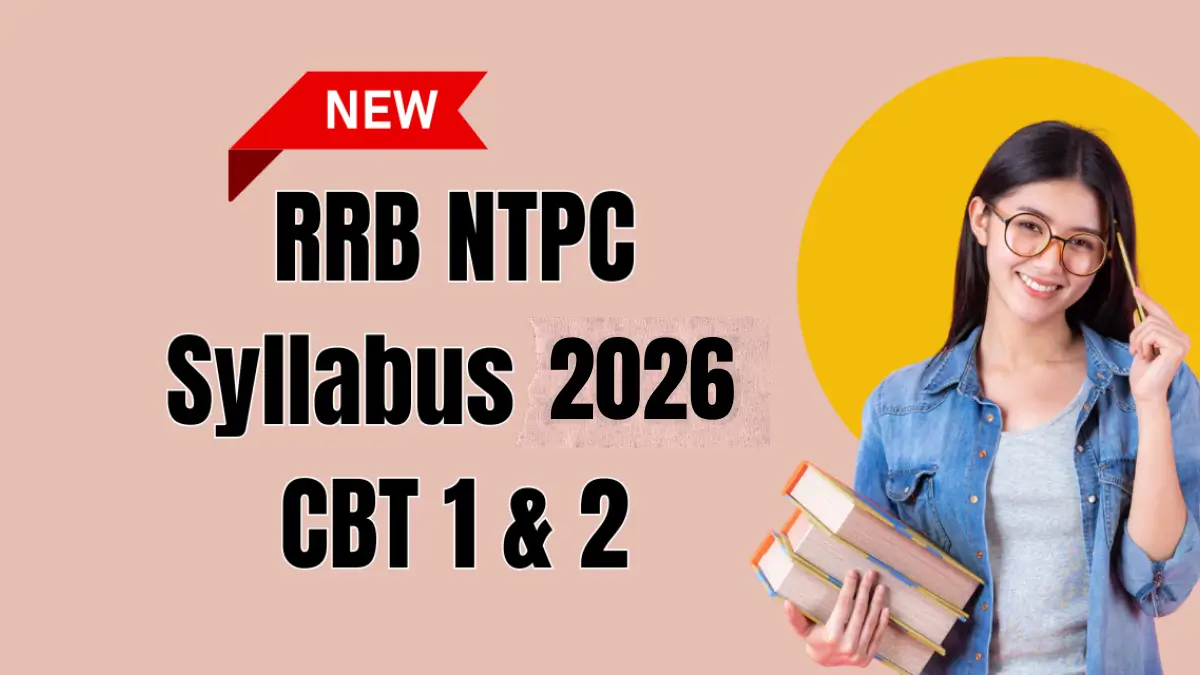
Candidates preparing for the RRB NTPC Exam 2026 should understand the RRB NTPC Syllabus 2026 and exam pattern. The syllabus for CBT 1 and CBT 2 covers Mathematics, General Intelligence and Reasoning, and General Awareness.
CBT 1 consists of 100 questions for 100 marks, while CBT 2 includes 120 questions for 120 marks, with 90 minutes allotted for each stage and 1/3 mark deducted for every incorrect answer.
The RRB NTPC 2026 selection process includes CBT 1, CBT 2, CBAT/Typing Skill Test (where applicable), and Document Verification. A clear understanding of the marking scheme, key topics, and subject-wise weightage can help candidates plan their preparation in a structured manner.
RRB NTPC Syllabus 2026
The RRB NTPC 2026 Notification has announced 5,165 Graduate and Undergraduate vacancies, with both levels covering largely similar subjects in the syllabus. Candidates can use common study materials for preparation, while Graduate-level aspirants should also practise advanced mock tests and previous years’ question papers.
RRB NTPC Syllabus 2026 PDF Download
A detailed syllabus PDF helps candidates plan their preparation for CBT 1 and CBT 2 effectively. Referring to the syllabus regularly ensures that all important topics are covered and helps candidates track their progress systematically.
RRB NTPC Syllabus – Highlights
| Particular | Details |
| Mode of Exam | Online (Computer-based) |
| Negative Marking | 1/3rd |
| Duration of Exam | 90 Minutes (Both CBT 1 and 2) |
| Question Type | Objective |
| Selection Stages | CBT 1, CBT 2, CBAT, Document Verification |
| Total Questions | CBT 1: 100 Qs CBT 2: 120 Qs |
| Total Marks | CBT 1: 100 CBT 2: 120 |
RRB NTPC CBT Exam Pattern 2026
RRB NTPC CBT 1 and CBT 2 are computer-based exams conducted in English, Hindi, and 13 regional languages. CBT 1 serves as a screening stage, while CBT 2 marks are considered for the final merit list. Candidates should understand the exam pattern and marking scheme of both stages to plan their preparation effectively.
| Exam Stage | Sections | Total Marks | Duration |
|---|---|---|---|
| CBT 1 | General Awareness: 40 Qs Mathematics: 30 Qs General Intelligence and Reasoning: 30 Qs |
100 | 90 Minutes |
| CBT 2 | General Awareness: 50 Qs Mathematics: 35 Qs General Intelligence and Reasoning: 35 Qs |
120 | 90 Minutes |
Check: RRB NTPC Exam Pattern CBT 1 & 2 in Detail
Subject-wise Syllabus for RRB NTPC Exam 2026
The core subjects covered in the RRB NTPC Graduate and Undergraduate exams are similar for CBT 1 and CBT 2. The main distinction lies in the difficulty level of the questions. Graduate-level examinations may include more conceptual, analytical, and application-based questions, whereas the Undergraduate exam generally focuses on fundamental concepts with questions ranging from basic to moderate difficulty.
Topics Covered in Mathematics Syllabus
The Mathematics section focuses on evaluating numerical skills and logical problem-solving abilities. Candidates can expect questions from fundamental topics commonly included in the Class 10 and Class 12 curriculum.
- Profit and Loss
- Fractions
- LCM, HCF
- Simple and Compound Interest
- Ratio and Proportions
- Elementary Algebra
- Percentage
- Geometry and Trigonometry
- Number System
- Elementary Statistics
- Mensuration
- Time and Work
- Decimals
- Time and Distance
Topics Covered in General Intelligence & Reasoning Syllabus
Questions in the General Intelligence & Reasoning section are designed to test logical thinking, analytical aptitude, and decision-making abilities. The detailed syllabus for this section is listed below.
- Analogies
- Completion of Number and Alphabetical Series
- Coding and Decoding
- Maps
- Relationships
- Venn Diagrams
- Analytical Reasoning
- Puzzle
- Mathematical Operations
- Data Sufficiency
- Syllogism
- Statement- Conclusion
- Jumbling
- Statement- Courses of Action
- Similarities and Differences
- Decision Making
- Interpretation of Graphs etc
Topics Covered in General Awareness Syllabus
- Current Events of National and International Importance
- Games and Sports,
- Art and Culture of India,
- Indian Literature,
- Monuments and Places of India,
- General Science and Life Science (up to 10th CBSE),
- History of India and Freedom Struggle,
- Physical, Social and Economic Geography of India,
- World and Indian Polity
- Governance- Constitution and political system,
- UN and Other important World organisations,
- Common Abbreviations,
- Transport Systems in India,
- Indian Economy,
- Basics of Computers and Computer Applications
- Environmental Issues Concerning India and the World at Large
- Famous Personalities of India and the World,
- Flagship Government Programs,
- Flora and Fauna of India,
- Important Government and Public Sector Organisations of India, etc.
- General Scientific and Technological Developments, including the Space and Nuclear Program of India,
Topic-wise Weightage in CBT 1 and CBT 2
The subject-wise distribution of questions by topic is provided below. Candidates can review the key topics for each subject to focus on while preparing for the upcoming CBT 1 Exam.
Topic-wise Weightage for Mathematics
| Topics | Number of Questions (CBT 1) |
Number of Questions (CBT 2)
|
| Number System | 3–4 | 4–5 |
| Simplification | 2–3 | 3–4 |
| Decimals & Fractions | 1–2 | 2–3 |
| Time and Distance | 1–2 | 2–3 |
| Simple & Compound Interest | 2–3 | 3–4 |
| Profit and Loss | 2–3 | 3–4 |
| Elementary Algebra | 1–2 | 2–3 |
| Geometry & Trigonometry | 1–2 | 2–3 |
| Elementary Statistics | 1 | 1–2 |
| Data Interpretation (DI) | 1 | 2–3 |
| LCM & HCF | 1–2 | 2–3 |
| Ratio and Proportion | 2–3 | 3–4 |
| Percentage | 2–3 | 3–4 |
| Mensuration | 2–3 | 3–4 |
| Time and Work | 1–2 | 2–3 |
Topic-wise Weightage for General Intelligence and Reasoning
| Topics | Number of Questions (CBT 1) |
Number of Questions (CBT 2)
|
| Analytical Reasoning | 2–3 | 3–4 |
| Syllogism | 1–2 | 2–3 |
| Jumbling | 1 | 1–2 |
| Venn Diagrams | 1–2 | 2–3 |
| Puzzle | 2–3 | 3–4 |
| Data Sufficiency | 1 | 1–2 |
| Statement-Conclusion | 1–2 | 2–3 |
| Decision Making | 1 | 1–2 |
| Maps & Interpretation of Graphs | 1 | 1–2 |
| Analogies | 3–4 | 4–5 |
| Number & Alphabet Series | 2–3 | 3–4 |
| Coding-Decoding | 3–4 | 4–5 |
| Mathematical Operations | 2–3 | 3–4 |
| Similarities & Differences | 1–2 | 2–3 |
| Relationships (Blood Relations) | 1–2 | 2–3 |
Topic-wise Weightage for General Awareness
| Topics | Number of Questions (CBT 1) |
Number of Questions (CBT 2)
|
| Art & Culture of India | 1–2 | 2–3 |
| Indian Literature | 1 | 1–2 |
| Monuments & Places of India | 1 | 1–2 |
| General Scientific & Technological Developments | 2–3 | 3–4 |
| UN and Other Important World Organisations | 1 | 1–2 |
| Environmental Issues | 1 | 1–2 |
| Basics of Computers & Applications | 2–3 | 3–4 |
| Famous Personalities | 1–2 | 2–3 |
| Static GK (various topics) | 5–7 | 7–9 |
| Current Events (National & International) | 10–12 | 12–15 |
| History of India | 5–6 | 6–8 |
| Geography (India & World) | 3–4 | 4–5 |
| Indian Polity & Governance | 2–3 | 3–4 |
| Indian Economy | 2–3 | 3–4 |
| General Science (Physics, Chemistry, Biology) | 7–8 | 8–10 |
RRB NTPC Typing Test Syllabus 2026
The Typing Skill Test (TST) is conducted for posts such as Senior Clerk cum Typist and Junior Accounts Assistant cum Typist. It is qualifying in nature, and the marks obtained are not considered for the final merit list.
- Candidates, equal to eight times the number of vacancies in each category, will be shortlisted for this test based on their 2nd Stage CBT scores.
- To qualify for the TST, candidates must type a minimum of 30 words per minute (WPM) in English or 25 WPM in Hindi on a personal computer.
- For candidates opting to type in Hindi, Kruti Dev and Mangal fonts will be provided during the test.
- PwBD candidates who are permanently disabled due to blindness, low vision, cerebral palsy, or locomotor disability (with at least 40% disability) may be exempted from the TST.
- Only candidates who qualify in the TST (or are exempted) will be considered for the final merit list, which is based on their performance in the 2nd Stage CBT.
| Important Links | |
| RRB NTPC Cutoff | RRB NTPC 2026 |
| RRB NTPC Previous Year Papers | RRB NTPC Preparation Tips |


 IBPS PO Syllabus 2026, Exam Pattern Revi...
 IBPS RRB PO Syllabus 2026, Exam Pattern ...
 NICL AO Syllabus and Exam Pattern 2026 f...