Table of Contents
The Reserve Bank of India (RBI) holds the Grade B Officer examination to select candidates for General, DEPR, and DSIM posts. The RBI Grade B Eligibility Criteria 2027 specifies the conditions applicants must fulfil to be eligible for these positions. Candidates who fail to meet any of the required criteria may be disqualified from the recruitment process.
In this article, you will find all the important eligibility details, including age limit, educational qualifications, nationality, number of attempts, and other requirements for RBI Grade B recruitment.
RBI Grade B Eligibility Criteria 2027
Candidates applying for the RBI Grade B examination must meet certain eligibility requirements. These include nationality, age criteria, age relaxation for different categories, and educational qualifications for the General, DEPR, and DSIM streams, along with the required minimum marks.
Applicants should also check the rules for CGPA-to-percentage conversion, work experience wherever required, and the permitted number of attempts. Fulfilling all the prescribed conditions is essential for candidates aspiring a Grade B Manager position at the Reserve Bank of India.
RBI Grade B Eligibility 2027 Highlights
Go through the information carefully to confirm your eligibility. The table below provides a quick summary of the details discussed further in this section.
| Particular | Details |
| Organization | Reserve Bank of India |
| Exam Name | RBI Grade B 2027 |
| Post Name | Grade B Manager (General, DEPR, DSIM) |
| Category | Eligibility Criteria |
| Age Limit | 21-30 years |
| Age Relaxation | Applicable to SC/OBC/ST/PWD/ESM/Bank Employees |
| Qualification | Graduation (as per post) |
| Nationality | Indian |
| Number of Attempts | 6 |
| Experience Requirement | Not Required |
| RBI Official website | rbi.org.in |
RBI Grade B Nationality
It is of utmost importance that the candidate’s nationality falls within these categories.
(a) Candidates must be Indian Citizens.
(b) A subject of Nepal or Bhutan
(c) A Tibetan Refugee who came to India before 1st January 1962 with the intention of permanent settlement.
(d) A Person of Indian Origin who has migrated from Burma, Pakistan, Vietnam, Sri Lanka, or East African countries of Zaire, Kenya, Tanzania, Uganda, Zambia, Ethiopia, and Malawi with the intention of permanent settlement in India
Candidates falling under categories B, C, and D are required to have a certificate of eligibility issued by the Government of India. Make sure you belong to one of these categories to avoid any issues during the final selection process.
Original nationality certificates, along with other documents, will be verified during the interview. Ensure you have these documents ready and valid.
RBI Grade B Age Limit
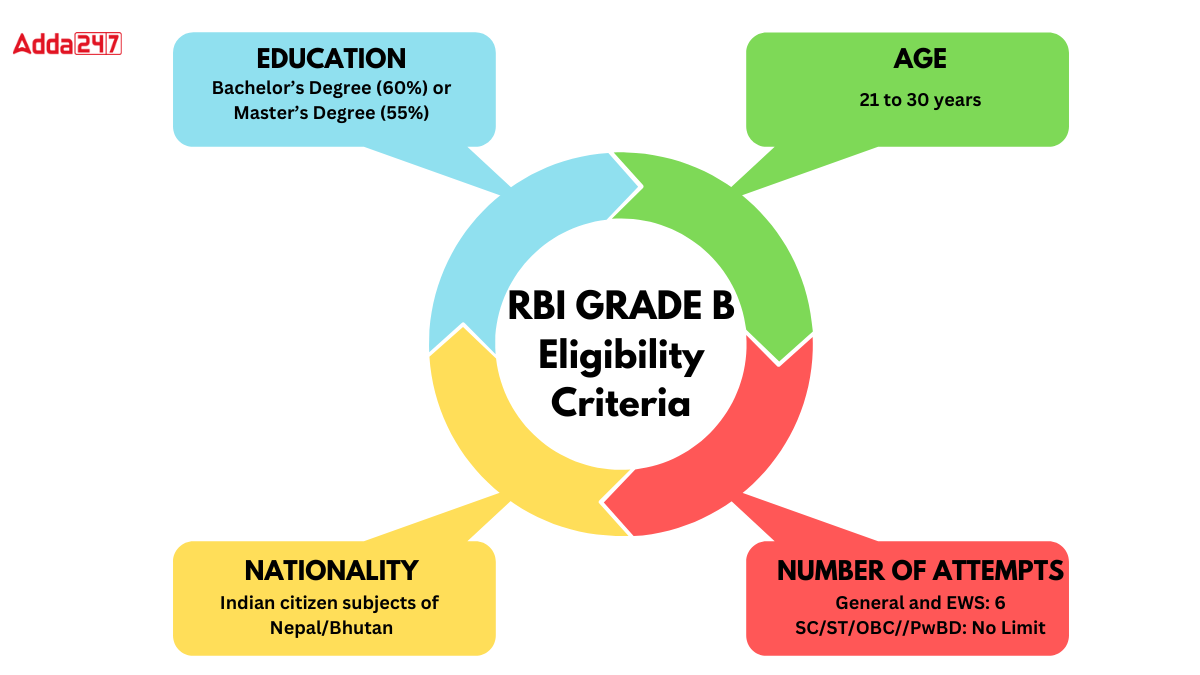
The age criteria for RBI Grade B differ according to category. In general, applicants must be between 21 and 30 years old, as specified under the official eligibility guidelines.
- Lower Age Limit for Candidates – 21 Years.
- Upper Age Limit for Candidates – 30 Years.
However, there are relaxations for reserved categories like SC/ST, OBC, and PWD candidates, providing them with additional years of the upper age limit. Age Relaxation granted to the reserved categories as per the government rules and regulations is given below.
RBI Grade B Age Relaxation
Age relaxation is granted based on the candidate’s category. For example, OBC candidates receive a 3-year relaxation, while SC/ST, EWS, and Ex-Bank Employees get a 5-year relaxation. PwD candidates are eligible for even greater age relaxation.
Check the table below for the maximum age limits and the relaxation periods. Additionally, candidates with M.Phil. and PhD qualifications have upper age limits of 32 and 34 years, respectively.
| Category | Maximum Age Limit (In Years) |
Number of Years Relaxed (above the max. age limit)
|
|
Other Backward Castes (OBC)
|
33 | 3 years |
|
Scheduled Caste (SC)
|
35 | 5 years |
|
Scheduled Tribe (ST)
|
35 | 5 years |
|
Ex-servicemen (including military services)
|
35 | 5 years |
|
Ex-bank employees
|
35 | 5 years |
|
PwD(General/EWS)
|
40 | 10 years |
| PWD(OBC) | 43 | 13 years |
| PwD(SC/ST) | 45 | 15 years |
| M.Phil | 32 | 2 years |
| PhD | 34 | 4 years |
Age Relaxation for Experienced Candidates
Candidates with experience in Scheduled Commercial Banks (SCBs), Public Sector Insurance Companies, or All India Financial Institutions (AIFIs) should note that their upper age limit may be extended by the number of full years of relevant experience, up to a maximum of three years. However, their total age, including this extension, should not exceed 33 years.
RBI Grade B Qualification
Candidates must carefully check the eligibility rules before applying, as limited relaxation is available in educational qualifications. Generally, applicants need a Bachelor’s degree with a minimum of 60% marks to qualify. Candidates who meet the required graduation criteria can apply, subject to the specific requirements of their chosen post. The educational qualifications for each post are listed below.
(A) Qualification for Officers in Grade ‘B’ (DR)–(General)
- Bachelor’s Degree: Minimum 60% marks or an equivalent grade (50% for SC/ST/PwBD candidates).
- Class 12 / Diploma: At least 60% marks or an equivalent grade (50% for SC/ST/PwBD candidates).
- Class 10: Minimum 60% marks or an equivalent grade (50% for SC/ST/PwBD candidates).
- Aggregate Marks: The Bachelor’s degree percentage will be calculated using the total marks obtained across all semesters or years.
(B) Qualification for Officers in Grade ‘B’ (DR)–DEPR:
A) A Master’s Degree in Economics/Econometrics/Quantitative Economics/Mathematical Economics/Integrated Economics Course/Finance, with a minimum of 55% marks or an equivalent grade in aggregate of all semesters/years from a recognised Indian or Foreign University/Institute; OR,
B) PGDM/ MBA Finance with a minimum of 55% marks or an equivalent grade in aggregate of all semesters/years from a recognised Indian or Foreign University /Institute; OR.
C) A master’s Degree in Economics in any of the sub-categories of economics, i.e., agricultural/ business/developmental/applied, etc., with a minimum of 55% marks or an equivalent grade in the aggregate of all semesters/years from a recognised Indian or Foreign University/Institute.
(C) Qualification for Officers in Grade ‘B’ (DR)–DSIM:
A) A master’s Degree in Statistics/Mathematical Statistics/Mathematical Economics/Econometrics/ Statistics and informatics from IIT-Kharagpur or applied Statistics and informatics from IIT-Bombay with a minimum of 55% marks or equivalent grade (aggregate of all semesters/years). OR,
B) A master’s Degree in Mathematics with a minimum of 55% marks or an equivalent grade in the aggregate of all semesters/years and a one-year postgraduate diploma in Statistics or related subjects from a reputed Institute. OR,
C) M. Stat. Degree from the Indian Statistical Institute with a minimum of 55% marks (aggregate of all semesters/years). OR,
D) Post Graduate Diploma in Business Analytics (PGDBA) jointly offered by ISI Kolkata, IIT Kharagpur, and IIM Calcutta with a minimum of 55% marks or equivalent grade in aggregate of all semesters/years. OR,
E) Two years’ Postgraduate Diploma in Business Analytics (PGDBA) with a minimum of 55% marks or equivalent grade in aggregate of all semesters/years from a recognised University/ Institute, an institute of national importance, or a UGC/ AICTE approved program.
RBI Grade B CGPA to Percentage Conversion Criteria
The Reserve Bank of India (RBI) has mentioned that some universities provide grading systems in percentages, whereas some provide them in the form of CGPA/OGPA/CPI out of 10. If you have your degree marks in percentage, then the same will be accepted, but if it’s the other way, then candidates have to convert them into CGPA.
If a University/Institute/Board has specified a method for converting Aggregate Grade Points into percentage marks, that method will be followed. However, if the University/Institute/Board hasn’t provided such criteria in the degree/passing certificates, the conversion will be calculated as follows:
| Equivalent CGPA/OGPA/CPI or similar terminologies allotted on a 10-point scale | Aggregate Percentage |
|---|---|
| 6.75 | 60% |
| 6.25 | 55% |
| 5.75 | 50% |
RBI Grade B 2027 Proof of Identity
For the RBI Grade B Exam (Phase I & II), candidates must carry their Admit Card along with a valid photo identity proof in both original and photocopy. Accepted photo IDs include: PAN Card, Passport, Driving Licence, Voter ID, Bank Passbook with photo, Aadhaar Card/e-Aadhaar, Employee ID, Bar Council ID with photo, College/University ID, or a photo identity proof issued by a Gazetted Officer/People’s Representative on official letterhead.
Is Any Experience Required to work with RBI?
This is a frequently asked question, especially by fresh graduates. The RBI Grade B exam has become highly popular in the last few years, and the good news is that no prior work experience is required to apply. As per the official notification, freshers are fully eligible since the RBI encourages young talent to join and contribute to its management roles. So, if you’re a newcomer, this is a great opportunity—go ahead and apply with confidence!
Number of Attempts Allowed in RBI Grade B
Many aspirants also want to know how many times they can appear for the RBI Grade B exam. General and EWS category candidates are allowed a maximum of six attempts in the Phase 1 examination. Once they have used all six attempts, they cannot apply again. In contrast, SC, ST, OBC, and PwBD candidates do not have a fixed limit on the number of attempts, subject to the applicable category-wise reservation rules and other eligibility conditions.
| Category | Number of Attempts |
| General | 6 |
| SC/ST/OBC/PWD | No Limit |
CGPA to Percentage Conversion Criteria by RBI
If a university specifies guidelines for converting grades into percentage marks, those guidelines will be followed. However, if the university does not provide such guidelines, the following calculation method will be employed:
| CGPA | Aggregate Percentage of Marks |
|---|---|
| 6.75 | 60% |
| 6.25 | 55% |
| 5.75 | 50% |
Important Takeaways
Now that the RBI Grade B Eligibility Criteria 2027 has been explained in detail, here are a few important points to keep in mind from the discussion above:
- Candidates must be a citizen of India, a subject of Nepal/Bhutan, a Tibetan refugee, or a Person of Indian Origin from accepted countries, provided that the Government of India authorises the certificate.
- The minimum age limit is 21 to 30 years, and relaxation is provided to reserved categories.
- Candidates must have attained 60% marks in a Bachelor’s/Master’s degree (50% in case of SC/ST/PwBD).
- Freshers can also apply for the post.
- There a total of 6 attempts available for the General category, but for SC/ST/OBC/PwD, there is no such limit.
| RBI Grade B Important Links | |
| RBI Grade B Online Coaching | RBI Grade B Mock Test |
| RBI Grade B Syllabus | RBI Grade B Salary |
| RBI Grade B Books | RBI Grade B Previous Year Papers |
| RBI Grade B Selection Process | |


 NIACL AO Eligibility Criteria 2026, Chec...