
Table of Contents
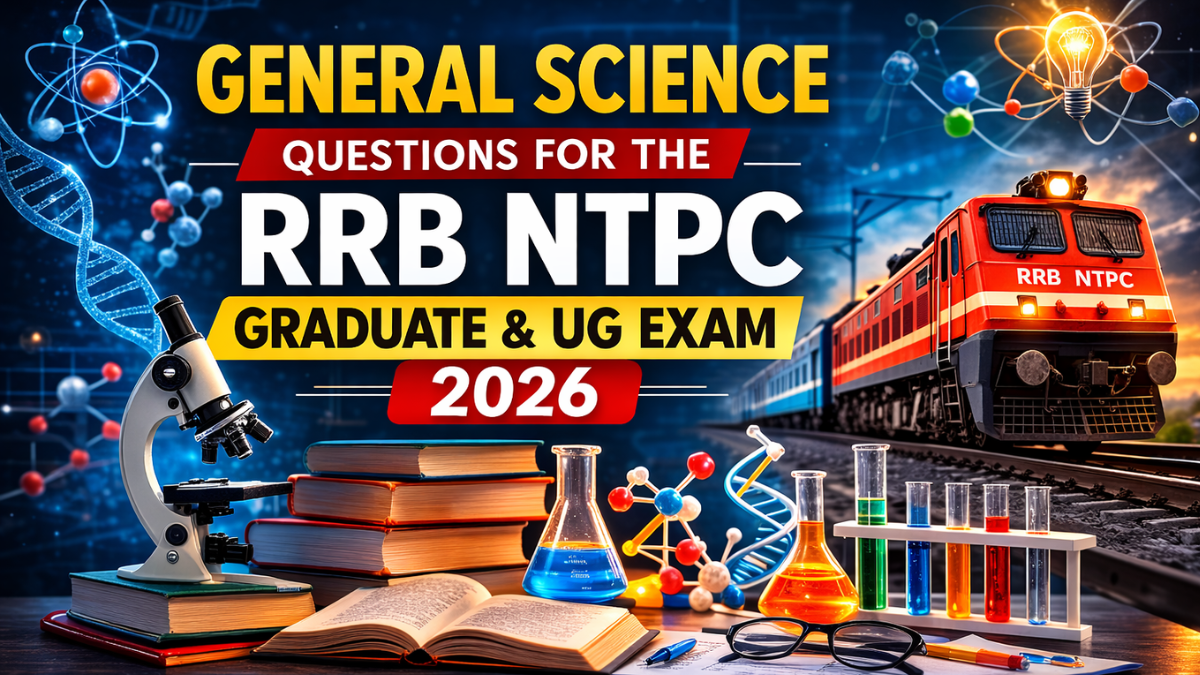
The RRB NTPC Exam 2026 is one of the most competitive railway recruitment examinations conducted by the Railway Recruitment Board. As per the latest updates, the RRB NTPC Exam Date 2026 has been set from 16th to 17th March. In this article, candidates can find General Science Questions for RRB NTPC Graduate and UG Exam 2026, which will help them practice important concepts and improve their performance in the upcoming examination. Read here for more details.
General Science Questions for RRB NTPC Graduate and UG Exam 2026
The General Science section in the RRB NTPC exam tests candidates’ knowledge of the fundamentals of General Science and its practical applications. Questions are asked on various topics such as the human body, motion, electricity, chemical reactions, atoms, environment, plants, diseases, and basic physics laws. Below, we will provide important General Science questions for the RRB NTPC Graduate and UG Exam 2026 that are frequently asked in railway examinations, along with solutions:
Q1. Why did Mendeleev leave gaps in his periodic table?
A. For undiscovered elements
B. To include isotopes
C. To avoid repetition of elements
D. To make the table symmetrical
Answer: A. For undiscovered elements
Solution:
Russian chemist Dmitri Mendeleev arranged elements by increasing atomic mass. Some elements did not fit the pattern, so he intentionally left empty spaces. He predicted that new elements would later fill these gaps. Later discoveries such as gallium and germanium confirmed his predictions.
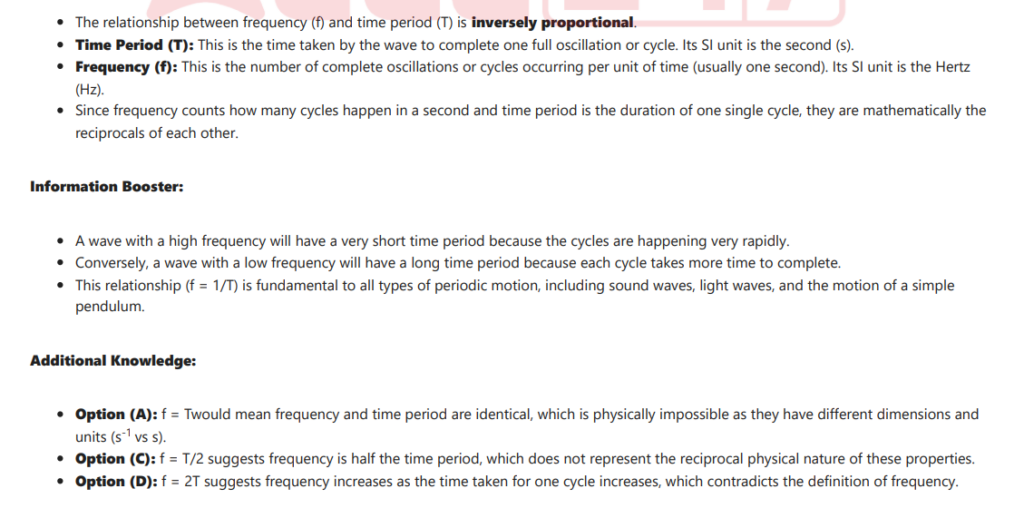
Q2. What is the relation between the frequency (f) and time period (T) of a sound wave?
A. f = T
B. f = 1/T
C. f = T/2
D. f = 2T
Answer: B. f = 1/T
Solution:
RRB NTPC CBT 1 City Intimation Slip 2026 – Click to Check
Q3. The mention of DNA as a long polymer of deoxyribonucleotides implies which structural characteristic?
A. Sugar-phosphate backbone and nitrogenous bases
B. Hydrogen bonds in a parallel chain
C. Circular sequence
D. Multiple short independent chains
Answer: A. Sugar-phosphate backbone and nitrogenous bases
Solution:
DNA is made of repeating nucleotide units containing a sugar, phosphate, and nitrogenous base. These form the backbone and internal base pairs.
The double helix structure of DNA was discovered by James Watson and Francis Crick in 1953.
Q4. Which principle states that each point on a wavefront acts as a source of secondary wavelets?
A. Doppler’s Principle
B. Superposition Principle
C. Huygens’ Principle
D. Fermat’s Principle
Answer: C. Huygens’ Principle
Solution:
According to Christiaan Huygens, every point on a wavefront behaves like a source of new wavelets. The new wavefront is formed by the envelope of these wavelets.
Q5. What is the relation between speed of sound (v), wavelength (λ) and time period (T)?
A. v = λ × T
B. v = λ / T
C. v = T / λ
D. v = λ + T
Answer: B. v = λ / T

Q6. Which blood cells help in clotting?
A. RBC
B. WBC
C. Platelets
D. Plasma
Answer: C. Platelets
Solution:
Platelets help in blood clotting by forming a plug at the site of injury to stop bleeding.
Q7. Which gas is responsible for global warming the most?
A. Oxygen
B. Carbon dioxide
C. Nitrogen
D. Hydrogen
Answer: B. Carbon dioxide
Solution:
Carbon dioxide is the primary greenhouse gas contributing to global warming by trapping heat in Earth’s atmosphere.
Q8. What is the SI unit of electric current?
A. Volt
B. Ampere
C. Ohm
D. Watt
Answer: B. Ampere
Solution:
The SI unit of electric current is the Ampere, named after André‑Marie Ampère.
Q9. Which vitamin is obtained from sunlight?
A. Vitamin A
B. Vitamin B
C. Vitamin C
D. Vitamin D
Answer: D. Vitamin D
Solution:
Sunlight helps the skin synthesize Vitamin D, which is essential for calcium absorption and bone health.
Q10. Which organ purifies blood in the human body?
A. Heart
B. Liver
C. Kidney
D. Lung
Answer: C. Kidney
Solution:
Kidneys filter waste products and excess water from blood to form urine.
Q11. What is the chemical formula of common salt?
A. KCl
B. NaCl
C. CaCl₂
D. MgCl₂
Answer: B. NaCl
Solution:
Common salt is sodium chloride, composed of sodium and chlorine ions.
Q12. Which metal is liquid at room temperature?
A. Mercury
B. Iron
C. Copper
D. Silver
Answer: A. Mercury
Solution:
Mercury is the only metal that remains liquid at room temperature.
Q13. What is the main source of energy for Earth?
A. Moon
B. Sun
C. Wind
D. Water
Answer: B. Sun
Solution:
The Sun is the primary source of energy for Earth, driving climate, weather, and photosynthesis.
Q14. Which gas is used in photosynthesis?
A. Oxygen
B. Carbon dioxide
C. Nitrogen
D. Hydrogen
Answer: B. Carbon dioxide
Solution:
Plants use carbon dioxide, water, and sunlight to produce glucose and oxygen during photosynthesis.
Q15. Which scientist discovered gravity?
A. Newton
B. Galileo
C. Einstein
D. Faraday
Answer: A. Newton
Solution:
The law of gravity was formulated by Isaac Newton.
Q16. What type of energy is stored in food?
A. Kinetic energy
B. Chemical energy
C. Mechanical energy
D. Heat energy
Answer: B. Chemical energy
Solution:
Food stores chemical energy which the body converts into usable energy.
Q17. Which part of plant performs photosynthesis?
A. Root
B. Stem
C. Leaf
D. Flower
Answer: C. Leaf
Solution:
Leaves contain chlorophyll which captures sunlight for photosynthesis.
Q18. What is the boiling point of water at sea level?
A. 90°C
B. 100°C
C. 80°C
D. 120°C
Answer: B. 100°C
Solution:
Water boils at 100°C at standard atmospheric pressure.
Q19. Which instrument measures temperature?
A. Barometer
B. Thermometer
C. Hygrometer
D. Ammeter
Answer: B. Thermometer
Solution:
A thermometer measures temperature of substances.
Q20. Which gas do humans inhale for respiration?
A. Nitrogen
B. Carbon dioxide
C. Oxygen
D. Hydrogen
Answer: C. Oxygen
Solution:
Humans inhale oxygen which is used in cellular respiration to produce energy.
Q21. What is the smallest unit of life?
A. Atom
B. Molecule
C. Cell
D. Tissue
Answer: C. Cell
Solution:
Cells are the basic structural and functional units of living organisms.
Q22. Which planet is known as the Red Planet?
A. Venus
B. Mars
C. Jupiter
D. Mercury
Answer: B. Mars
Solution:
Mars appears red because of iron oxide (rust) on its surface.
Q23. Which gas is most abundant in Earth’s atmosphere?
A. Oxygen
B. Carbon dioxide
C. Nitrogen
D. Hydrogen
Answer: C. Nitrogen
Solution:
Nitrogen makes up about 78% of Earth’s atmosphere.
Q24. What type of lens is used in a magnifying glass?
A. Concave lens
B. Convex lens
C. Cylindrical lens
D. Plane lens
Answer: B. Convex lens
Solution:
A convex lens converges light rays and magnifies nearby objects.
Q25. Which organ controls the human body?
A. Heart
B. Brain
C. Liver
D. Lungs
Answer: B. Brain
Solution:
The brain controls body functions through the nervous system.
Download PDFs for General Science Questions for RRB NTPC Graduate and UG Exam 2026
Candidates preparing for the RRB NTPC 2026 exam can download the General Science Questions for RRB NTPC Graduate and UG Exam 2026 in PDF format, in English as well as Hindi, along with details solutions.
General Science Questions for RRB NTPC Graduate and UG Exam 2026 PDF Link (English)
General Science Questions for RRB NTPC Graduate and UG Exam 2026 PDF Link (Hindi)


 RBI Office Attendant Result 2026 Date, C...
 RBI Assistant Admit Card 2026, Prelims C...
 SSC Selection Post Phase 14 Salary 2026,...