
Table of Contents
India Israel FTA: Relevance
- GS 2: Bilateral, regional and global groupings and agreements involving India and/or affecting India’s interests.
India Israel FTA: Context
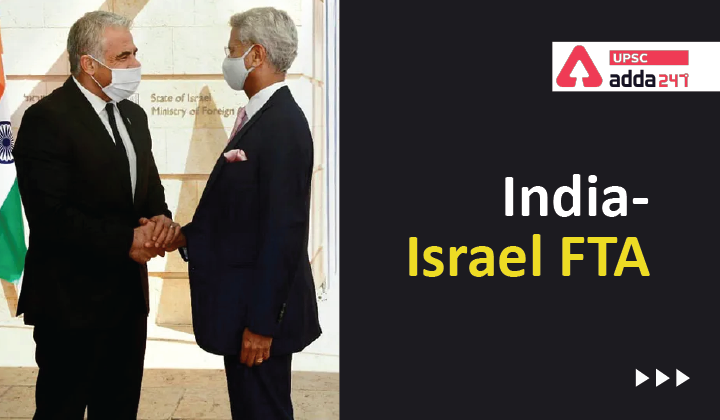
- Recently, the union minister of commerce and industry has said that India is in dialogue with Israel to conclude Free Trade Agreement (FTA).
India Israel FTA: Key points
- The announcement coincides with the 30th anniversary of the establishment of diplomatic ties between the two countries.
- The minister also informed that bilateral free trade agreements are being negotiated with the United Arab Emirates, the United Kingdom, Australia and Canada.
- He also informed that the agreement with the UAE was ‘close to finalisation’ while the FTA with Australia was at a ‘very advanced stage.
- The FTAs would cover a wide range of sectors such as agricultural products and pharmaceuticals.

Benefits of FTA
- Tariff reduction –One of the known benefits of FTA or PTA is reduced tariff for the offered product list for example in India-MERCOSUR PTA, MERCOSUR offered preferential tariff reduction ranging from 10% to 100% on 450 listed products. It allows exporters to access the market at lower tariff, and hence provides competitive final prices for the exporters of a partner country.
- Access to new markets –Trade with MERCOSUR saw a significant growth post the FTA. The FTAs give easier and competitive access to the exporters as well as importers in the partner countries. For example: copper wires import from Malaysia saw a sudden spike post the signing of India –ASEAN FTA in 2010.
- Trade risk diversification –Increasing the diversification in terms of product basket and diversification countries help in hedging the unfavourable consequences on global and national trade due to geopolitical turmoil. For example, oil crisis after Iran imbroglio, rift in GCC and incidental issues that are on rise in 21st century.
- Innovation and competition –Generally better market integration tend to enhance competition thereby pushing the industry towards innovation benefitting consumers in long run.
- Technology transfer and increased integration – Increased trade leads to better integration of market and also facilitate transfer of skills and technology.
Also Read:








 TSPSC Group 1 Question Paper 2024, Downl...
 TSPSC Group 1 Answer key 2024 Out, Downl...
 UPSC Prelims 2024 Question Paper, Downlo...