Table of Contents
The Child Development & Pedagogy section holds substantial significance and is a high-scoring component in various teaching examinations, including TET, CTET, DSSSB, and NVS. Child Development & Pedagogy encompasses many topics such as Piaget’s theory, Bloom’s Taxonomy, Learning, Motivation, Growth, Development, and Teaching.
These topics are integral to teaching exams. To facilitate your exam preparation, we have compiled essential study notes and questions related to Child Development and Pedagogy(बाल विकास और शिक्षा शास्त्र), specifically tailored for CTET and TET exams, aiming to simplify and streamline your exam readiness.
CDP Weightage in Teaching Exam
Below we have added the table of CDP weightage marks and questions in particular TET and teaching recruitment exams. Almost all TET exams have the CDP section in their exams. So candidates must prepare this topic in detail.
| Exams | Total Marks | Total Questions |
|---|---|---|
| CTET Paper 1 | 30 Marks | 30 |
| CTET Paper 2 | 30 marks | 30 |
| UPTET Paper 1 | 30 Marks | 30 |
| UPTET Paper 2 | 30 marks | 30 |
| EMRS Principal & Vice-Principal – Academic | 30 marks | 30 |
| EMRS TGT & PGT -Teaching Aptitude / Pedagogy | 20 marks | 20 |
| UTET Paper 1 | 30 marks | 30 |
| UTET Paper 2 | 30 marks | 30 |
| UGC NET | 10 marks | 5 |
| DSSSB PRT | 100 | 100 |
| DSSSB TGT | 10-15 | 10-15 |
| DSSSB PGT | 20-25 | 20-25 |
| KVS PRT | 60 | 60 |
| KVS TGT | 40 | 40 |
| KVS PGT | 40 | 40 |
| SUPER TET | 20 | 20 |
| NVS TGT | 15 | 15 |
| NVS PGT | 20 | 20 |
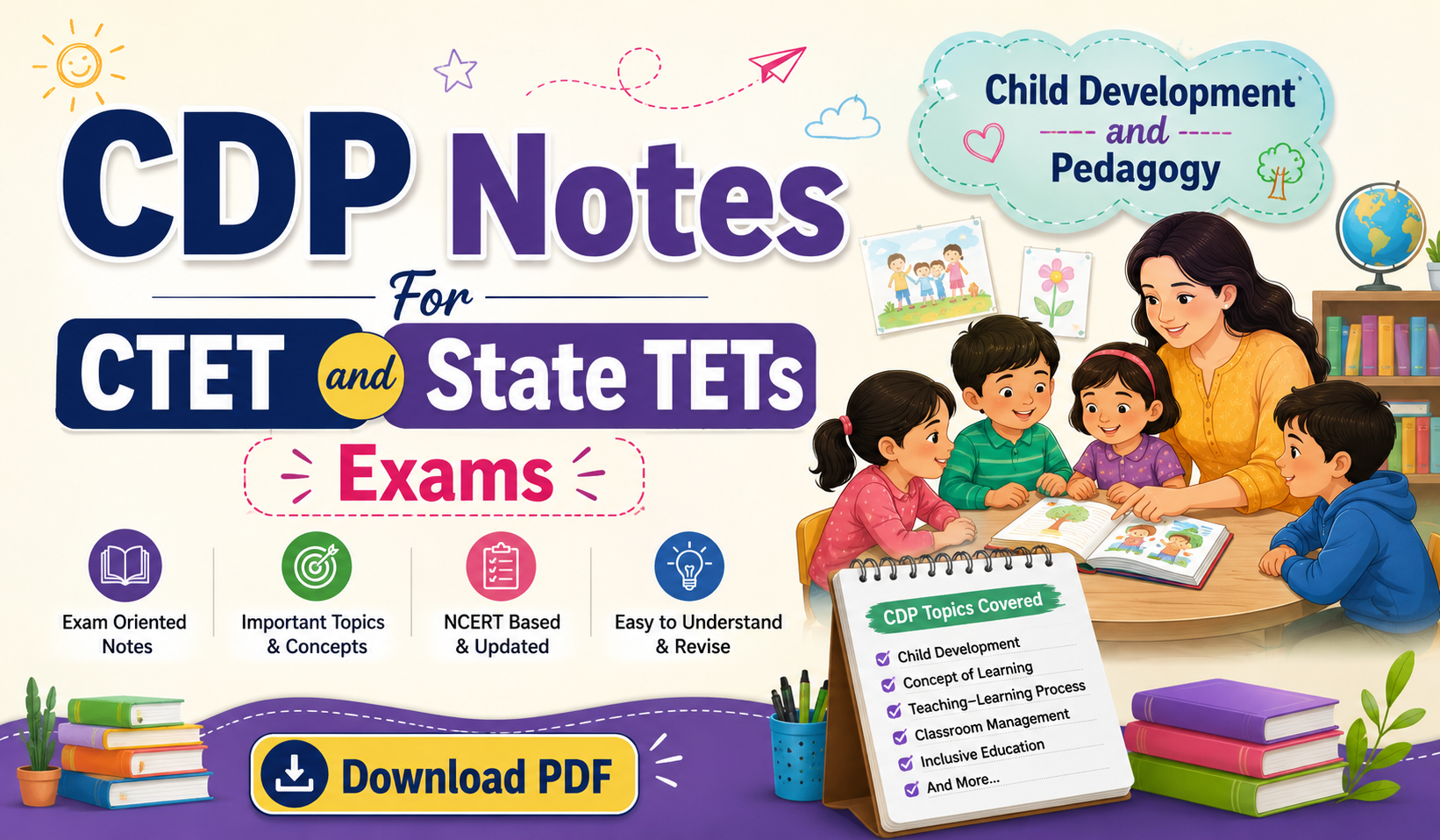
Child Development and Pedagogy Notes (CDP Notes PDF)
Adda247 presents an all-inclusive collection of study material and notes meticulously crafted to match the latest exam patterns and syllabi for teaching exams. Within this invaluable repository, you’ll discover monthly study notes for Child Development and Pedagogy (CDP), uniquely tailored to meet the needs of aspirants gearing up for upcoming exams.
These CDP notes are thoughtfully designed to cater to various TET and CTET examinations, thus becoming an indispensable resource for effective exam readiness. By delving into the detailed content of these notes, candidates can amplify their comprehension of Child Development and Pedagogy concepts, gaining a competitive advantage in their exam preparation.
CDP Difficulty Level
Child Development & Pedagogy (CDP) helps teachers understand how children learn and think, which is important for teaching them effectively in the classroom. CDP provides useful strategies for creating good teaching methods, assessments, and engaging learning activities for students.
The difficulty of CDP questions depends on the exam and the type of teaching post. The level of questions reflects the age and psychology of the children being taught:
- For PRT (Primary Teacher) Post: Questions are based on students up to 8th grade.
- For TGT (Trained Graduate Teacher) Post: Questions are based on students up to 10th grade.
- For PGT (Post Graduate Teacher) Post: Questions are based on students up to 12th grade.
- For Assistant Professor: Questions are based on college-level content.