
Table of Contents
WHO UPSC: Relevance
- GS 2: Important International institutions, agencies and fora – their structure, mandate.
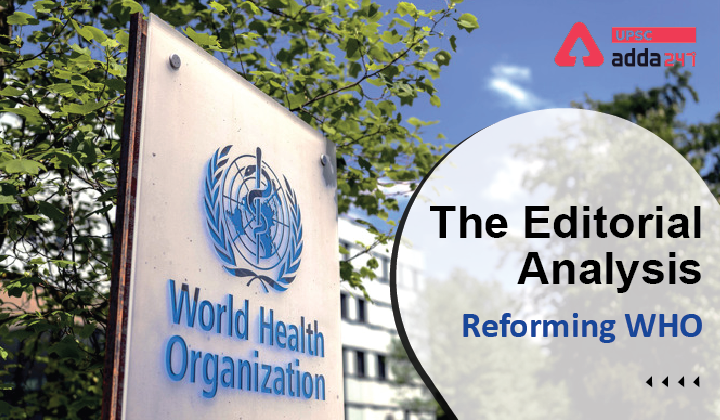
WHO reforms: Context
- Recently, the Prime Minister has discussed issue of reforming the World Health Organization while addressing the heads of countries at the second global COVID-19 summit.
WHO reforms: Why needed?
- To strengthen WHO and its ability to respond to novel and known disease outbreaks in order to limit the harm caused to the global community.
- The long delay and the reluctance of China to readily and quickly share vital information regarding the novel coronavirus, and its stubborn refusal to allow the global agency to investigate, freely and fairly, the origin of the virus have highlighted the need to strengthen WHO.
- For several years, the mandatory contribution has accounted for less than a fourth of the total budget, thus reducing the level of predictability in WHO’s responses; the bulk of the funding is through voluntary contribution.
- It is time to provide the agency with more powers to demand that member states comply with the norms and to alert WHO in case of disease outbreaks that could cause global harm.
- The demand for a review of the vaccine approval process is based on the assumption that the emergency use listing (EUL) of COVAXIN was intentionally delayed by the health agency.
- The technical advisory group had regularly asked for additional data from the company only underscores the incompleteness of the data presented by the company.
- To believe that the agency was influenced more by media reports than the data submitted by the company is naive; the media were only critical of the Indian regulator approving the vaccine even in the absence of efficacy data.
Additional information
Recent WHO news
- Recently, the Union Cabinet has approved the establishment of the WHO Global Centre for Traditional Medicine (WHO GCTM) in Jamnagar, Gujarat.
- India signed a Host Country Agreement with the World Health Organization (WHO) for establishing WHO Global Centre for Traditional Medicine in India.
- WHO Global Centre for Traditional Medicine would be the first and only global outposted Centre (office) for traditional medicine across the globe.
Read current affairs for UPSC

 TSPSC Group 1 Question Paper 2024, Downl...
 TSPSC Group 1 Answer key 2024 Out, Downl...
 UPSC Prelims 2024 Question Paper, Downlo...