Table of Contents
The Central Teacher Eligibility Test (CTET) is conducted by the Central Board of Secondary Education (CBSE). It is one of the most important exams for candidates who want to become teachers in Kendriya Vidyalayas (KVS), Navodaya Vidyalayas (NVS), EMRS, and other central government schools in India.
Whether you are preparing for CTET Paper 1 (Classes 1 to 5) or CTET Paper 2 (Classes 6 to 8), understanding the latest CTET syllabus is the first step to success. Focus on the official subject-wise syllabus and important high-weightage topics to improve your preparation and score well. To qualify for the exam, General category candidates need 60% marks, while reserved category candidates need 55% marks.
CTET Syllabus PDF Download Link
The official CTET syllabus and exam pattern are released by CBSE as part of the Information Bulletin for each exam cycle. Below is the link to download the CTET Syllabus and Exam Pattern in PDF format.
| CTET Syllabus and Exam Pattern in PDF | |
| CTET Syllabus Paper 1 & Paper 2 | Download PDF |
CTET Syllabus 2026
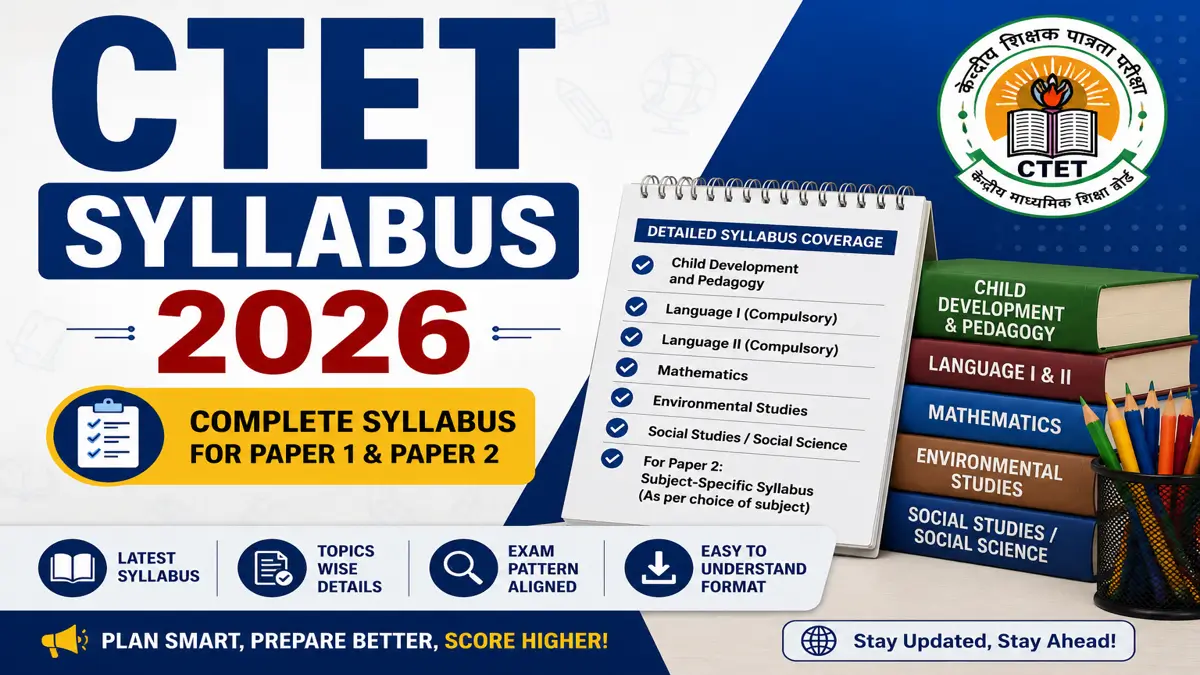
The CTET syllabus is divided clearly across five sections in Paper 1 and four sections in Paper 2. The section-wise syllabus for both papers is given in detail below.
CTET Paper 1 Syllabus (Primary Stage: Classes I–V)
1. Child Development and Pedagogy (30 Questions)
This section focuses on how children grow, think, and learn. Key topics include:
- Concept of child development and its link with learning
- Principles of child development
- Role of heredity and environment
- Piaget, Kohlberg, and Vygotsky’s theories
- Concepts of child-centered and progressive education
- Multi-dimensional intelligence
- Inclusive education and children with special needs
- Learning and pedagogy – how children think, learn, and fail
- Motivation, cognition, and factors affecting learning
2. Language I (30 Questions)
This section tests your reading and language teaching skills in the medium of instruction chosen by you. Topics include:
- Unseen reading passages (prose and poetry)
- Grammar and verbal ability
- Principles of language teaching and learning
- Role of listening, speaking, reading, and writing
- Remedial teaching
3. Language II (30 Questions)
This is a different language from Language I. Topics include:
- Unseen prose passages
- Grammar and comprehension
- Communication and language skills
- Pedagogy of language development
4. Mathematics (30 Questions)
Content topics include geometry, shapes, numbers, addition, subtraction, multiplication, division, measurement, fractions, patterns, and data handling. Pedagogy topics include the nature of mathematics, teaching problems, error analysis, and remedial teaching.
5. Environmental Studies (30 Questions)
Content topics include family and friends, food, shelter, water, travel, animals, plants, and things we make and do. Pedagogy topics cover the scope of EVS, integrated learning, experimentation, CCE, and teaching aids.
CTET Paper 2 Syllabus (Elementary Stage: Classes VI–VIII)
1. Child Development and Pedagogy (30 Questions)
Same broad themes as Paper 1, but focused on the 11–14 age group. Topics include development theories, inclusive education, diverse learners, motivation, and classroom learning processes.
2. Language I and Language II (30 Questions each)
Same structure as Paper 1 – one language related to the teaching medium, the other testing language communication and pedagogy.
3. Mathematics and Science (60 Questions – for Maths/Science teachers)
Mathematics topics include number system, fractions, integers, algebra, ratio and proportion, geometry, mensuration, and data handling. Science topics include food, materials, the living world, electric circuits, magnets, natural phenomena, and natural resources. Both sections have 30 questions each.
4. Social Studies/Social Science (60 Questions – for SST teachers)
History topics cover ancient India, medieval India, the colonial period, and post-independence India. Geography topics include earth, globe, environment, water, air, agriculture, and resources. Social and Political Life includes democracy, government, media, gender, judiciary, and the Constitution. Pedagogy topics cover critical thinking, enquiry, sources, and classroom discussions.
CTET Exam Pattern 2026
The CTET exam pattern is designed to test both subject knowledge and teaching ability. Understanding the paper-wise structure below will help you allocate your preparation time smartly in all sections.
CTET Paper 1 Exam Pattern (Primary Stage: Classes I to V)
| Subject | Number of Questions | Marks |
|---|---|---|
| Child Development and Pedagogy | 30 | 30 |
| Language I (compulsory) | 30 | 30 |
| Language II (compulsory) | 30 | 30 |
| Mathematics | 30 | 30 |
| Environmental Studies | 30 | 30 |
| Total | 150 | 150 |
CTET Paper 2 Exam Pattern (Elementary Stage: Classes VI to VIII)
| Subject | Number of Questions | Marks |
|---|---|---|
| Child Development and Pedagogy | 30 | 30 |
| Language I (compulsory) | 30 | 30 |
| Language II (compulsory) | 30 | 30 |
| Mathematics and Science (for Maths/Science teachers) OR Social Studies/Social Science (for SST teachers) | 60 | 60 |
| Total | 150 | 150 |
How to Prepare for CTET Paper 1 and Paper 2?
Preparing for CTET requires a clear strategy, consistent study, and the right resources. Since the exam tests both subject knowledge and teaching skills, candidates need to balance content preparation with pedagogy concepts. The tips below will help you build a strong and effective preparation strategy.
- Start with the syllabus and exam pattern. Before reading any book, go through the full CTET syllabus.
- Use NCERT books as your base. The CTET question paper is directly based on the NCERT textbooks of classes I to VIII.
- Practice previous year question papers. Solving past CTET papers helps you understand the difficulty level and question style.
- Focus on pedagogy topics. Many candidates lose marks in pedagogy because they treat it as general knowledge.
- Manage language sections well. Choose your Language I and Language II wisely based on your strongest languages.
- Make short notes. While studying, write down key points, formulas, and theories in a notebook.
- Stay consistent. CTET is not a difficult exam if you prepare sincerely for 3-4 months. Study 2–3 hours daily and maintain a timetable.





 UGC NET Revised Notification 2026 Out, D...
 MH SET Exam Center List 2025, District W...
 AP DSC Preparation Tips 2026, Strategy a...