Table of Contents
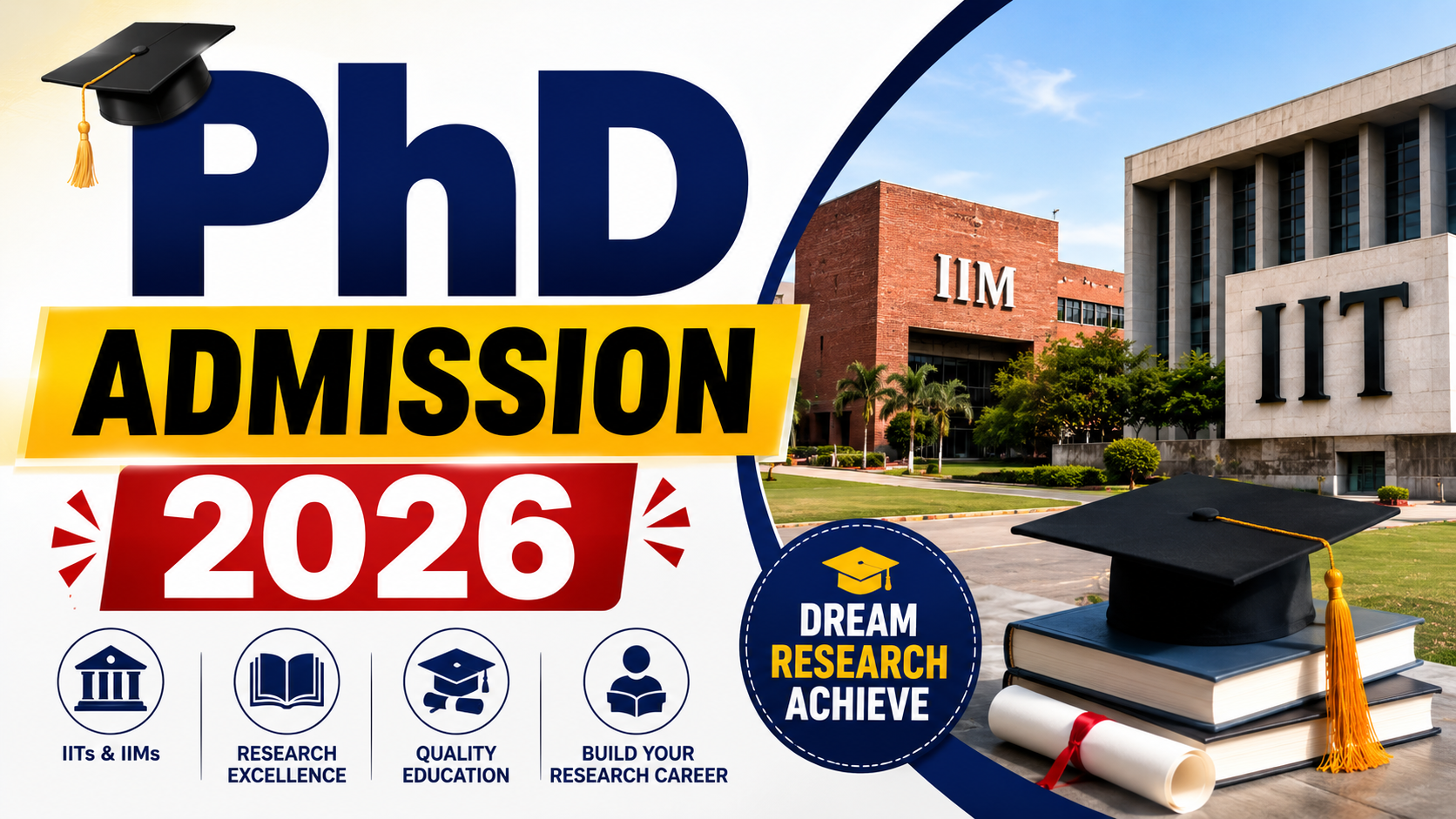
Pursuing a PhD from premier institutes such as the Indian Institutes of Technology (IITs) and Indian Institutes of Management (IIMs) is a dream for many research aspirants. However, understanding the admission process, selecting the right research topic, preparing a research proposal, and clearing the interview often become major challenges for candidates. Every institute follows its own admission guidelines, eligibility criteria, and selection process, making it important to prepare strategically. This article explains the complete IIT and IIM PhD admission process, eligibility requirements, research proposal preparation, selection criteria, and important admission timelines.
PhD Admission 2026 at IIT & IIM
Admission to PhD programmes at IITs and IIMs is conducted through institute-specific admission processes. While many institutes accept UGC NET/JRF, GATE, CAT, GRE, GMAT, or other national-level examinations, several IITs and IIMs also conduct their own written tests followed by interviews. Candidates should regularly visit the official websites of their preferred institutes, as admission notifications are released at different times throughout the year.
PhD Admission 2026: Overview
| Particular | Details |
|---|---|
| Course | Doctor of Philosophy (PhD) |
| Institutes | IITs, IIMs and other premier institutions |
| Admission Mode | Online |
| Selection Process | Entrance Test (if applicable) + Research Proposal + Interview |
| Eligibility | Master’s Degree or equivalent qualification |
| National Exams Accepted | UGC NET, JRF, GATE, CAT, GRE, GMAT (Institute-wise) |
| Official Websites | Respective IIT/IIM websites |
How to Start Your PhD Journey?
Many candidates remain confused about where to begin. Experts recommend dividing your preparation into two stages:
- Pre-interview preparation
- Interview preparation
The majority of your effort should focus on the pre-interview stage, which includes selecting universities, identifying research interests, preparing a proposal, and understanding institute-specific admission requirements.
How to Choose the Right University?
Choosing the right institute is the first and most important step. Candidates should:
- Shortlist IITs, IIMs, or universities based on their research interests.
- Visit the official website of each institute.
- Read the admission brochure carefully.
- Check eligibility criteria.
- Understand the admission process.
- Verify whether the institute accepts NET/JRF, GATE, CAT, or conducts its own entrance examination.
Candidates can also compare institutes using rankings such as NIRF Rankings, QS World University Rankings and Financial Times (FT) Rankings (for Management Institutes). These rankings help candidates identify institutions with strong research output and academic reputation.
How to Select a Research Topic?
Choosing a research topic is one of the most critical aspects of PhD admissions. Experts recommend:
- Selecting an area that genuinely interests you.
- Narrowing down broad subjects into specific research questions.
- Reading existing research papers before deciding.
- Identifying research gaps and limitations in previous studies.
- Focusing on future research opportunities instead of selecting entirely new, unexplored topics.
How to Prepare a Research Proposal?
Most IITs and IIMs require candidates to submit a research proposal during the admission process. A good research proposal generally includes a Research Title, Introduction, Problem Statement, Literature Review, research objectives, research questions, and Proposed Methodology, Expected Outcomes and References. Candidates should study sample research proposals available on IIT websites before preparing their own.
Eligibility Criteria for PhD Admission 2026
Although eligibility differs slightly across institutes, the general requirements are:
- Master’s degree with at least 55%–60% marks (depending on the institute).
- Valid UGC NET/JRF, GATE, CAT, GRE, GMAT, or institute-specific qualification wherever applicable.
- Candidates with a four-year bachelor’s degree may also be eligible under NEP 2020 guidelines in certain institutes.
- Reserved category candidates receive relaxation as per Government and UGC norms.
Selection Process for IIT & IIM PhD Admission
The selection process generally consists of the following stages:
- Online application submission.
- Screening of applications.
- Written examination (if applicable).
- Evaluation of research proposal.
- Personal Interview.
- Final merit list.
- Admission and document verification.
Some IITs conduct their own written examinations, while several IIMs shortlist candidates directly for interviews based on national-level examination scores.
PhD Interview Preparation Tips
The interview is an important part of the selection process. Candidates should prepare for questions related to:
- Introduction and academic background.
- Why they want to pursue a PhD.
- Research interests.
- Research proposal.
- Subject knowledge.
- Previous academic projects.
- Future research plans.
- Whether they are willing to modify their proposed research topic.
Important Documents Required for PHD Admission
Candidates should keep the following documents ready:
- 10th and 12th certificates
- Graduation mark sheets and degree
- Postgraduation mark sheets and degree
- UGC NET/JRF/GATE/CAT scorecard (if applicable)
- Identity proof
- Passport-size photographs
- Research proposal
- Updated CV
- Category certificate (if applicable)
- Experience certificates (if applicable)
Important Dates for PhD Admission 2026
Admission schedules vary from institute to institute. Generally, IITs conduct admissions twice a year (Spring and Autumn sessions), several IIMs open admissions once every year, and some institutes keep applications open for multiple cycles depending on departmental requirements. Candidates should regularly visit the official websites of their preferred institutes to avoid missing application deadlines.
Tips to Improve Your Chances of Selection at PhD Admission
- Start preparing at least six months before admissions.
- Read recent research papers in your subject.
- Prepare a well-structured research proposal.
- Stay updated with institute notifications.
- Build communication and presentation skills.
- Practice subject-specific interview questions.
- Be open to modifying your research topic based on faculty guidance..




 UGC NET Revised Notification 2026 Out, D...
 MH SET Exam Center List 2025, District W...
 AP DSC Preparation Tips 2026, Strategy a...