Table of Contents
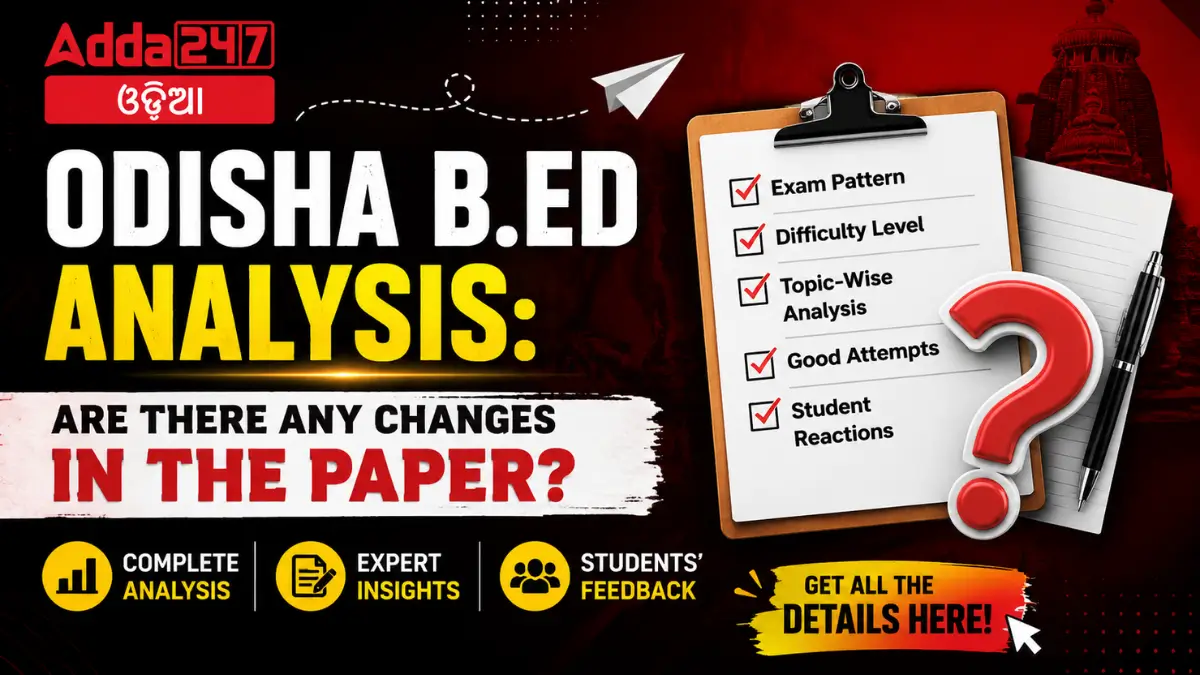
Aspiring teachers in Odisha often worry about sudden shifts in the entrance exam landscape. With the 2025 and 2026 Odisha B.Ed Entrance Exams, the key question is: Has the Council or State Selection Board (SSB) introduced major changes?
The short answer is no; the core structure remains consistent with previous years, but there are critical nuances regarding the conducting body and digital updates that every candidate should know.
Comparative Overview of the Exam Pattern
The Odisha B.Ed entrance remains a single-stage, offline (OMR-based) examination consisting of two distinct papers.
| Feature | 2025 Exam Pattern | 2026 Exam Pattern | Change Status |
| Mode of Exam | Offline (OMR) | Offline (OMR) | No Change |
| Total Marks | 100 Marks | 100 Marks | No Change |
| Number of Papers | 2 (Paper I & Paper II) | 2 (Paper I & Paper II) | No Change |
| Duration | 2 Hours (120 Mins) | 2 Hours (120 Mins) | No Change |
| Negative Marking | -0.25 per wrong answer | -0.25 per wrong answer | No Change |
| Conducting Body | SSB Odisha / SAMS | SSB Odisha / SAMS | Institutional Updates |
Odisha B.Ed Exam Analysis 2026
Here we are provided the Odisha B.Ed Exam Analysis 2026 for Arts Stream Code B and Science Stream Code D in the article below. The Odisha B.Ed Question paper 2026 has been available by adda247. Candidate must ead the below article to know in detail about Odisha B.Ed Exam Analysis 2026, Difficulty Level, Good Attempts with section-wise and topic-wise.
| Stream | Subject | No. of Questions | Difficulty Level | Good Attempts |
|---|---|---|---|---|
| Common | Language (English) | 10 | Moderate | 6-8 |
| General Awareness | 10 | Easy to Moderate | 7-8 | |
| Reasoning | 10 | Easy to Moderate | 7-8 | |
| Teaching Aptitude | 10 | Moderate | 6-8 | |
| Arts | General English | 15 | Easy | 12-13 |
| Odia | 10 | Easy | 12-13 | |
| History & Political Science | 20 | Easy | 17-18 | |
| Geography & Economics | 15 | Moderate | 12-13 | |
| Science | Physical Science | 20 | Easy to Moderate | 17-18 |
| BioScience | 20 | Easy to Moderate | 17-18 | |
| Mathematics | 20 | Easy to Moderate | 17-18 |
Detailed Paper Breakdown: No Major Shift in Content
The 2026 syllabus confirms that the weighting of subjects remains identical to the 2025 cycle.
Paper I: Compulsory for All (40 Marks)
This paper tests general aptitude and is mandatory for both Arts and Science stream students.
- Language (English): 10 Marks
- General Awareness: 10 Marks (Focus: Educational committees, policies, and everyday science)
- Reasoning: 10 Marks
- Teaching Aptitude: 10 Marks
Paper II: Stream-Specific (60 Marks)
Candidates must choose one group based on their graduation background.
- Arts Stream: * General English (15 Marks)
- Odia (10 Marks)
- History & Political Science (20 Marks)
- Geography & Economics (15 Marks)
- Science Stream: *
- Physical Science (20 Marks)
- Bio-Science (20 Marks)
- Mathematics (20 Marks)
Key Observations & Minor Updates
While the paper pattern hasn’t changed, the recruitment environment has seen minor administrative adjustments:
- Conducting Authority Clarity: The State Selection Board (SSB), Odisha, continues to manage the entrance test on behalf of the Higher Education Department. Ensure you follow the official SSB Odisha website for the most authentic updates.
- Digital Integration: The application process is now more tightly integrated with the SAMS Odisha portal. 2026 aspirants must ensure their graduation marks are updated in the SAMS database for smooth “Choice Locking” during counselling.
- Strict Negative Marking: While the 0.25 penalty isn’t “new,” it remains the biggest hurdle. With the 2026 competition expected to be higher, candidates are moving away from “wild guessing” to “educated elimination.”
- Smart Strategy for 2025-2026 Aspirants
Since the pattern is stable, your focus should be on depth rather than change:
- Focus on Teaching Aptitude: This section often decides the rank. Study the role of agencies like NCTE, UGC, and the impact of the NEP 2020.
- Current Educational Policies: General Awareness now heavily features the latest educational initiatives in Odisha (like the 5T transformations in schools).
- Mock Tests: Since the exam is OMR-based, practice with physical OMR sheets to improve your speed and avoid “bubble-filling” errors.



 UGC NET Revised Notification 2026 Out, D...
 Bihar STET Exam Date 2026 Out, Check Exa...
 UPSC Principal and Vice Principal Previo...