CTET 2026 Notification, Application, Exam date, Syllabus
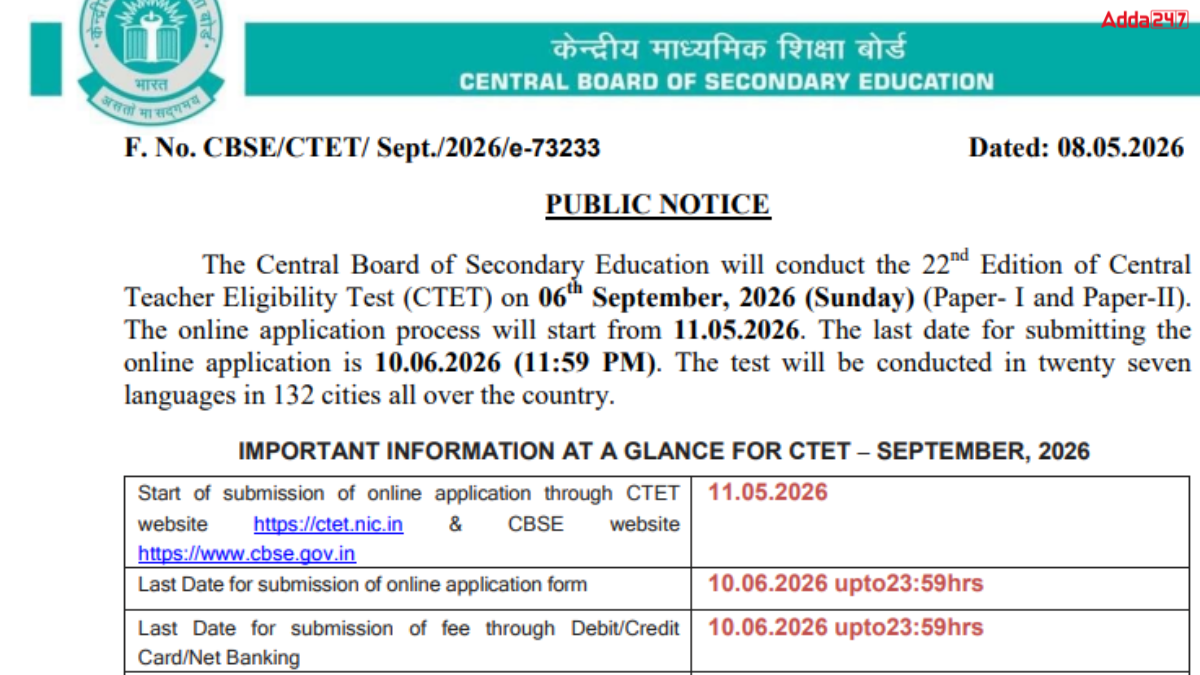
The Central Teacher Eligibility Test (CTET) 2026 is a national-level eligibility examination conducted by the Central Board of Secondary Education (CBSE) to certify candidates for teaching positions in Classes I to VIII. It serves as a mandatory qualification for recruitment in central government schools such as KVS, NVS, and other CBSE-affiliated institutions. With the upcoming CTET 2026 cycle approaching, candidates must clearly understand the notification timeline, application process, exam schedule, eligibility, and detailed syllabus.
CTET 2026 Notification: Overview
The CTET 2026 Notification for the upcoming cycle is expected to be released soon. CBSE generally conducts CTET twice a year, typically in July and December cycles.
Particulars | Details |
|---|---|
Exam Name | Central Teacher Eligibility Test (CTET) |
Conducting Body | CBSE |
Exam Level | National Level |
Frequency | Twice a Year |
Mode of Exam | Offline (OMR Based) |
Papers | Paper I (Primary), Paper II (Upper Primary) |
Duration | 150 Minutes (Each Paper) |
Total Marks | 150 Marks |
Official Website | ctet.nic.in |
CTET 2026 Important Dates (Expected)
The upcoming CTET cycle is expected to follow a pattern similar to previous years. Below is the trend-based schedule for better clarity.
Event | July 2026 Cycle (Expected) | December 2026 Cycle (Expected) |
|---|---|---|
Notification Release | April–May 2026 | October–November 2026 |
Application Start Date | May 2026 | November 2026 |
Last Date to Apply | June 2026 | December 2026 |
Correction Window | June 2026 | December 2026 |
Admit Card Release | July 2026 (1st Week) | December 2026 (2nd Week) |
Exam Date | July/August 2026 | December 2026 / January 2027 |
Answer Key | Within 10–15 days | Within 10–15 days |
Result Declaration | August/September 2026 | January/February 2027 |
CTET 2026 Notification
The CTET 2026 Notification is expected to be released soon by the Central Board of Secondary Education (CBSE) for the upcoming examination cycle. This notification will provide complete details regarding the application process, exam dates, eligibility criteria, syllabus, and exam pattern for candidates aspiring to become teachers for Classes I to VIII. Based on previous year trends, the notification for the July 2026 cycle is likely to be released between April and May 2026, while the December cycle notification may be announced around October–November 2026. Candidates are advised to regularly check the official website and begin their preparation early to secure a strong position in the CTET 2026 examination.
CTET Notification | |
Notice | Click to Download (December 2025) |
Information Bulletin | Click to Download (December 2025) |
CTET 2026 Application Form
The CTET 2026 Application Form for the upcoming cycle will be released online by CBSE on the official website. Candidates who wish to appear for Paper I (Primary Level) or Paper II (Upper Primary Level) must complete the registration process within the specified timeline. Based on previous trends, the application form is typically released 3 months before the exam date, giving candidates sufficient time to apply and prepare.
CTET 2026 Exam Date
The CTET 2026 next exam cycle is expected to follow the consistent schedule pattern set by CBSE over the years. Since CTET is conducted twice annually, candidates can anticipate the upcoming exams in the mid-year (July cycle) and end-year (December cycle). Although the official dates are yet to be announced, past trends clearly indicate that the exam is usually conducted within 2–3 months after the release of the notification. Aspirants are advised to align their preparation strategy with this expected timeline to stay ahead.
Cycle | Notification Release | Expected Exam Date |
|---|---|---|
July 2026 Cycle | April–May 2026 | July–August 2026 |
December 2026 Cycle | October–November 2026 | December 2026 / January 2027 |
Steps to Fill CTET 2026 Application Form
Candidates must follow a structured process while filling out the CTET online form.
Step | Process Details |
|---|---|
Step 1 | Visit the official CTET website |
Step 2 | Click on “Apply Online” |
Step 3 | Complete registration with basic details |
Step 4 | Fill personal, academic, and contact details |
Step 5 | Upload scanned photograph and signature |
Step 6 | Select exam centre preferences |
Step 7 | Pay application fee online |
Step 8 | Submit form and download confirmation page |
Details Required in CTET Application Form
While filling the CTET 2026 form, candidates need to enter accurate information.
- Personal Details (Name, DOB, Gender)
- Educational Qualifications
- Category and Reservation Details
- Paper Selection (Paper I / II / Both)
- Language Preferences (Language I & II)
- Exam Centre Choices
CTET 2026 Eligibility Criteria
CTET 2026 eligibility criteria are defined by CBSE to ensure that only candidates with the required educational qualifications and teacher-training background can appear for the exam. The criteria vary for Paper 1 (Primary Level: Classes I–V) and Paper 2 (Upper Primary Level: Classes VI–VIII). Candidates must meet any one of the prescribed qualification combinations to be eligible. There is no upper age limit, and candidates appearing in the final year of their teacher education programs can also apply.
Common Eligibility Criteria
Category | Requirement |
|---|---|
Nationality | Must be an Indian citizen |
Age Limit | No upper age limit |
Final-Year Candidates | Candidates appearing in the final year of D.El.Ed, B.Ed or equivalent courses are eligible |
CTET 2026 Eligibility Criteria for Paper 1 (Primary Level: Classes I–V)
Candidates must meet any one of the following:
Qualification Path | Required Educational Background |
|---|---|
Option 1 | Senior Secondary (or equivalent) with at least 45% marks + 2-year D.El.Ed. |
Option 2 | Senior Secondary with minimum 45% marks + 4-year B.El.Ed. |
Option 3 | Graduation + B.Ed. |
Option 4 | Senior Secondary or Graduation with any other approved teacher-training course as mentioned in the official notification |
CTET 2026 Eligibility Criteria for Paper 2 (Upper Primary Level: Classes VI–VIII)
Candidates must satisfy any one of the following:
Qualification Path | Required Educational Background |
|---|---|
Option 1 | Graduation with 40–50% marks + 2-year D.El.Ed. |
Option 2 | Graduation + B.Ed. / B.El.Ed. |
Option 3 | Senior Secondary with 50% + B.A./B.Sc.Ed. / B.A.Ed. / B.Sc.Ed. (passed or appearing) |
Option 4 | Graduation with 50% + 1-year B.Ed. (Special Education) (passed or appearing) |
Check Complete: CTET Eligibility Criteria 2026
CTET 2026 Selection Process
The CTET selection process primarily involves a written examination consisting of two papers. Paper I is for candidates aspiring to teach Classes I-V (Primary Stage), and Paper II is for those aiming to teach Classes VI-VIII (Elementary Stage). Candidates can choose to appear for either one or both papers, depending on their eligibility and teaching preferences.
Qualifying CTET 2026 is the first and most important step to become eligible for teaching jobs in India. The process is simple and exam-focused, but securing the CTET certificate opens doors to central and state school recruitments. Here’s a quick glance at the complete selection process:
Step | Details |
|---|---|
1. Application & Exam | Fill online application. Appear for Paper 1 (Classes I–V) and/or Paper 2 (Classes VI–VIII), offline pen-and-paper mode. |
2. Minimum Qualifying Marks | General: 60% (90/150) |
3. Result & Scorecard | Download individual scorecards from the official portal; check subject-wise marks and qualifying status. |
4. CTET Certificate | Qualifying candidates receive a lifetime-valid CTET certificate via DigiLocker, proving eligibility for teaching posts. |
5. Recruitment by Schools | Apply to KVS, NVS, Central/State Government, aided and private schools; schools may conduct interviews, demo lessons, or additional tests. |
CTET 2026 Exam Pattern
CTET 2026 will be conducted in two shifts—morning for Paper I (Classes I-V) and afternoon for Paper II (Classes VI-VIII). The exam will follow an offline pen-and-paper mode. Each paper carries 150 questions for 150 marks, with a duration of 2 hours 30 minutes. All questions are multiple choice with no negative marking. The structure evaluates teaching aptitude, child development concepts and subject knowledge essential for classroom teaching.
- Paper I will be for a person who intends to be a teacher for classes I to V.
- Paper II will be for a person who intends to be a teacher for classes VI to VIII.
Note: A person who intends to teach for both levels (classes I to V and classes VI to VIII) will have to appear in both papers (Paper I and Paper II).
Note: Mathematics & Science- 30 MCQs each -60 Marks, or Social Studies/Social Science -60 MCQs -60 Marks (for Social Studies/Social Science teacher). There is no penalty for any wrong answers.
Check Complete: CTET Exam Pattern 2026
CTET 2026 Syllabus
The syllabus includes key components such as Child Development and Pedagogy, Language I, Language II, Mathematics, Environmental Studies, Science and Social Science. The syllabus is designed to assess understanding of child psychology, basic concepts, learning theories and subject competencies. NCERT books from Classes I to VIII form the backbone of the exam content, making them essential for preparation.
CTET Paper 1 & 2 Syllabus
The Central Board of Secondary Education has released the new syllabus on its official website. The syllabus is based on the National Curriculum Framework (NCF) 2005 and the Right to Education Act (RTE) 2009. To crack the CTET Exam, students must be aware of the CTET Syllabus 2026 & New Exam Pattern in detail. Take a look at the important points:
- CTET Paper 1 Syllabus : Paper 1 focuses on teaching at the primary level. The Child Development and Pedagogy section evaluates understanding of learners aged 6–11 years, inclusive education and learning processes. Language I tests proficiency in the medium of instruction, while Language II checks comprehension and communication skills. Mathematics includes number operations, geometry and problem-solving. Environmental Studies covers daily-life themes like family, food, travel, resources and community.
- CTET Paper 1 Subjects: Child Development and Pedagogy (CDP), Language I (compulsory), Language II (compulsory), Subject concerned Pedagogy, Mathematics and Subject concerned Pedagogy, Environmental Studies and Subject concerned Pedagogy.
- CTET Paper 2 Syllabus: Paper 2 targets candidates aspiring to teach Classes VI-VIII. Child Development and Pedagogy tests knowledge of adolescent learners, teaching approaches and evaluation. Language sections remain similar to Paper 1, with emphasis on grammar, comprehension and communication. Candidates choose either Mathematics & Science or Social Studies. The content draws heavily from NCERT Class VI-VIII textbooks, requiring conceptual clarity and applied understanding.
- CTET Paper 2 Subjects: Child Development and Pedagogy (CDP), Language I (compulsory), Language II (compulsory), Subject concerned Pedagogy, Mathematics & Science, and Subject concerned Pedagogy OR Social Science and Subject concerned Pedagogy.
CTET Previous Year Papers
CTET Previous Year Papers are one of the most powerful tools for scoring well in the CTET 2026 exam. These papers help candidates understand the latest exam trends, question difficulty and topic-wise weightage exactly as asked by CBSE. Aspirants who regularly solve CTET past papers develop stronger concepts, better accuracy and faster question-solving skills. Most high scorers and experts recommend practising at least 5–10 previous year papers to improve confidence and identify weak areas. If you want a clear idea of the real exam pattern, CTET Previous Year Question Papers are the most reliable resource to start your preparation effectively.
CTET 2026 Cut-Off Marks
CTET Off Marks are the minimum scores candidates must achieve to qualify for the CTET certificate and become eligible for teaching positions in schools. For the upcoming CTET 2026 exam, candidates must score at least 60% (90 marks) if they belong to the General category, while candidates from OBC, SC, ST and PwD categories must score 55% (82 marks) to qualify. Understanding the qualifying marks helps aspirants set a clear target, plan an effective preparation strategy and improve their chances of clearing CTET on the first attempt.
Category | Minimum Qualifying Percentage | Qualifying Marks (Out of 150) |
|---|---|---|
General (UR) | 60% | 90 |
OBC | 55% | 82 |
SC | 55% | 82 |
ST | 55% | 82 |
PwD | 55% | 82 |
CTET 2026 Exam Centre
The CTET Exam will be conducted in more than 135 CTET Exam Centres in 2026. CTET 2026 Exam Centres are assigned across major cities in India to ensure smooth and accessible conduct of the CTET 2026 exam. Candidates can select their preferred exam city while filling out the application form, but the final allotment depends on seat availability and is confirmed only through the admit card.
CTET Exam Centre | ||
S.No. | States & UT | Cities |
1 | Andaman & Nicobar Island | Sri Vijay Puram (Port Blair) |
2 | Andhra Pradesh | Anantapur, Bhimavaran, Chirala, Eluru, Guntur,Kadapa, Kakinada, Kurnool, Nandyala, Narsaraopeta, Nellore, Proddatur, Rajamundry, Srikulam, Tirupati, Vijaywada, Visakhapatnam, Viziannagaram |
3 | Assam | Dibrugarh, Guwahati, Jorhat, Silchar, Tezpur |
4 | Bihar | Bhagalpur, Bhojpur, Gaya, Muzzafarpur, Patna, Purnea, |
5 | Chhattisgarh | Bhilai Nagar, Bilaspur, Raipur |
6 | Chandigarh | Chandigarh |
7 | Dadar & Nagar Haveli | Dadar & Nagar Haveli |
8 | Daman & Diu | Daman |
9 | Delhi | New Delhi |
10 | Goa | Panaji |
11 | Gujarat | Ahmedabad, Anand, Bardoli, Gandhinagar, Jamnagar, Mehsana, Rajkot, Surat, Vadodara, Valsad, Vapi |
12 | Haryana | Ambala, Faridabad, Gurugram, Karnal, Hisar, Kurukshetra |
13 | Himachal Pradesh | Bilaspur, Hamirpur, Kullu, Mandi, Shimla, Solan, Una |
14 | Jammu | Jammu, Samba, Srinagar |
15 | Jharkhand | Bokaro, Dhanbad, Hazaribagh, Jamshedpur, Ranchi |
CTET 2026 Online Coaching
CTET online coaching by Adda247 provides flexible and accessible preparation for the CTET. It includes features like video lectures, interactive quizzes, and practice tests tailored to the syllabus. Candidates benefit from expert guidance, personalized feedback, and the ability to study at their own pace, with access to live sessions and recorded tutorials. This approach allows for effective preparation while accommodating individual schedules and learning preferences.
CTET Preparation Tips
Cracking CTET 2026 becomes much easier when you follow a structured, smart and syllabus-focused preparation plan. Since the exam tests both subject knowledge and teaching aptitude, candidates must build strong concepts from NCERT books, revise pedagogy daily and practise plenty of previous year papers. A clear understanding of the exam pattern for Paper 1 and Paper 2 helps you decide what to study first, how much time to spend on each subject and how to improve accuracy in the final exam.
Section | Paper 1 Strategy (Classes I–V) | Paper 2 Strategy (Classes VI–VIII) |
|---|---|---|
Child Development & Pedagogy | Study learning theories, Piaget, Vygotsky, Kohlberg; practise pedagogy-based MCQs daily | Focus on inclusive education, teaching methods and learning psychology; attempt theory-based questions regularly |
Language I | Build grammar and comprehension skills; practise unseen passages | Strengthen language pedagogy; improve reading speed and vocabulary |
Language II | Practise grammar rules and error-spotting; revise teaching methodologies | Solve language-based pedagogy questions; improve accuracy in comprehension |
Mathematics | Use NCERT Class 1–5 books; revise basic concepts and teaching methods | Practise problem-solving from NCERT 6–8; focus on application, pedagogy and formulas |
Environmental Studies (EVS) | Study EVS themes from NCERT; revise teaching-learning concepts | - |
Science / Social Studies | - | For Science: study Physics, Chemistry, Biology basics + pedagogy; For SST: revise history, civics, geography from NCERT + teaching approaches |
Mock Tests | Take weekly mock tests; analyse mistakes | Attempt full-length mocks; focus on time management and accuracy |
Revision | Make short notes and revise regularly | Use structured revision cycles for high-weightage chapters |
CTET Mock Test 2026
The CTET Exam is an important examination administered by the Central Board of Secondary Education (CBSE) in India to assess candidates for teaching roles in schools nationwide. Participating in CTET Mock Tests 2026 is a vital component of the preparation process. Mock tests provide candidates with a chance to replicate the actual exam setting, helping them become familiar with the exam format, question types, and time limits they will face on test day. Moreover, these practice sessions enable candidates to identify their strengths and weaknesses, allowing them to tailor their study strategies for more effective preparation.