Table of Contents
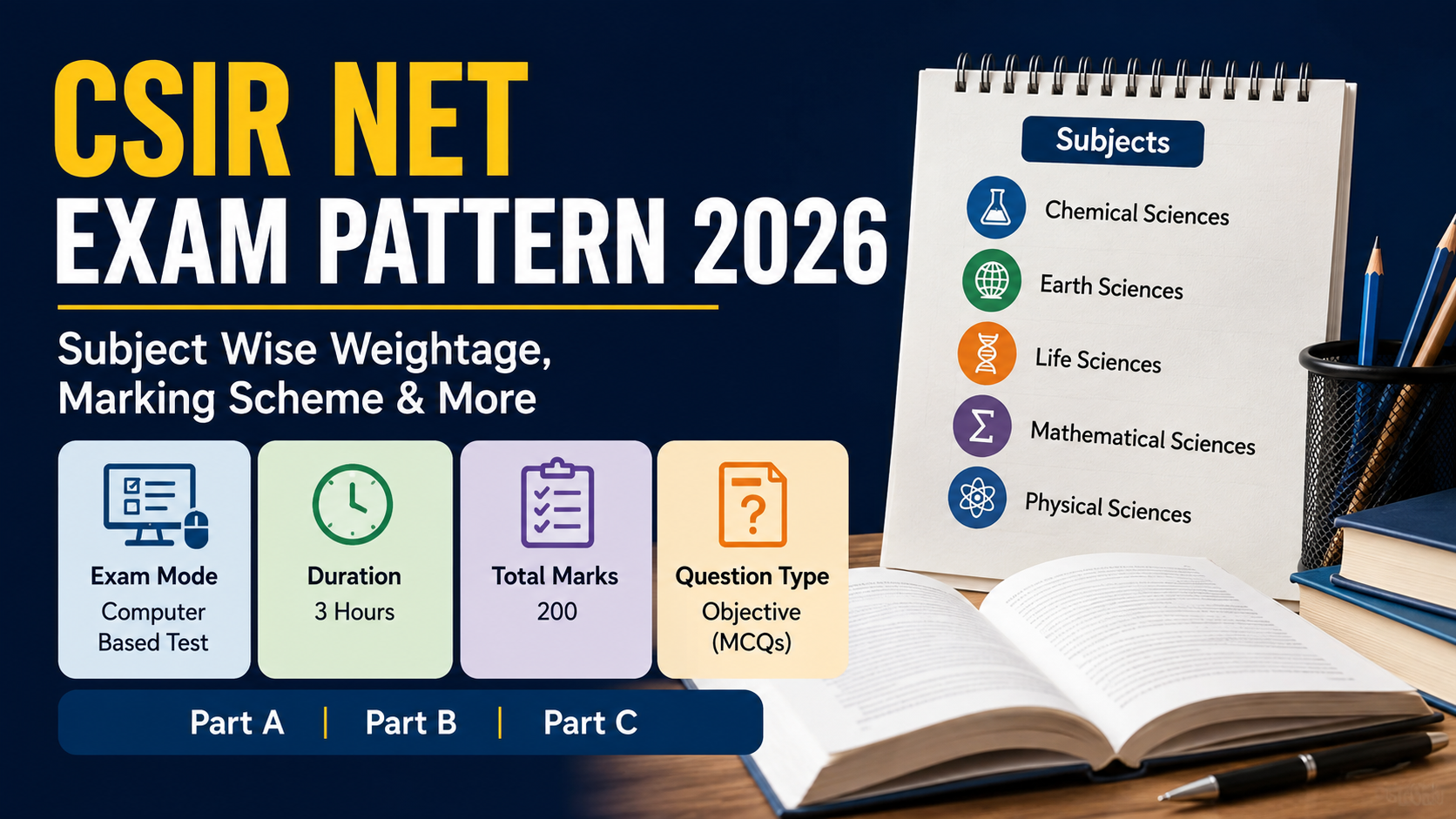
The CSIR NET Exam Pattern 2026 helps candidates understand the number of questions, questions to be attempted, marks and negative marking for each subject. As per the Joint CSIR-UGC NET December 2026 Information Bulletin, the examination is conducted in Computer-Based Test (CBT) mode. The question paper consists of three parts—Part A, Part B and Part C, and all three parts contain objective-type multiple-choice questions. There is no break between the parts.
CSIR NET Exam Pattern 2026
The CSIR NET December 2026 examination is conducted for five subjects: Chemical Sciences, Earth, Atmospheric, Ocean and Planetary Sciences, Life Sciences and Bio-Technology, Mathematical Sciences, and Physical Sciences. Although all papers are divided into Part A, B and C, the number of questions, number of questions to be attempted, marks per question and negative marking differ from subject to subject.
CSIR NET Exam Pattern 2026 Overview
The CSIR NET Exam 2026 is conducted by the National Testing Agency (NTA) in Computer-Based Test (CBT) mode for five science subjects. The exam consists of a single paper divided into Part A, Part B, and Part C, with each section testing different skills. The paper carries a total of 200 marks, and the number of questions to be attempted varies by subject. Since the marking scheme and negative marking are different for each subject, candidates should understand the exam pattern before starting their preparation.
| Particulars | Details |
|---|---|
| Exam Mode | Computer-Based Test (CBT) |
| Duration | 180 minutes (3 hours) |
| Total Marks | 200 marks |
| Question Type | Objective-type Multiple-Choice Questions (MCQs) |
| Parts | Part A, Part B and Part C |
| Subjects | 5 |
| Medium | Hindi and English |
| Break Between Parts | No break |
CSIR NET Subject-Wise Exam Pattern
The CSIR NET exam pattern is different for each of the five science subjects. The exam is divided into Parts A, B, and C for all papers, the total number of questions, marks per question, maximum questions to attempt, and negative marking vary by subject. Candidates should check the subject-wise exam pattern carefully to understand the paper structure and prepare accordingly.
| Subject | Code | Total Questions | Questions to Attempt | Maximum Marks |
|---|---|---|---|---|
| Chemical Sciences | 701 | 120 | 75 | 200 |
| Earth, Atmospheric, Ocean and Planetary Sciences | 702 | 150 | 75 | 200 |
| Life Sciences and Bio-Technology | 703 | 145 | 75 | 200 |
| Mathematical Sciences | 704 | 120 | 60 | 200 |
| Physical Sciences | 705 | 75 | 55 | 200 |
CSIR NET Exam Pattern 2026 for Chemical Sciences
The Chemical Sciences paper tests candidates on core chemistry concepts through Parts A, B, and C. Understanding the marking scheme and the number of questions to attempt helps candidates plan their exam strategy effectively.
- Total questions in the paper: 120
- Candidates need to attempt 75 questions
- Part A and Part B carry 2 marks per question
- Part C carries 4 marks per question
- 25% negative marking for every incorrect answer
- Total exam duration: 3 Hours
| Particulars | Part A | Part B | Part C | Total |
|---|---|---|---|---|
| Total Questions | 20 | 40 | 60 | 120 |
| Maximum Questions to Attempt | 15 | 35 | 25 | 75 |
| Marks per Correct Answer | 2 | 2 | 4 | 200 |
| Negative Marking | 0.5 | 0.5 | 1 | – |
CSIR NET Exam Pattern 2026 for Earth Sciences
The Earth Sciences paper includes questions from geology, geophysics, ocean sciences, and related topics. Candidates should understand the exam structure and marking scheme before starting their preparation.
- Total questions in the paper: 150
- Candidates need to attempt 75 questions
- Part A and Part B carry 2 marks each
- Part C carries 4 marks per question
- 25% negative marking in Part A & B and 33% negative marking in Part C
- Total exam duration: 3 Hours
| Particulars | Part A | Part B | Part C | Total |
|---|---|---|---|---|
| Total Questions | 20 | 50 | 80 | 150 |
| Maximum Questions to Attempt | 15 | 35 | 25 | 75 |
| Marks per Correct Answer | 2 | 2 | 4 | 200 |
| Negative Marking | 0.5 | 0.5 | 1.32 | – |
CSIR NET Exam Pattern 2026 for Life Sciences
The Life Sciences paper evaluates candidates on different areas of biology through objective-type questions. Knowing the question distribution and marking pattern is important for effective preparation.
- Total questions in the paper: 145
- Candidates need to attempt 75 questions
- Part A and Part B carry 2 marks each
- Part C carries 4 marks per question
- 25% negative marking in all three parts
- Total exam duration: 3 Hours
| Particulars | Part A | Part B | Part C | Total |
|---|---|---|---|---|
| Total Questions | 20 | 50 | 75 | 145 |
| Maximum Questions to Attempt | 15 | 35 | 25 | 75 |
| Marks per Correct Answer | 2 | 2 | 4 | 200 |
| Negative Marking | 0.5 | 0.5 | 1 | – |
CSIR NET Exam Pattern 2026 for Mathematical Sciences
The Mathematical Sciences paper is divided into three parts with different marking schemes. Candidates should be aware of the number of questions to attempt and the negative marking rules before the exam.
- Total questions in the paper: 120
- Candidates need to attempt 60 questions
- Part A carries 2 marks, Part B 3 marks, and Part C 4.75 marks
- Negative marking is applicable only in Part A and Part B
- No negative marking in Part C
- Total exam duration: 3 Hours
| Particulars | Part A | Part B | Part C | Total |
|---|---|---|---|---|
| Total Questions | 20 | 40 | 60 | 120 |
| Maximum Questions to Attempt | 15 | 25 | 20 | 60 |
| Marks per Correct Answer | 2 | 3 | 4.75 | 200 |
| Negative Marking | 0.5 | 0.75 | 0 | – |
CSIR NET Exam Pattern 2026 for Physical Sciences
The Physical Sciences paper covers topics from various branches of physics. Candidates should understand the marking scheme and question distribution to prepare according to the exam requirements.
- Total questions in the paper: 75
- Candidates need to attempt 55 questions
- Part A carries 2 marks
- Part B carries 3.5 marks
- Part C carries 5 marks
- 25% negative marking in all parts
- Total exam duration: 3 Hours
| Particulars | Part A | Part B | Part C | Total |
|---|---|---|---|---|
| Total Questions | 20 | 25 | 30 | 75 |
| Maximum Questions to Attempt | 15 | 20 | 20 | 55 |
| Marks per Correct Answer | 2 | 3.5 | 5 | 200 |
| Negative Marking | 0.5 | 0.875 | 1.25 | – |
CSIR NET Subject-Wise Weightage 2026
The paper is divided into three sections. Part A is common for all subjects, while Parts B and C test subject knowledge.
| Part | Weightage |
|---|---|
| Part A | General Aptitude, Logical Reasoning, Numerical Ability |
| Part B | Subject-based direct questions |
| Part C | Conceptual and analytical subject questions |
CSIR NET Negative Marking Rules 2026
Candidates should keep these points in mind while attempting the paper.
- Negative marking is applicable in all subjects.
- The deduction varies according to the subject and section.
- Mathematical Sciences does not have negative marking in Part C.
- If more questions than the prescribed limit are attempted, only the first required number of responses are evaluated.
Why is understanding the CSIR NET Exam Pattern Important?
Candidates who know the exam pattern can plan their preparation better and avoid mistakes during the examination.
- Helps in time management.
- Improves question selection strategy.
- Reduces negative marking.
- Makes subject-wise preparation easier.
- Increases overall score by focusing on high-weightage sections.





 UGC NET 2026 Notification Out, Check App...
 Bihar STET Art of Teaching PDF: Download...
 BPSC TRE 4.0 Eligibility Criteria 2026 f...