Home   »   CG Vyapam TGT Syllabus 2026, Check...

CG Vyapam TGT Syllabus 2026, Check Subject wise

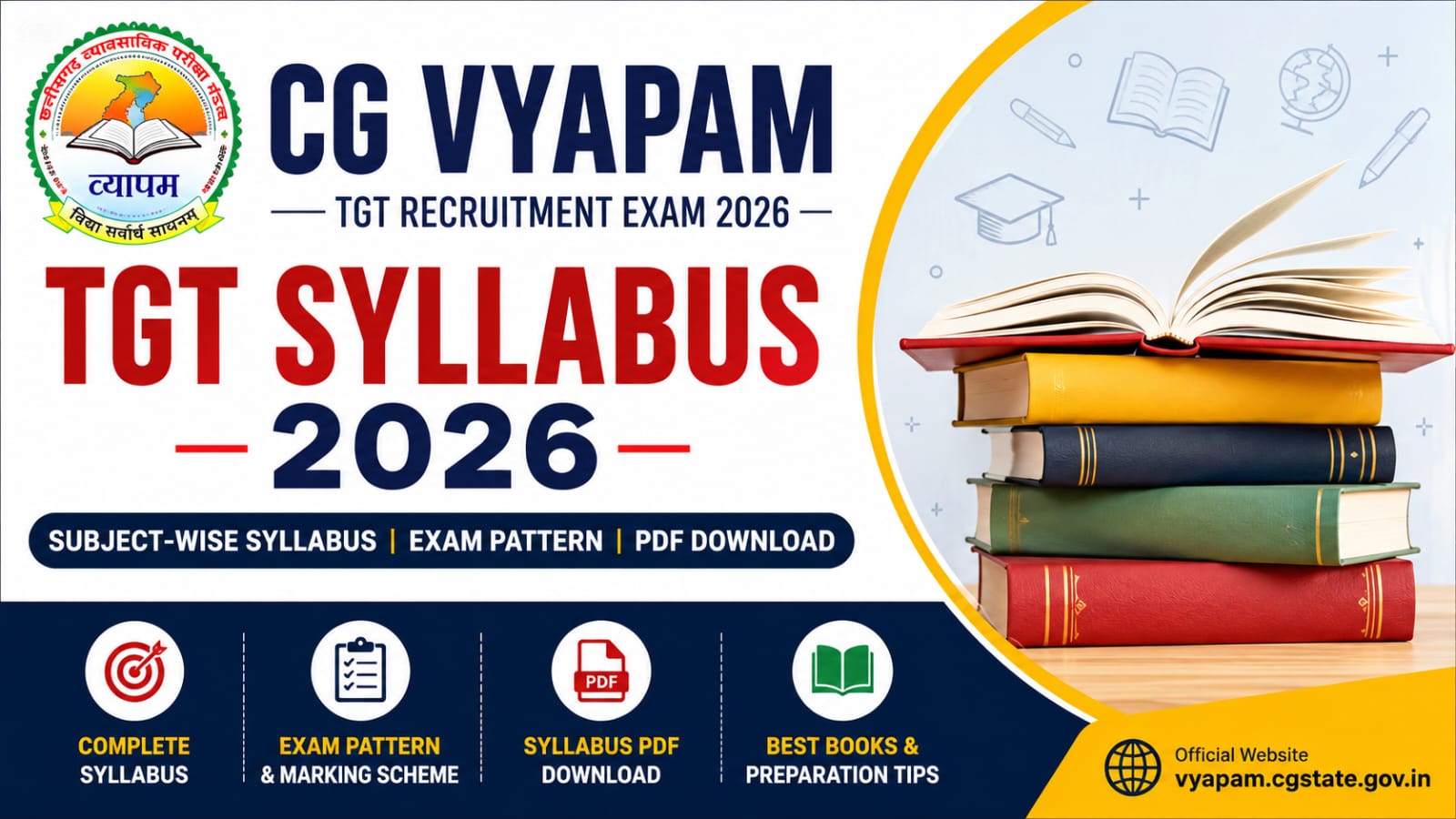
The CG Vyapam TGT Syllabus 2026 is one of the most important resources for candidates preparing for the Chhattisgarh Vyavsayik Pariksha Mandal (CG Vyapam) Trained Graduate Teacher (TGT) Recruitment Exam. Knowing the latest syllabus and exam pattern helps candidates understand which topics are important and prepare in a planned manner. In this article, candidates can check the CG Vyapam TGT Syllabus 2026, exam pattern, subject-wise syllabus, marking scheme, preparation tips, and syllabus PDF details.

CG Vyapam TGT Syllabus 2026

The CG Vyapam TGT Syllabus 2026 covers the topics candidates need to study for the recruitment examination. Before starting preparation, candidates should check the syllabus carefully and understand the weightage of different sections. This helps in setting study priorities and completing the preparation on time.

Candidates should go through the complete syllabus before starting their preparation. The official syllabus helps in identifying important topics and planning a proper study schedule.

Particulars Details
Exam Name CG Vyapam TGT Recruitment Exam 2026
Conducting Body Chhattisgarh Professional Examination Board (CG Vyapam)
Post Name Trained Graduate Teacher (TGT)
Subjects English, Hindi, Sanskrit, Maths, Social, Agriculture
Mode of Exam Offline (OMR-Based)
Question Type Multiple Choice Questions (MCQs)
Official Website vyapam.cgstate.gov.in

CG Vyapam TGT Exam Pattern 2026

Candidates should understand the exam pattern before beginning their preparation. It gives a clear idea about the number of questions, marking scheme, and exam duration. The exam pattern is common across the six subjects: English, Hindi, social science, Sanskrit, mathematics, and agriculture. Each subject paper carries 100 marks, divided into the subject-specific section, Child Development & Pedagogy, and General Studies & Language.

Part Section Marks
Part A Subject-Specific Content 50
Part B Child Development & Pedagogy 15
Part C Language & General Studies 35
Total Overall 100

CG Vyapam TGT Subject-wise Syllabus 2026

The CG Vyapam TGT syllabus mainly includes questions from the concerned subject along with teaching-related topics wherever applicable. Candidates should focus on both conceptual understanding and regular practice.

Subject Subject-wise Topics & Sub-topics
English
  • Grammar: Determiners, Modals, Question Tags, Finite & Non-finite Verbs, Phrasal Verbs, Subject-Verb Agreement, Tenses, Clauses, Sentence Transformation, Direct & Indirect Speech, Inversion, Cleft Sentences, Conditional Sentences, Elliptical Sentences.
  • Vocabulary: Root Words & Affixes, Polysemy, Homophones, Collocations, Word Classes, Lexical Bundles, Idiomaticity & Opacity, Figures of Speech.
  • Reading Comprehension: Unseen prose, poetry, drama, articles, editorials, scientific and literary extracts; comprehension, inference, vocabulary, tone, rhetorical devices and logical sequencing.
  • Language Pedagogy: Language learning and acquisition, linguistic systems, language skills, listening and speaking, functions of language, second-language teaching methods, diverse classrooms, linguistic difficulties, teaching-learning materials, multilingual resources and remedial teaching.
Hindi
  • Hindi Literature: History of Hindi literature, major periods and trends — Adikal, Bhaktikal, Ritikal and Adhunik Kal.
  • Prose: Story, drama/one-act play, essay, sketch, memoir, biography, autobiography, travelogue, short story and satire.
  • Poetry: Adikal poets, Sagun/Nirgun/Sufi poetry, Ritikal poetry, Bharatendu Yug, Dwivedi Yug, Chhayavad and Pragativad.
  • Grammar: Ras, Chhand, Alankar, Shabd Shakti, sentence structure and types, punctuation, idioms, proverbs and unseen passage.
  • Hindi Teaching: Teaching methods and language skills — listening, speaking, reading and writing.
  • Chhattisgarhi: Chhattisgarhi language and literature.
Social Science
  • Geography: Location of places, maps, Earth’s interior, oceans and continents, lithosphere, hydrosphere, biosphere, climate, earthquakes, volcanoes, rivers, groundwater, glaciers, wind, sea waves, Indian physiography, natural and human resources, vegetation, wildlife, human environment, soil and water.
  • History: Sources and chronology, Vedic culture, Jainism, Buddhism, Indus Valley Civilization, art and crafts, Mauryan period, rise of modern culture, Gupta Empire, Mughal Empire, Mughal-Rajput relations, Mughal administration/social/economic/cultural conditions, British policies, Revolt of 1857, World Wars and Cold War.
  • Chhattisgarh History: Naming, education, literature, art, industries, press, freedom struggle, tribal revolts and major dynasties.
  • Civics: Constitution, Fundamental Rights and Duties, President, Governor, democracy, elections, Parliament, Lok Sabha, Rajya Sabha, Prime Minister and Council of Ministers, foreign policy, Legislature, Executive, Judiciary, local government, Panchayati Raj, UN, globalization, international organizations, Indian society, family, community and women.
  • Economics: Economic/non-economic activities, importance of work, industries, Indian economy, government budget, taxation, data collection and presentation, globalization, money and credit.
Sanskrit
  • Grammar: Letters and pronunciation, noun declensions, pronouns, numbers up to 100, unseen comprehension, verb forms, cases, suffixes, Sandhi, Samasa, indeclinables, prefixes and time expression.
  • Sentence Construction: Correct/incorrect sentence identification, unseen passages, translation, questions-answers and short Sanskrit essay.
  • Poetry: Raghuvamsham First Canto, verses 1–25; Abhijnanashakuntalam, Fourth Act; Bhagavad Gita, Second Chapter.
  • Prose: Shukanasopadesha, Panchatantra, prescribed prose extracts.
  • Literature: Introduction to Kalidasa, Bhasa, Bhavabhuti, Shudraka, Bharavi, Sriharsha and Bhartrihari.
  • Other Topics: Sanskrit Subhashitas, Chhand — Anushtubh, Upajati, Vamshastha, Vasantatilaka, Malini, Sragdhara, Shardulavikridita; Alankaras — Anuprasa, Upama, Rupaka, Utpreksha, Yamaka, Shlesha, Arthantaranyasa; Vedic literature, four Vedas, Ishavasyopanishad and Taittiriya Upanishad.
Mathematics
  • History & Nature of Mathematics: Indian mathematicians, Vedic Mathematics, development of mathematical thought, abstraction, specification and generalisation, learning models, constructivism, assessment, abstract thinking, conceptual and procedural knowledge.
  • Arithmetic: Number system, natural/whole/integer/rational/irrational/real numbers, basic operations, BODMAS, fractions, decimals, factors, multiples, prime numbers, LCM, HCF, ratio, proportion, simple and compound interest, percentage, profit-loss, discount, time-work, time-distance-speed, average and commercial mathematics.
  • Algebra: Real numbers, exponents, algebraic expressions, polynomials, linear equations in one/two variables, quadratic equations and arithmetic/geometric progressions.
  • Trigonometry: Ratios, identities, values, graphs, equations, height and distance.
  • Geometry: Lines and angles, triangles, congruence, quadrilaterals, similarity, circles, tangents and constructions.
  • Mensuration: Areas of plane figures and surface area/volume of cube, cuboid, cylinder, cone and sphere.
  • Statistics: Data collection/classification, frequency distribution, tally marks, bar graphs, histograms, pie charts, graphs, mean, median and mode.
Agriculture
  • General Agriculture & Agrometeorology: Agricultural revolutions, crop production/productivity, fertilizer consumption, irrigation, agricultural research organisations, atmosphere, weather elements, weather vs climate, condensation, weather instruments, forecasting, climate change, global warming and ozone depletion.
  • Agricultural Engineering & Water Management: Surveying, levelling, irrigation projects, water sources, irrigation measurement, soil erosion and control, tillage/intercropping, farm implements, soil conservation, soil-plant-water relationship, soil moisture, evapotranspiration, crop water requirement, effective rainfall, irrigation scheduling, irrigation methods and efficiency, watershed management and drainage.
  • Agronomy & Horticulture: Crop classification, agro-climatic zones, tillage, cropping/farming systems, crop rotation, diversification, sustainable/rainfed/dry farming, weed management, recommended practices for major crops, fruits, vegetables, tuber crops, flowers, spices and aromatic plants; pruning, propagation, landscaping, lawn, food preservation and preparation of pickle, jam, jelly, squash, ketchup, sauce and chips.
  • Extension, Economics, Entomology, Plant Pathology & Soil Science: Extension education, communication and methods; agricultural economics, finance, cooperatives, crop insurance and credit; insect classification, major crop pests, IPM and beneficial/storage insects; plant pathogens, diseases, pesticides and fungicides; soil properties, Chhattisgarh soils, humus, C:N ratio, nutrients, problem soils, fertility, productivity, manures and fertilizers.
  • Animal Husbandry, Fisheries, Poultry & Dairy: Animal anatomy, physiology, breeding, artificial insemination, breeds, management, nutrition, fodder, veterinary care and diseases; fish species, feeding, culture and seed production; poultry breeds, management, incubation, housing, feeding and diseases; dairy development, White Revolution, cooperatives, milk production, processing, dairy equipment, milk composition, dairy products, marketing, artificial milk and oxytocin.
  • Agricultural Science & Mathematics: Agricultural physics, chemistry, mathematics, botany, genetics, plant physiology, biotechnology and plant breeding.

UP TGT General Studies Syllabus

These sections are repeated across English, Hindi, Social Science, Sanskrit, Mathematics and Agriculture, so they do not need to be repeated under every subject. The common syllabus consists of Child Development & Pedagogy, General Hindi, General English, Mental Ability, Computer Education and General Knowledge.

Common Section Topics & Sub-topics
Child Development & Pedagogy Child Development: Concept of development and its relationship with learning; principles of child development; heredity and environment; critical perspective on intelligence; multiple intelligence; language and thought; individual differences; linguistic diversity; differences based on caste, gender, community and religion; assessment for learning vs assessment of learning; school-based assessment; Continuous and Comprehensive Evaluation.

Inclusive Education: Teaching learners from disadvantaged and weaker backgrounds; children with learning difficulties and disabilities; teaching creative and specially talented learners.

Learning & Pedagogy: Basics of teaching-learning; children’s learning strategies; learning as a social activity; social context of learning; child as problem solver and scientific investigator; cognition and emotion; motivation and learning; individual and environmental factors supporting learning.

General Hindi Swar, Vyanjan, spelling; gender, number and tense; noun, pronoun, adjective, verb, adverb and case; Samasa; Sandhi — vowel, consonant and visarga; grammatical errors; prefixes and suffixes; word types — Tatsam, Tadbhav, Deshaj and foreign words; synonyms, antonyms, multiple-meaning words and one-word substitutions.
General English Number, Gender, Articles; Noun, Pronoun, Adjective, Verb, Adverb; Prepositions and Conjunctions; Synonyms, Antonyms and Homonyms; One-word substitution; Spellings; Prefixes and Suffixes; Proverbs and Idioms; Active/Passive Voice; Declarative, Negative, Interrogative, Imperative and Exclamatory sentences; Punctuation.
General Mental Ability Reasoning, relationships, analogy, numerical ability, spatial relationships, odd-one-out, number series, letter series, relationships through letters/numbers/figures, coding language, hidden figures, classification, mathematical operations, figure matching and cube-related patterns.
Computer Education Introduction to computers; hardware, software, CPU, ALU, CU, memory, input/output devices; printers; operating systems — MS-DOS, Windows, macOS, Linux, Ubuntu; MS Word, Excel and PowerPoint; Internet and email — Inbox, Outbox, CC, BCC; website browsing; government websites; antivirus and computer security; multimedia; storage devices; search engines and online platforms.
General Knowledge Indian Constitution & Polity: Constitutional provisions, Fundamental Duties, political system, constitutional rights, RTI, democracy, elections, Lok Sabha and Rajya Sabha.

History: Indian history, national movement, civilization and culture, historical events, freedom struggle from 1857–1947 and post-1947 developments.

Geography: General geography, India and world geography.

Economy: Socio-economic development, population, GNP, per-capita income, Five-Year Plans, agriculture and rural development, industrial development, Indian economy, banking system and current economic events.

Science: Basics of Physics, Chemistry, Biology and Botany.

Chhattisgarh GK: History, geography, political system, economy, government schemes, awards, traditions, folk songs/music, important personalities and other important topics related to Chhattisgarh.

NEP 2020: Part 1 — School Education.

CG Vyapam TGT Syllabus PDF 2026

CG Vyapam releases the detailed syllabus along with the official recruitment notification. Candidates should download the latest syllabus PDF from the official website and prepare according to the prescribed topics.

PDF Name PDF Link
English Click Here
Hindi Click Here
Mathematics Click Here
Social Science Click Here
Sanskrit Click Here
Agriculture Click Here

CG Vyapam TGT Preparation Tips 2026

Candidates can improve their preparation by following these tips:

  • – Read the complete syllabus before starting preparation.
  • – Make a subject-wise study timetable.
  • – Focus more on important and frequently asked topics.
  • – Solve previous year question papers.
  • – Attempt mock tests regularly.
  • – Revise short notes every week.
  • – Improve time management through daily practice.
  • – Study from standard books and official resources.
CG Vyapam TGT Syllabus 2026, Check Subject wise_2.1

CG Vyapam TGT Syllabus 2026, Check Subject wise

Where can I download the CG Vyapam TGT Syllabus 2026 PDF?

Candidates can download the syllabus PDF from the official CG Vyapam website after the notification is released.

What is the mode of the CG Vyapam TGT Exam?

The examination is expected to be conducted in offline mode using OMR sheets.

Is there any negative marking in the CG Vyapam TGT Exam?

Candidates should check the official notification for the latest marking scheme.

Which subjects are included in the CG Vyapam TGT syllabus?

The syllabus includes the concerned teaching subject such as English, Hindi, Mathematics, Science, Social Science, Agriculture, and other subjects notified by CG Vyapam.

How should I prepare for the CG Vyapam TGT Exam?

Candidates should follow the syllabus, make a study plan, practise previous year papers and mock tests, and revise important topics regularly.

prime_image

TOPICS: