Table of Contents
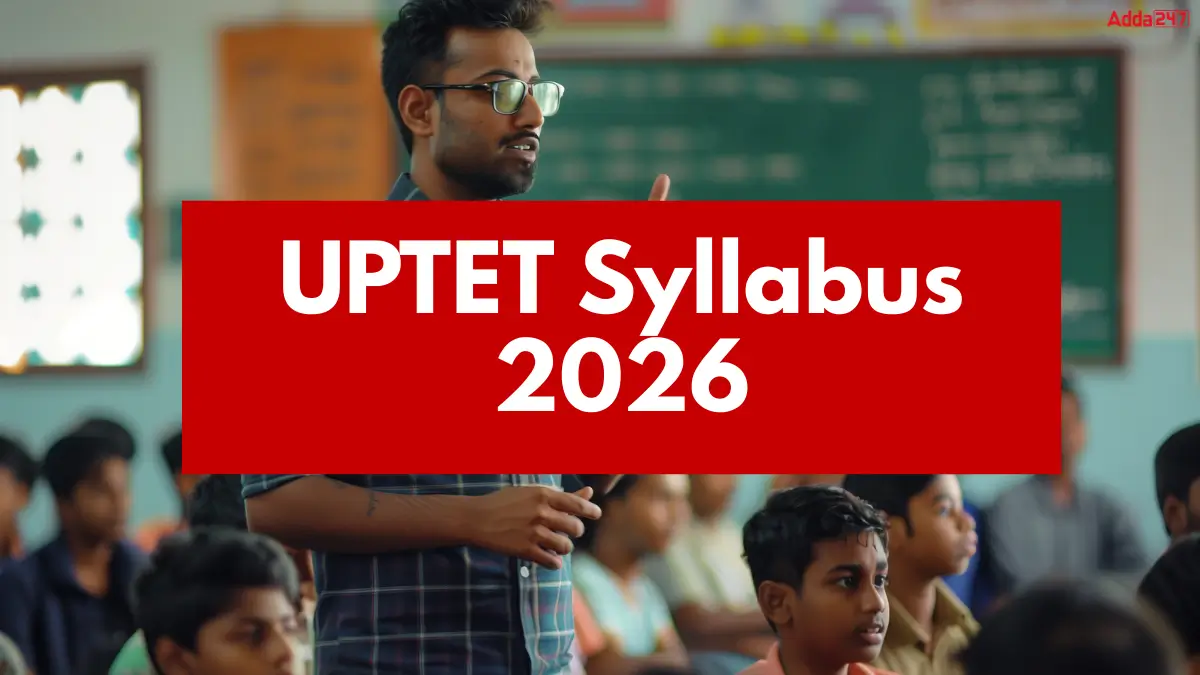
The Uttar Pradesh Teacher Eligibility Test (UPTET) 2026 is an important qualifying exam for candidates who want to teach in government and private schools across the state. To prepare effectively, aspirants should have a clear understanding of the latest UPTET Syllabus 2026 and exam pattern.
The Uttar Pradesh Education Service Selection Commission has released the official UP TET Syllabus 2026 along with the notification on its website. Candidates can check and download the syllabus PDF to stay updated with the exam requirements. Knowing the syllabus early helps in planning preparation in a structured way. It allows candidates to focus on important topics, skip irrelevant areas, and build a strategy that improves their chances of qualifying for the UPTET 2026 exam.
UPTET Exam Pattern 2026
The UPTET Exam 2026 is conducted in two papers based on the teaching level chosen by candidates. Paper 1 is for those aiming to teach Classes I to V, while Paper 2 is for candidates targeting Classes VI to VIII. Each paper includes 150 multiple-choice questions for a total of 150 marks. Candidates are given 2 hours and 30 minutes to complete the exam. Every correct answer carries 1 mark, and there is no negative marking, so candidates can attempt all questions without hesitation.
The exam is conducted by the Uttar Pradesh Education Service Selection Commission and follows the NCERT curriculum. It tests not only subject knowledge but also teaching methodology and pedagogy, which are essential for effective classroom teaching.
UPTET Paper 1 Exam Pattern (Classes 1-5)
UPTET Paper 1 is for candidates aiming to teach at the primary level.
| Section | Questions | Marks |
|---|---|---|
| Child Development & Pedagogy | 30 | 30 |
| Language 1 (Hindi) | 30 | 30 |
| Language 2 (English/Urdu/Sanskrit) | 30 | 30 |
| Mathematics | 30 | 30 |
| Environmental Studies | 30 | 30 |
| Total | 150 | 150 |
UPTET Paper 2 Exam Pattern (Classes 6-8)
UPTET Paper 2 is meant for upper primary teaching aspirants.
| Section | Questions | Marks |
|---|---|---|
| Child Development & Pedagogy | 30 | 30 |
| Language 1 (Hindi) | 30 | 30 |
| Language 2 (English/Urdu/Sanskrit) | 30 | 30 |
| Mathematics & Science OR Social Studies | 60 | 60 |
| Total | 150 | 150 |
UPTET Syllabus 2026
The UPTET Syllabus 2026 is designed for candidates who want to become teachers at the primary level (Classes 1 to 5) and upper primary level (Classes 6 to 8) in Uttar Pradesh. It is mainly based on the NCERT curriculum and ensures that candidates are well-prepared for classroom teaching.
Released by the Uttar Pradesh Education Service Selection Commission, the syllabus focuses not just on subject knowledge but also on teaching skills and child psychology. This approach helps assess whether candidates can effectively understand students’ learning needs and handle real classroom situations with confidence.
UPTET Paper 1 Syllabus 2026 (Classes I-V)
The UPTET Paper 1 Syllabus 2026 is designed for candidates who want to teach at the primary level, Classes I to V, in Uttar Pradesh. It follows the NCERT curriculum from Classes 1 to 5 and focuses on both subject knowledge and teaching ability.
Released by the Uttar Pradesh Education Service Selection Commission, the syllabus goes beyond academics and evaluates a candidate’s understanding of child development, learning behaviour, and classroom pedagogy. These aspects are essential for effectively teaching young learners. Along with subject-specific topics, the syllabus also highlights teaching aptitude and basic psychological concepts related to early education. A clear understanding of these areas helps candidates build a strong foundation and approach the exam with a focused and structured preparation strategy.
| Subject / Section | Key Topics Covered |
|---|---|
| Child Development and Pedagogy | Child Development
Learning and Its Theories
Teaching and Teaching Methods
Inclusive Education (Guidance and Counselling)
Learning and Teaching
|
| Language 1 – Hindi | हिंदी (विषय-वस्तु)
भाषा विकास का अध्यापन
|
| Language 2 – English / Urdu / Sanskrit |
|
| Mathematics | Content
Pedagogical Issues
|
| Environmental Studies (EVS) (Science, History, Geography, Civics, and Environment) | Content
Pedagogical Issues
|
UPTET Paper 2 Syllabus 2026 (Classes VI-VIII)
The UPTET Paper 2 Syllabus 2026 is framed for candidates aiming to teach at the upper primary level, Classes VI to VIII. Compared to Paper 1, this syllabus is more conceptual, analytical, and application-oriented, testing a deeper understanding of subjects and pedagogy. It is strictly based on the NCERT curriculum for Classes 6 to 8 and focuses on subject clarity, teaching methodology, and the ability to apply concepts in real classroom situations. A strong grasp of this syllabus is essential for candidates preparing seriously for the UPTET Paper 2 exam.
| Subject / Section | Key Topics Covered |
|---|---|
| Child Development and Pedagogy | Child Development
Learning and Its Theories
Teaching and Teaching Methods
Inclusive Education (Guidance and Counselling)
Learning and Teaching
|
| Language 1 – Hindi |
|
| Language 2 – English / Urdu / Sanskrit |
|
| Mathematics (Optional) | Content
Pedagogical Issues
|
| Science (Optional) | Content
Pedagogical Issues
|
| Social Studies (Optional) | History
Civics
Geography
Environmental Studies
Home Science
Physical Education and Sports
Music
Agriculture and Horticulture
Pedagogical Issues (Social Studies)
|
UPTET 2026 Syllabus PDF Download Link
The Uttar Pradesh Basic Education Board releases the official UPTET 2026 Syllabus PDF for both Paper 1 and Paper 2 in Hindi and English.
| UPTET syllabus PDF | |
| UPTET Paper 1 Syllabus PDF Download | Click Here |
| UPTET Paper 2 Syllabus PDF Download | Click Here |
Difficulty Level of UPTET 2026 vs. Previous Years
UPTET 2026 is not just another exam; it’s expected to be one of the toughest in recent years. After a gap of four years, the exam pattern and difficulty have changed. Here’s what to expect:
- More Competition: This time, four batches of B.Ed. and D.El.Ed. students (2022-2026) are appearing together. With so many candidates, the questions are likely to be harder than before.
- Concept-Based Questions
Earlier, questions were mostly factual, like: “In which year was the mid-day meal started?”
Now, questions will focus on application and understanding, for example: “As a teacher, how would you implement NIPUN Bharat in a multi-lingual classroom?”
- Subject-Wise Difficulty
| Aspect | Previous Years | UPTET 2026 (Expected) |
|---|---|---|
| Competition | One batch of candidates per year | Four batches (2022-2026) are competing together, increasing competition |
| Question Style | Mostly factual and direct | More application-based, scenario, and pedagogy-focused questions aligned with NEP 2020 |
| Child Development & Pedagogy (CDP) | Moderate; basic understanding of Piaget, Vygotsky, Kohlberg | Moderate to difficult; in-depth conceptual questions and classroom application |
| Mathematics & Science | Class 10 level for Paper 2 | Moderate to high; concepts up to Class 12 level may be tested, with a problem-solving focus |
| Environmental Studies (EVS) | General knowledge about the environment and basic local issues | Moderate to difficult; focus on climate change, sustainability, and UP-specific policies |
| Language 1 & 2 | Grammar, comprehension, and language pedagogy | Slightly higher difficulty; comprehension passages, usage, and teaching methodology-based questions |
| Overall Exam Trend | Knowledge-based with low emphasis on reasoning | Conceptual, analytical, and practical pedagogy-based questions are expected |
UPTET vs. CTET Syllabus: Key Differences You Need to Know
Many candidates make the mistake of thinking CTET and UPTET are identical. While the subjects are the same, the approach required to clear them is fundamentally different. Factual Knowledge vs. Pedagogical Logic The primary difference lies in the “Nature of Questions.” CTET focuses heavily on Pedagogy (50% of the paper), whereas UPTET is notorious for its focus on Factual Knowledge and State-Board specifics.
| Feature | UPTET 2026 | CTET 2026 |
| Question Type | Fact-Oriented: Focus on names, dates, definitions, and specific grammar rules. | Concept-Oriented: Focus on classroom scenarios and child psychology applications. |
| Syllabus Source | SCERT UP: Questions often come directly from UP State Board textbooks. | NCERT: Strictly follows the national NCERT curriculum. |
| Pedagogy Weight | Lower (approx. 20-30% of the subject). | High (exactly 50% of the marks in most sections). |
| Language Section | Deep focus on Sanskrit/Hindi Literature and the poets of Uttar Pradesh. | Focus on comprehension and language acquisition skills. |
| Maths/Science | Calculation-intensive and formula-based. | Concept-based with focus on “how to teach” math. |


 MAHA TET Syllabus 2026, Download Subject...
 HP SET Syllabus 2026 and New Exam Patter...
 Jharkhand JET Syllabus 2026, Download Su...