Table of Contents
The Central Board of Secondary Education (CBSE) has successfully conducted the 21st edition of the Central Teacher Eligibility Test (CTET) 2026 on 7 and 8 February 2026. More than 25 lakh candidates appeared for the exam across multiple centres nationwide, making it one of the largest teaching eligibility tests in India.
In this article, we’ve shared direct links to the unofficial CTET question papers and answer keys, along with a clear guide on how candidates can download the official PDFs once Central Board of Secondary Education releases them. This will help you analyse your performance, predict your qualification chances, and plan the next steps with clarity.
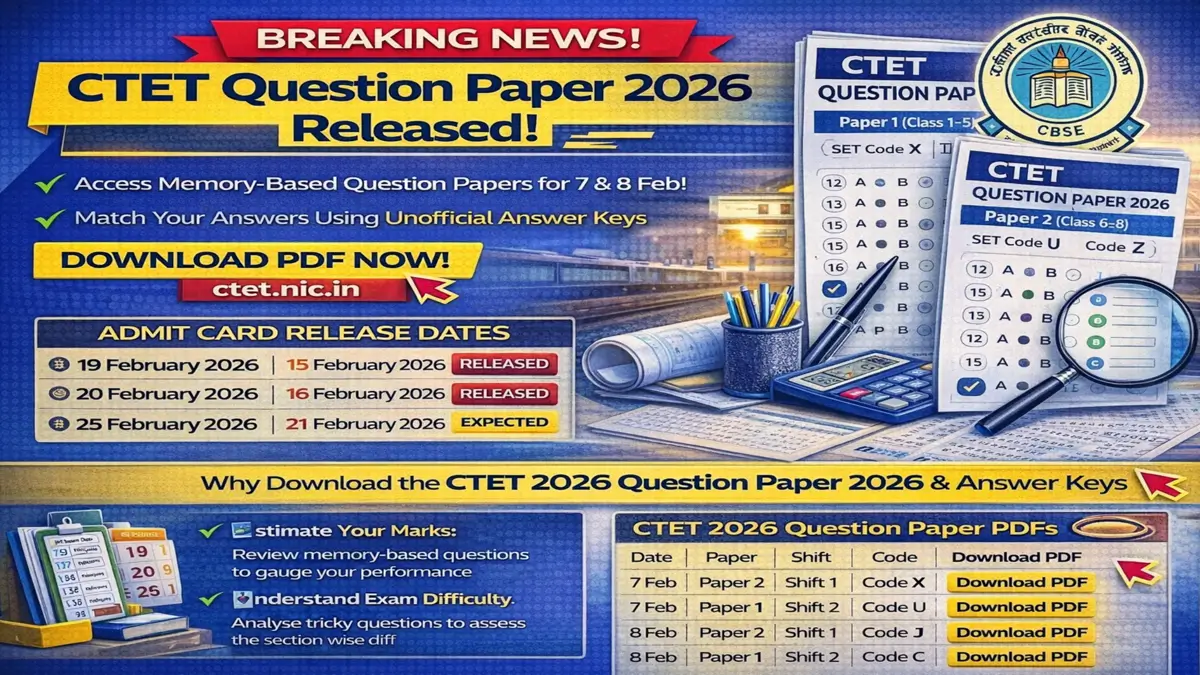
CTET Question Paper 2026
The official CTET 2026 Question Paper for all sets of Paper 1 and Paper 2 is expected to be released by Central Board of Secondary Education towards the end of February 2026. Once released, these papers will be available on the official CTET portal for candidates who appeared in the offline OMR-based examination.
Until then, candidates can refer to the unofficial CTET question paper PDFs released by Adda247 to revisit the exact questions asked in the exam. These memory-based papers are useful for analysing section-wise difficulty, checking attempted answers, and participating in post-exam discussions with peers and experts.
CTET 2026 Question Paper Highlights
The exam was conducted in an offline (Pen-and-Paper) mode. The following table provides a quick summary of the examination and the availability of the question papers:
| CTET Question Paper 2026 | |
| Exam Name | Central Teacher Eligibility Test (CTET) 2026 |
| Conducting Body | Central Board of Secondary Education (CBSE) |
| Exam Date | 7 and 8 February 2026 |
| Mode of Exam | Offline (Pen and Paper) |
| Paper Levels | Paper 1 (Class 1–5) and Paper 2 (Class 6–8) |
| Official Website | ctet.nic.in |
Download CTET Question Paper 2026 PDFs (Unofficial)
Adda247 has released the CTET Question Paper 2026 after the exam to help candidates review and analyse their performance. The question papers are available shift-wise and separately for Paper I and Paper II, giving aspirants a clear idea of the exam pattern, difficulty level, and the topics that carry more weight. Candidates can check the table below to find paper-wise details and direct download links for the CTET 2026 question papers.
| Date | Paper | Shift | Code | Download Link |
| 7 Feb | Paper 2 | Shift 1 | Code X | Download PDF |
| 7 Feb | Paper 2 | Shift 1 | Code Y | Download PDF |
| 7 Feb | Paper 2 | Shift 1 | Code Z | Download PDF |
| 7 Feb | Paper 1 | Shift 2 | Code U | Download PDF |
| 7 Feb | Paper 1 | Shift 2 | Code V | Download PDF |
| 8 Feb | Paper 2 | Shift 1 | Code H | Download PDF |
| 8 Feb | Paper 2 | Shift 1 | Code J | Download PDF |
| 8 Feb | Paper 1 | Shift 2 | Code C | Download PDF |
| CTET Answer Key 2026 | ||||
How to Download CTET Question Paper 2026?
If you prefer to download the papers directly from the official portal, follow these point-to-point instructions:
- Visit the official CTET website at ctet.nic.in.
- Navigate to the “Archive” or “Important Links” section on the homepage.
- Look for the link titled “CTET February 2026 Question Paper.”
- Select your respective Paper (Paper 1 or Paper 2) and the specific Set Code.
- The PDF will open in a new tab; click the download icon to save it for future reference.
Why does Accessing CTET Question Papers Matter?
Accessing the question paper right after the exam is an important step for serious aspirants. At this stage, the questions and the logic used to solve them are still fresh in mind, making self-evaluation more accurate. Since official results and scanned OMR sheets are released later, the question paper, whether in physical or PDF form, becomes the only reliable reference for checking performance.
Benefits of Analyzing the CTET Question Paper
Analyzing the 2026 paper provides several advantages, even for those who have already appeared.
- Accuracy in Self-Scoring: By matching the question paper with expert-verified solutions, you can estimate your marks and determine if you meet the qualifying criteria (60% for General and 55% for reserved categories).
- Identifying Difficult Areas: Reviewing the paper helps you identify which sections, such as Child Development & Pedagogy or Mathematics, were more time-consuming or complex.
- Future Reference: For those who may need to appear again or help others, the 2026 paper acts as the most recent primary source for understanding current difficulty levels and topic weightage.



 Haryana Teachers Must Pass Mandatory Exa...
 Gujarat TAT HS Question Paper 2026 OUT, ...
 UP Education Commission’s Recruitment ...