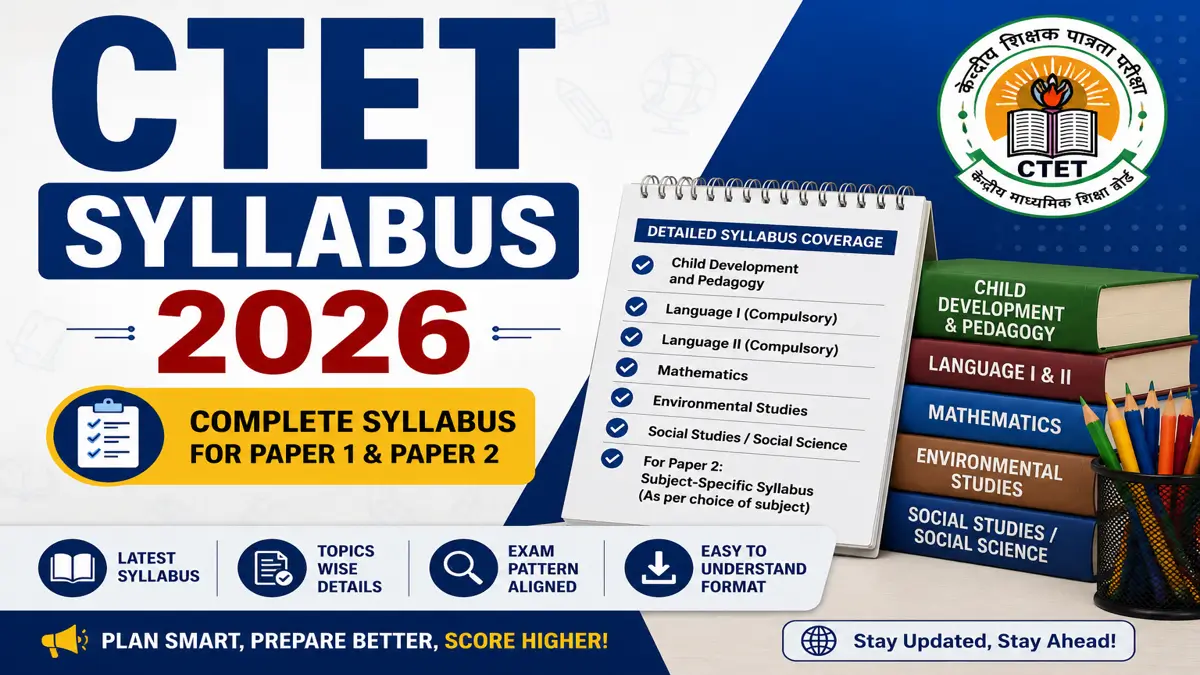
The main key to effective CTET exam preparation is understanding the exam pattern and syllabus. The CTET Syllabus 2026 outlines the topics candidates need to study. The syllabus for the CBSE CTET exam differs between Paper 1 and Paper 2. Paper 1 is for teachers of Classes 1 to 5, while Paper 2 is for teachers of Classes 6 to 8. The CTET Paper 1 syllabus consists of five sections: Child Development and Pedagogy, Language I, Language II, Mathematics, and Environmental Studies. On the other hand, the CTET Paper 2 syllabus has four sections: Child Development and Pedagogy, Language I, Language II, and either Mathematics and Science or Social Studies/Social Sciences.
CTET Exam Pattern 2026
CTET Paper I and Paper II both feature 150 multiple-choice questions (MCQs). Each correct answer is awarded 1 mark, with no negative marking for incorrect answers. The exam is administered offline in a pen-and-paper format. Paper I consists of 5 sections, while Paper II includes 4 sections. Before starting the CTET paper preparation, you must check the CTET Paper 1 and 2 Exam Pattern and the New Syllabus.
- CTET Exam will be conducted in 2 Parts: CTET Paper 1 & CTET Paper 2.
- Paper I is for candidates aspiring to teach students in Classes I to IV. On the other hand, Paper II is for candidates looking to teach students in Classes VI to VIII.
- Each subject comprises 30 questions, each carrying one mark, making a total of 30 marks per subject. A total of 150 Questions will be asked in each paper. Each question carries one mark
- There is no negative marking in the CTET Exam 2026.
- The CTET exam 2026 will take place in online mode as a computer-based test.
- Candidates can select any two languages from the available options to take the Language I and Language II exams.
- Paper 1 has five sections: Child Development and Pedagogy, Language 1, Language 2, Mathematics, and Environmental Science.
- Paper 2 has four sections: Child Development and Pedagogy, Language 1, Language 2, and either Mathematics/Science or Social Studies.
CTET Syllabus 2026
The Central Board of Secondary Education (CBSE) has given the detailed syllabus for the CTET 2026 exam, covering both Paper 1 for the Primary Stage (teaching classes I to V) and Paper 2 for the Elementary Stage (teaching classes VI to VIII). As a national-level eligibility test, CTET 2026 is vital for candidates aiming to teach in CBSE-affiliated schools and other government-recognized institutions.
Exam Name | CTET 2026 Exam |
|---|
Conducting Body | CBSE |
Category | Syllabus |
CTET Exam Date 2026 | 8th February 2026 |
Admit Card Status | NOT Released |
CTET Exam Mode | Offline- Pen Paper Mode (OMR) |
Type Of Questions | Multiple-Choice Questions (MCQs); 4 options with only 1 correct option |
Total Marks | 150 |
Maximum Marks | +1 for a correct answer, 0 for an incorrect answer |
CTET Official Website | https://ctet.nic.in/ |
CTET Paper 1 Syllabus 2026
For effective preparation, candidates should understand the topic-wise weightage of the CTET exam. The CTET 2026 exam comprises several key sections. Child Development and Pedagogy (40 questions) focuses on child development concepts, inclusive education, and teaching strategies. Language 1 and Language 2 sections each include 30 questions, equally split between comprehension and pedagogy, to test language skills and teaching methods.
The Mathematics and Environmental Studies sections also have 30 questions each, covering topics like numbers, geometry, food, water, and environmental concepts, as well as pedagogical issues. Each section assesses both content knowledge and teaching aptitude. For reference, a downloadable CTET Syllabus Paper 1 PDF is available for quick access to detailed exam content.
Child Development and Pedagogy Syllabus | Development of a Primary School Child | 15 |
Concept of Inclusive Education and understanding children with special needs | 5 |
Learning and Pedagogy | 10 |
Language 1 and Language 2 (30 Questions each) | Language Comprehension | 15 |
Pedagogy of Language Development | 15 |
Mathematics | Content (numbers, solving simple equations, algebra, geometry patterns, time, measurement, data handling, solids, data handling, etc.) | 15 |
Environmental Studies | Content (environment, food, shelter, water, family, friends, etc.) | 15 |
|
|
|
CDP Paper 1 Syllabus
Child Development and Pedagogy is one of the most important sections in the CTET exam, consisting of 30 questions, with each correct answer awarding 1 mark. This section emphasizes the educational psychology of teaching and learning, particularly for children aged 6 to 11 years.
a) Child Development (Primary School Child) - 15 Questions
- Concept of development and its relationship with learning
- Principles of the Development of Children
- Influence of Heredity & Environment
- Socialization processes: Social world & children (Teacher, Parents, Peers)
- Piaget, Kohlberg, and Vygotsky: constructs and critical perspectives
- Concepts of child-centred and progressive education
- Critical Perspective of the Construct of Intelligence
- Multi-Dimensional Intelligence
- Language & Thought
- Gender as a social construct: gender roles, gender bias, and educational practice
- Individual differences among learners, understanding differences based on diversity of language, caste, gender, community, religion, etc.
- The distinction between Assessment for learning and Assessment of learning.
- School-Based Assessment, Continuous & Comprehensive Evaluation: Perspective and Practice
- Formulating appropriate questions for assessing the readiness levels of learners, enhancing learning and critical thinking in the classroom, and assessing learner achievement.
b) Concept of Inclusive education and understanding children with special needs - 5 Questions
- Addressing learners from diverse backgrounds, including disadvantaged and deprived
- Addressing the needs of children with learning difficulties, ‘impairment’, etc.
- Addressing the Talented, Creative, and Specially Abled Learners
c) Learning and Pedagogy - 10 Questions
- How children think and learn; how and why children ‘fail’ to achieve success in school performance.
- Basic processes of teaching and learning; children’s strategies of learning; learning as a social activity; social context of learning.
- Child as a problem solver and a ‘scientific investigator.’
- Alternative conceptions of learning in children, understanding children’s errors as significant steps in the learning process.
- Cognition & Emotions.
- Motivation and learning.
- Factors contributing to learning – personal & environmental.
CTET Language 1 Syllabus (Paper 1)
Language 1 will focus on proficiencies related to the medium of instruction. This section is also scoring, but it demands proper preparation. It consists of 30 questions, and each question carries 1 mark.
a) Language Comprehension - 15 Questions
Reading unseen passages – two passages, one prose or drama and one poem, with questions on comprehension, inference, grammar, and verbal ability (Prose passage may be literary, scientific, narrative, or discursive)
b) Pedagogy of Language Development - 15 Questions
- Learning and acquisition
- Principles of Language Teaching
- Role of listening and speaking, the function of language, and how children use it as a tool
- A critical perspective on the role of grammar in learning a language for communicating ideas verbally and in written form
- Challenges of teaching language in a diverse classroom: language difficulties, errors, and disorders
- Language Skills
- Evaluating language comprehension and proficiency: speaking, listening, reading, and writing
- Teaching-learning materials: Textbook, multimedia materials, multilingual resources of the classroom
- Remedial Teaching
CTET Language 2 Syllabus (Paper 1)
Language 2 is also based on basic concepts, such as Language 1. Language 2 will focus on the elements of language and comprehension abilities. It consists of 30 questions & each question carries 1 mark.
a) Comprehension - 15 Questions
Two unseen prose passages (discursive or literary narrative, or scientific) with questions on comprehension, grammar, and verbal ability.
b) Pedagogy of Language Development - 15 Questions
- Learning and acquisition
- Principles of Language Teaching
- Role of listening and speaking, the function of language, and how children use it as a tool
- A critical perspective on the role of grammar in learning a language for communicating ideas verbally and in written form.
- Challenges of teaching language in a diverse classroom: language difficulties, errors, and disorders.
- Language Skills.
- Evaluating language comprehension and proficiency: speaking, listening, reading, and writing.
- Teaching-learning materials: Textbook, multimedia materials, and multilingual resources of the classroom.
- Remedial Teaching.
CTET Mathematics Syllabus For Paper 1
The mathematics syllabus is lengthy, but the level of questions asked in the exam is moderate. Most questions are asked from basic arithmetic from the 1st to the 5th standard. It consists of 30 questions. Each correct response carries 1 mark.
a) Content - 15 Questions
- Geometry
- Shapes & Spatial Understanding
- Solids around Us
- Numbers
- Addition and Subtraction
- Multiplication
- Division
- Measurement
- Weight
- Time
- Volume
- Data Handling
- Patterns
- Money
b) Pedagogical issues - 15 Questions
- Nature of Mathematics/ Logical thinking; understanding children’s thinking and reasoning patterns and strategies for making meaning and learning
- Place of Mathematics in the Curriculum
- Language of Mathematics
- Community Mathematics
- Evaluation through formal and informal methods
- Problems of Teaching
- Error analysis and related aspects of learning and teaching
- Diagnostic and Remedial Teaching
EVS Paper 1 Syllabus
The environmental studies is a very scoring section. This section consists of 30 questions. Each correct response carries 1 mark. The EVE topic is very significant for the aspirants and the number scoring. To score good numbers and marks in the CTET exam, you must study the EVS Notes or study materials from Adda247.
a) Content - 15 Questions
- Family and Friends: Relationships, Work and Play, Animals, Plants
- Food
- Shelter
- Water
- Travel
- Things We Make and Do
b) Pedagogical Issues - 15 Questions
- Concept and scope of EVS
- Significance of EVS-integrated EVS
- Environmental Studies & Environmental Education
- Learning Principles
- Scope & Relation to Science & Social Science
- Approaches to presenting concepts
- Activities
- Experimentation/Practical Work
- Discussion
- CCE
- Teaching material/Aid
- Problems
CTET Paper 2 Syllabus 2026
In the table below, we have given the detailed CTET Syllabus for Paper 2. If you want to download the CTET Syllabus Paper 2 PDF, Download it. To become an Upper Level Teacher, you must have good knowledge of the CTET Paper 2 Syllabus 2026.
Subject | Important Topics | Questions | Marks |
|---|
Child Development and Pedagogy | - Child Development (Elementary School Child) - Inclusive education and understanding of children with special needs - Learning and Pedagogy - Theories | 30 | 30 |
Language-I | - Reading Comprehension - Poem - Pedagogy of Language Development | 30 | 30 |
Language-II | - Reading Comprehension - Pedagogy of Language Development | 30 | 30 |
Mathematics | - Number system, Algebra, Geometry, Mensuration - Pedagogical issues | 30 | 30 |
Science | - Food, Material, The World of the Living, Moving Things, People and Ideas, How things work, Natural Phenomena, Natural Resources - Science Pedagogical Issues | 30 | 30 |
Social Studies | - History, Geography, Social and Political Life - Social Studies Pedagogical Issues | 60 | 60 |
I. Child Development and Pedagogy Syllabus For Paper 2
Child development and pedagogy are some of the most crucial subjects for the CTET exam. This is a very conceptual & theoretical subject. It analyzes the candidate’s conceptual understanding. The students can score well in this section if they study each topic extensively. This section consists of 30 questions. Each correct response carries 1 mark.
a) Child Development (Elementary School Child)-15 Questions
- Concept of development and its relationship with learning
- Principles of the Development of Children
- Influence on Heredity & Environment
- Socialization processes: Social world & children (Teacher, Parents, Peers)
- Piaget, Kohlberg, and Vygotsky: constructs and critical perspectives
- Concepts of child-centred and progressive education
- Critical Perspective of the Construct of Intelligence
- Multi-Dimensional Intelligence
- Language & Thought
- Gender as a social construct: gender roles, gender bias, and educational practice
- Individual differences among learners, understanding differences based on diversity of language, caste, gender, community, religion, etc.
- The distinction between Assessment for learning and Assessment of learning; School-Based Assessment, Continuous and Comprehensive Evaluation: perspective and Practice
- Formulating appropriate questions for assessing readiness levels of learners, for enhancing learning and critical thinking in the classroom, and for assessing learner achievement.
b) Concept of Inclusive education and understanding children with special needs: Questions
- Addressing learners from diverse backgrounds, including disadvantaged and deprived
- Addressing the needs of children with learning difficulties, ‘impairment’, etc.
- Addressing the Talented, Creative, and Specially Abled Learners
c) Learning and Pedagogy-10 Questions
- How children think and learn; how and why children ‘fail’ to achieve success in school performance.
- Basic processes of teaching and learning; children’s strategies of learning; learning as a social activity; social context of learning.
- Child as a problem solver and a ‘scientific investigator.’
- Alternative conceptions of learning in children, understanding children’s errors as significant steps in the learning process.
- Cognition & Emotions
- Motivation and learning
- Factors contributing to learning – personal & environmental
II. Language I Syllabus For Paper 2
Language 1 in the CTET exam evaluates a candidate's proficiency in the medium of instruction they plan to use as a teacher. Although this section is seen as scoring potential, it necessitates comprehensive preparation and a strong command of the chosen language.
a) Language Comprehension-15 Questions
Reading unseen passages – two passages, one prose or drama and one poem, with questions on comprehension, inference, grammar, and verbal ability (Prose passage may be literary, scientific, narrative, or discursive)
b) Pedagogy of Language Development-15 Questions
- Learning and acquisition
- Principles of Language Teaching
- Role of listening and speaking, the function of language, and how children use it as a tool
- A critical perspective on the role of grammar in learning a language for communicating ideas verbally and in written form.
- Challenges of teaching language in a diverse classroom: language difficulties, errors, and disorders
- Language Skills
- Evaluating language comprehension and proficiency: speaking, listening, reading, and writing
- Teaching-learning materials: Textbook, multimedia materials, multilingual resources of the classroom
- Remedial Teaching
- IT as a Tool (New Topic)
3. Language II Syllabus- 30 Questions
Language 2, like Language 1, focuses on key concepts vital for effective communication. This section specifically addresses aspects of language such as grammar, vocabulary, and comprehension skills.
a) Comprehension-15 Questions
Two unseen prose passages (discursive or literary narrative or scientific) with questions on comprehension, grammar, and verbal ability.
b) Pedagogy of Language Development -15 Questions
- Learning and acquisition
- Principles of Language Teaching
- Role of listening and speaking, the function of language, and how children use it as a tool
- A critical perspective on the role of grammar in learning a language for communicating ideas verbally and in written form.
- Challenges of teaching language in a diverse classroom: language difficulties, errors, and disorders
- Language Skills
- Evaluating language comprehension and proficiency: speaking, listening, reading, and writing
- Teaching-learning materials: Textbook, multimedia materials, multilingual resources of the classroom
- Remedial Teaching
IV. (A) Mathematics and Science Syllabus For Paper 2
(i) Mathematics-30 Questions
The mathematics syllabus is lengthy and tough, but the level of questions asked in the exam is easy to moderate. Most questions were asked from the NCERT Class 6th to 8th.
a) Content-20 Questions
(i) Number System
- Knowing our Numbers
- Playing with Numbers
- Whole Numbers
- Negative Numbers and Integers
- Fractions
(ii) Algebra
- Introduction to Algebra
- Ratio and Proportion
(iii) Geometry
- Basic geometrical ideas (2-D)
- Understanding Elementary Shapes (2-D and 3-D)
- Symmetry: (reflection)
- Construction (using Straight edge, Scale, protractor, compasses)
- Mensuration
- Data handling
b) Pedagogical issues- 10 Questions
- Nature of Mathematics/Logical Thinking
- Place of Mathematics in the Curriculum
- Language of Mathematics
- Community Mathematics
- Evaluation
- Remedial Teaching
- Problem of Teaching
V. Social Studies/Social Sciences Syllabus For Paper 2
The science syllabus is lengthy and tough, but the level of questions asked in the exam is moderate. Questions are related to the basic understanding of the concepts. It consists of 30 questions from Chemistry, Physics, and Biology. Questions will be based on the topics prescribed in the syllabus i.e. NCERT Class 6th to 8th, but the difficulty standard could be up to the senior secondary stage.
a) Content-20 Questions
I. Food
- Sources of food
- Components of food
- Cleaning food
II. Materials
III. The World of the Living
IV. Moving Things, People and Ideas
V. How things work
- Electric current and circuits
- Magnets
VI. Natural Phenomena
VII. Natural Resources
b) Pedagogical issues- 10 Questions
- Nature & Structure of Sciences
- Natural Science/Aims & Objectives
- Understanding & Appreciating Science
- Approaches/Integrated Approach
- Observation/Experiment/Discovery (Method of Science)
- Innovation
- Text Material/Aids
- Evaluation – cognitive/psychomotor/affective
- Problems
- Remedial Teaching
CTET Social Sciences Syllabus (Paper 2)
This subject covers a broad range of topics, including History, Geography, Polity, Economics, and Pedagogy, making it a comprehensive and lengthy area of study that requires thorough preparation. The questions will be based on the NCERT syllabus for classes 6 to 8, but the difficulty level may extend to the senior secondary stage. The section will consist of 30 questions, so it is essential to be well-prepared across all the prescribed topics.
a) Content-40 questions.
History
- When, Where, and How
- The Earliest Societies
- The First Farmers and Herders
- The First Cities
- Early States
- New Ideas
- The First Empire
- Contacts with Distant Lands
- Political Developments
- Culture and Science
- New Kings and Kingdoms
- Sultans of Delhi
- Architecture
- Creation of an Empire
- Social Change
- Regional Cultures
- The Establishment of Company Power
- Rural Life and Society
- Colonialism and Tribal Societies
- The Revolt of 1857-58
- Women and Reform
- Challenging the Caste System
- The Nationalist Movement
- India After Independence
II. Geography
- Geography as a social study and as a science
- Planet: Earth in the solar system
- Globe
- The environment in its totality: natural and human environment
- Air
- Water
- Human Environment: settlement, transport, and communication
- Resources: Types- Natural and Human
- Agriculture
III. Social and Political Life
- Diversity
- Government
- Local Government
- Making a Living
- Democracy
- State Government
- Understanding Media
- Unpacking Gender
- The Constitution
- Parliamentary Government
- The Judiciary
- Social Justice and the Marginalised
b) Pedagogical issues- 20 Questions
- Concept & Nature of Social Science/Social Studies
- Class Room Processes, activities, and Discourse
- Developing Critical Thinking
- Inquiry/Empirical Evidence
- Problems of Teaching Social Science/Social Studies
- Sources – Primary & Secondary
- Projects Work
- Evaluation
CTET Syllabus PDF Download
The CTET syllabus for Papers 1 and 2 has been detailed in an article released by CBSE. You can now access the updated CTET syllabus PDF, which covers all topics and the exam pattern. The syllabus has been revised to align with the latest CET exam structure. To help the aspirants, we have provided the CTET Syllabus PDF download link below.
CTET Official Syllabus PDF |
| |