Table of Contents
The University Grants Commission (UGC) Bill 2026, officially known as the Promotion of Equity in Higher Education Institutions Regulations, 2026, has become the centre of a nationwide debate in India. Notified on January 13, 2026, these rules aim to completely maintain how colleges and universities handle discrimination. If you are a student, teacher, or parent, understanding these changes is important. Here is a breakdown of the new rules, the benefits, and why they are causing such a Controversy.
🚀 LATEST UPDATE (January 29, 2026): The Supreme Court has stayed the implementation of the UGC 2026 Rules on 29 January 2026, citing the need for further examination. The Court observed that some provisions, especially the definition of caste-based discrimination, are unclear and may be misused. Notices have been issued to the Central Government and the UGC, and the matter is under review. Until a final decision is taken, the UGC Regulations, 2012 will continue to apply in all higher education institutions.
Latest Updates
- The UGC 2026 Rules are on hold, so students will follow the 2012 UGC regulations for now.
- No new equity committees or helplines will be compulsory until the Court gives a final order.
- The stay ensures that unclear or confusing rules are not forced on students and institutions.
- The Court wants policies to be fair, clear, and inclusive for all students.
- Existing complaint and grievance systems will continue without change.
- Student protests and concerns have been officially acknowledged by the Court.
- Any future rules may be revised and improved after proper review.
- Students can continue their studies without uncertainty or sudden policy changes.
Supreme Court Stay on UGC Bill 2026: Latest Updates
The Supreme Court’s decision to stay the UGC Bill 2026, formally titled the University Grants Commission (Promotion of Equity in Higher Education Institutions) Regulations, 2026, has triggered widespread debate across academic and policy circles. On 29 January 2026, the apex court put the new UGC rules on hold, calling for a detailed re-examination of their provisions. The interim order has been viewed as a setback for the government, while offering temporary relief to protesting students, teachers’ bodies, and other stakeholders who had raised concerns over the scope, clarity, and potential misuse of the regulations. Until further directions, the Court has made it clear that the 2012 UGC regulations will continue to remain in force.
- The Supreme Court stayed the implementation of the UGC Bill 2026 on 29 January 2026, citing the need for judicial review of its provisions.
- A bench comprising Chief Justice Surya Kant and Justice Joymalya Bagchi issued notices to the Central Government and the UGC on petitions challenging the regulations.
- The Court observed that certain provisions, especially the definition of caste-based discrimination, appear vague and open to misuse, which could have serious social implications.
- Regulation 3(C) of the UGC Bill 2026 was flagged by the Court for lacking clarity, with the bench stating that the language requires modification.
- The apex court warned that unchecked implementation could lead to social division, stressing that India’s unity must be reflected in its educational institutions.
- For the time being, the UGC (Promotion of Equity in Higher Educational Institutions) Regulations, 2012 will continue to apply across universities and colleges.
- The new UGC rules, notified on 13 January 2026, had mandated the formation of equity committees and helplines in higher education institutions to address discrimination complaints.
- Multiple petitions argued that the 2026 regulations adopted a non-inclusionary approach, limiting institutional protection only to SC, ST, and OBC categories.
- Student groups and organisations across the country held protests, demanding a rollback or comprehensive revision of the UGC Bill 2026.
- The Supreme Court’s stay has temporarily paused the implementation of the new equity framework, while the matter remains under judicial consideration.
Why Did the Supreme Court Stay the UGC 2026 Rules?
The Supreme Court stayed the UGC 2026 Rules on 29 January 2026 after observing that certain provisions of the regulations were unclear, potentially misused, and could create division within educational institutions. While the rules were introduced to prevent caste-based discrimination and promote equity on campuses, the apex court felt that the framework required a thorough review before implementation. Until a final decision is taken, the Court has directed that the UGC Regulations, 2012 will continue to remain in force.
| Reason | Supreme Court Observation |
|---|---|
| Vague definition of caste-based discrimination | The Court noted that Regulation 3(C) lacks clarity and clear boundaries, making it open to misuse. |
| Risk of misuse | The bench observed that unclear language in sensitive regulations could be misinterpreted and applied arbitrarily. |
| Non-inclusionary framework | Petitions argued that the rules limit protection only to SC, ST, and OBC categories, excluding others who may face discrimination. |
| Threat of social division | The Court warned that unchecked implementation could divide society and disrupt campus harmony. |
| Need for detailed review | The Supreme Court stated that the matter requires re-examination before such rules are enforced nationwide. |
| Continuation of old rules | Until further orders, the Court directed that the 2012 UGC Regulations will continue to apply. |
What is the UGC Bill 2026?
The UGC Bill 2026 is a new set of rules that will replace the old rules from 2012. The main purpose of these new rules is to stop discrimination based on caste and to make sure all students, no matter where they come from, have a fair and safe experience at colleges and universities.
| Feature | Details |
| Official Name | Promotion of Equity in Higher Education Institutions Regulations, 2026 |
| Applicability | All Universities and Colleges in India |
| Main Target | Prevention of Caste, Gender, and Disability-based discrimination |
| Reporting | 24/7 Helpline and Online Portal mandatory |
Note: Many upper-caste leaders and bureaucrats in North India have resigned, calling the bill one-sided. A PIL has already been filed challenging Regulation 3(1)(c). By only protecting SC, ST, and OBC students, the law “discriminates against the general category” by not providing them with similar committee representation.
Ques: Who is the current head of UGC in 2026?
Ans: Professor M. Jagadesh Kumar
UGC New Rules and Major Changes
The UGC 2026 regulations are a big change from the older rules. Now, this time, they turn suggestions into actual laws. Here are the most important changes:
- Inclusion of OBCs and EWS: The new rules now protect Other Backward Classes (OBCs) and Economically Weaker Sections (EWS) along with SC/ST students, which wasn’t fully covered in the 2012 rules.
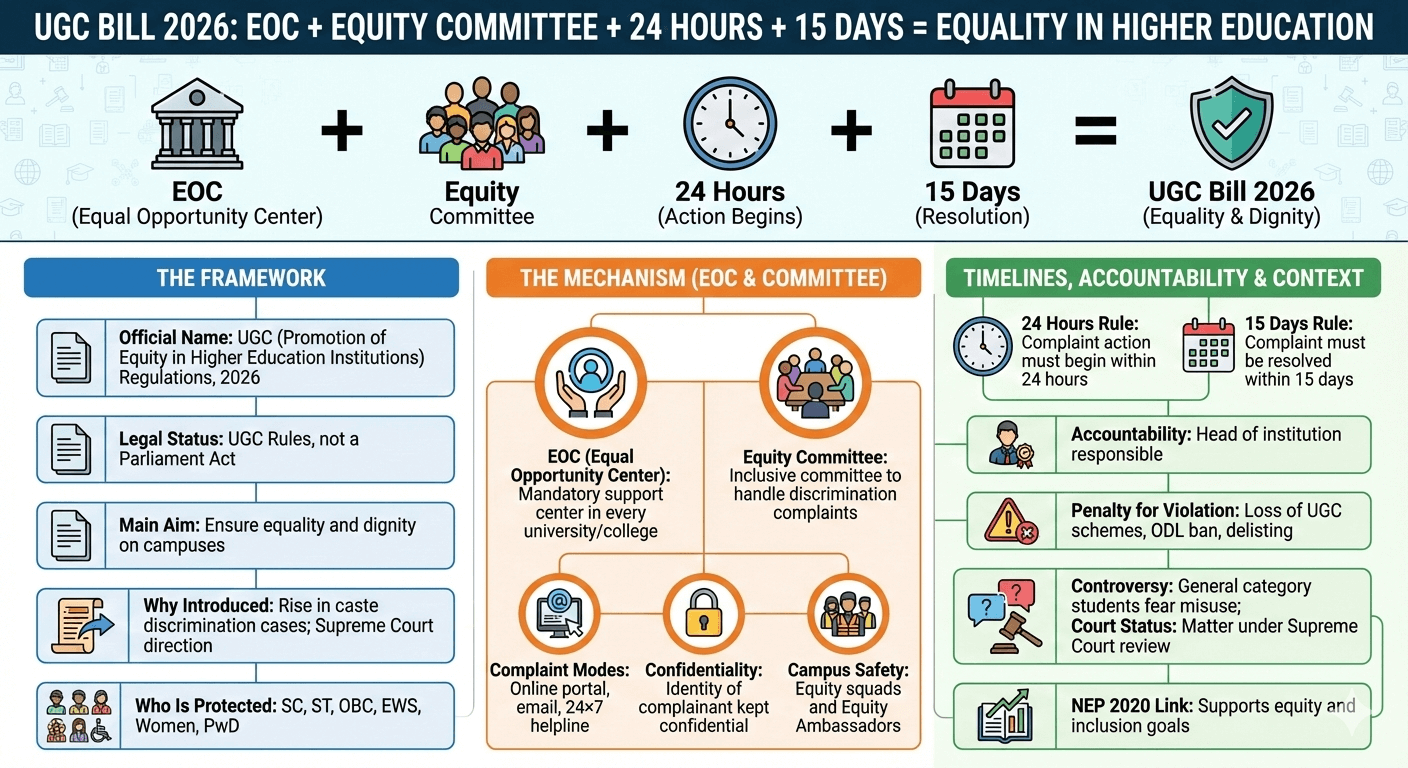
- Mandatory Equal Opportunity Centres (EOCs): Every college and university must set up an Equal Opportunity Centre. This centre will:
- Help students from disadvantaged backgrounds.
- Handle complaints about discrimination.
- Run programs to raise awareness among staff and students.
- Equity Committees and Squads: Those Colleges and universities must have an Equity Committee, led by the Head of the College. The committee must include people from different groups, like SC, ST, OBC, women, and people with disabilities, to make sure everyone is treated fairly.
- Strict Time Limits for Complaints: The new rules set clear deadlines so complaints are not delayed.
- Within 24 hrs: The committee must take action after a complaint is filed
- Within 15 working Days: A detailed investigation report must be completed
- Within 30 days: The student can appeal to an Ombudsperson if not satisfied
Why is it Controversial? (The “Vivad”)
This topic is trending because it raises a major legal issue, but it’s not just controversial; it’s also about whether a law unfairly treats certain groups differently.
- The “General Category” Exclusion: Critics argue that by limiting caste-based discrimination to specific castes (SC, ST, OBC), the law overlooks the fact that students from the General Category can also face discrimination, such as hostility, slurs, or exclusion. For example 2022 anti-Brahmin slogans at JNU. Petitioners claim that these experiences aren’t being recognised, and the law creates biased rules that only protect certain groups.
- Violation of Article 14: Advocate Vineet Jindal’s PIL: Jindal’s petition challenges Regulation 3(c) as unconstitutional, arguing that it violates Article 14 of the Indian Constitution, which guarantees equality before the law. His claim is that the law unfairly divides people into “victims” and “perpetrators” based on caste, which he argues creates a “hostile classification” and denies equal protection for everyone, regardless of their caste.
- Removal of the false complaint rule: An early draft included punishment for false or fake complaints, but this was removed in the final 2026 rules. Because of this, some people fear that the system could be misused to harass others legally.
- Misuse of the Law: Some critics are worried that the rule about “indirect discrimination” is too broad. They fear it could lead to false or unfair complaints being made against teachers or students. The concern is that there’s no punishment for people who do fake reports.
- Burden of Proof: Some legal experts believe the new rules place the “burden of proof” (the responsibility to show evidence) on the person accused of discrimination. They argue that this goes against the idea that someone is innocent until proven guilty.
- Presumption of Guilt: Some argue that this law brings back a colonial-era logic where certain groups are automatically seen as “victims” (SC, ST, OBC) and others (General Category) as “perpetrators” by default. This creates an unfair system and goes against modern ideas of equality and justice. They believe this violates egalitarian principles, treating some people as more likely to be guilty or innocent just because of their caste.
UGC Bill Regulations 2026 PDF
The UGC Bill 2026 introduces strict rules to stop discrimination and harassment in colleges and universities. It explains the punishments for faculty, staff, and students who break these rules, including suspension, expulsion, or even police action in serious cases. These new regulations ensure a safer and fair environment for everyone on campus. For those who want to read the full details, we provide the PDF download link below.
UGC Bill 2026 in Hindi PDF Download Link
Benefits of the New Rules
The 2026 rules were made because cases of discrimination on college campuses increased a lot. The Supreme Court also pushed for action after the tragic deaths of students like Rohith Vemula and Payal Tadvi.
- For students: These rules create a 24/7 support system. Colleges must have helplines and online complaint portals. Students do not have to wait for months for an internal investigation that may never happen.
- For institutions: Colleges and universities must change how they work. They can no longer say, “This doesn’t happen here.” They are now legally required to record and prove the steps they take to prevent discrimination.
- Human Dignity Clause: For the first time, acts like calling out a student’s caste or separating students in labs or hostels are clearly defined as violations of human dignity. This gives victims a stronger and clearer legal basis to seek justice.
UGC 2012 vs UGC 2026
| Point | UGC 2012 | UGC 2026 |
|---|---|---|
| Official name | Anti-Discrimination Regulations, 2012 | Promotion of Equity in Higher Education Institutions Regulations, 2026 |
| Main aim | Prevent discrimination in universities | Promote equity, inclusion, and fairness |
| Scope | Mainly focused on caste-based discrimination | Covers caste, religion, gender, disability, region, race, etc. |
| Nature | Mostly advisory (guidelines) | Mandatory and enforceable |
| Committees | The internal committee suggested | Equity Committee is compulsory in every institution |
| Equal Opportunity Centre | Recommended | Mandatory |
| Complaint system | Weak/unclear | A clear grievance redressal system, helpline required |
| UGC powers | Limited monitoring | UGC can monitor, investigate, and penalise |
| Penalty for non-compliance | Not clearly defined | Penalties possible (warnings, funding impact, etc.) |
| Student protection | General protection | Stronger protection and accountability |
| Why controversial | Less debate | Fear of misuse, bias, vague definitions |
MANAS-SETU: The National Monitoring Portal
As of January 15, 2026, all Higher Education Institutions (HEIs) must connect their internal complaint systems to the MANAS-SETU Portal.
- Real-time Tracking: The UGC can now track how long a complaint has been pending in real-time.
- Mandatory FIR Upload: If a complaint involves a potential crime, the portal automatically notifies the institution to upload the FIR within 24 hours.
Why Did UGC Introduce New Rules in 2026?
The UGC Rules 2026 were framed following direct instructions from the Supreme Court. In 2025, while hearing cases related to Rohith Vemula and Payal Tadvi, the apex court observed serious lapses in existing anti-discrimination mechanisms. The court directed UGC to replace the outdated 2012 regulations with stricter, time-bound rules within eight weeks. Both cases involved alleged caste-based harassment that led to tragic deaths, prompting nationwide concern over campus safety and accountability.
Supreme Court-Backed Report That Triggered the Change
UGC submitted detailed data to the Supreme Court and a Parliamentary Committee, revealing a sharp rise in caste-based discrimination complaints.
| Year | Number of Complaints |
|---|---|
| 2017–18 | 173 |
| 2023–24 | 378 |
| Increase | 118.4% |
- Pending cases rise from 18% to 108% in five years
- This data was submitted by the UGC to the Supreme Court
Definition of Discrimination Under UGC Act 2026
The UGC Act 2026 regulations clearly define discrimination for the first time in strong legal language. Discrimination includes:
- Direct or indirect caste-based harassment
- Derogatory remarks or actions
- Any conduct that undermines dignity, equality, or access to education
- Strict disciplinary action is mandated against individuals or institutions found guilty.
Significance of the UGC Bill 2026
The UGC Bill is seen as a big step toward social justice in higher education. It brings in a strict legal framework that institutions must follow. Some key benefits of the UGC Bill 2026 include:
- Strict penalties for institutions that fail to follow rules, including removal from UGC schemes
- Faster relief for students through fixed timelines for complaint resolution
- Mandatory structural changes, such as equal opportunity centres and equity committees
- National-level monitoring, where a UGC-appointed committee will regularly check obedience and investigate serious cases
Why These Laws Were Made (The People Behind Them)
The UGC 2026 rules were made stricter because of a case filed in the Supreme Court in 2019. The case was filed by the mothers of two students who had died. Because of these cases the rules changed from being only advice to compulsory laws.
- Rohith Vemula (2016): He was a PhD student at the University of Hyderabad. His death started a nationwide discussion about discrimination and the unfair treatment of Dalit students in universities.
- Dr. Payal Tadvi (2019): She was a postgraduate medical student in Mumbai. Her death was linked to repeated harassment and caste-based insults by her senior students.
- Darshan Solanki (2023): He was a student at IIT Bombay. After his death, the Supreme Court ordered an investigation into the campus environment at top technical institutes.
Note: According to some newspapers headlines 491 student suicides due to caste discrimination in collages and universities between 2019 to 2023.
Why is this data changing in 2026?
Under the new UGC 2026 Rules, a new transparency system has been launched:
- Mandatory FIRs: From January 15, 2026, the Supreme Court orders that all colleges and universities must immediately report any student suicide or unnatural death to the police.
- Equity Audit Data: Starting this year, the UGC will publish an Annual Equity Report. This report will try to show how the campus environment affects student dropouts and deaths.
- Support for Students: If you or someone you know is feeling distressed, you can get help through the Tele-MANAS helpline. It is linked to the new UGC equity system.
- National support number: 14416
- Campus-specific helplines are now required at all universities.
Penalties for Faculty, Staff, and Students for Discrimination in 2026
The ugc 2026 rules say that if an Equity Committee finds someone guilty of discrimination, the school or college must take strict action depending on how serious the offense is.
For Teachers & Staff:
- Service Record: The offense will be permanently noted in their work record. This can affect future promotions, salary increases, and pensions.
- Suspension or Firing: Serious cases (like physical exclusion, ongoing harassment, or caste-based insults) can lead to immediate suspension or being fired.
- Police Involvement: If the act is a crime (under the SC/ST Act or Indian Penal Code), the institution must file a police report (FIR) within 24 hours.
For Students:
- Expulsion or Rustication: If students are found guilty of bullying or ragging can be expelled or banned for some semesters.
- Holding Degree: The university can hold the student’s degree or marksheet until the case is resolved.
- Hostel Eviction: The student can be immediately removed from hostel or campus housing.



 CTET Question Paper 2026 Out, Download S...
 BPSC TRE 3.0 Question Papers 2024, Downl...
 PSTET 2026 Application Form Out, Get App...