Table of Contents
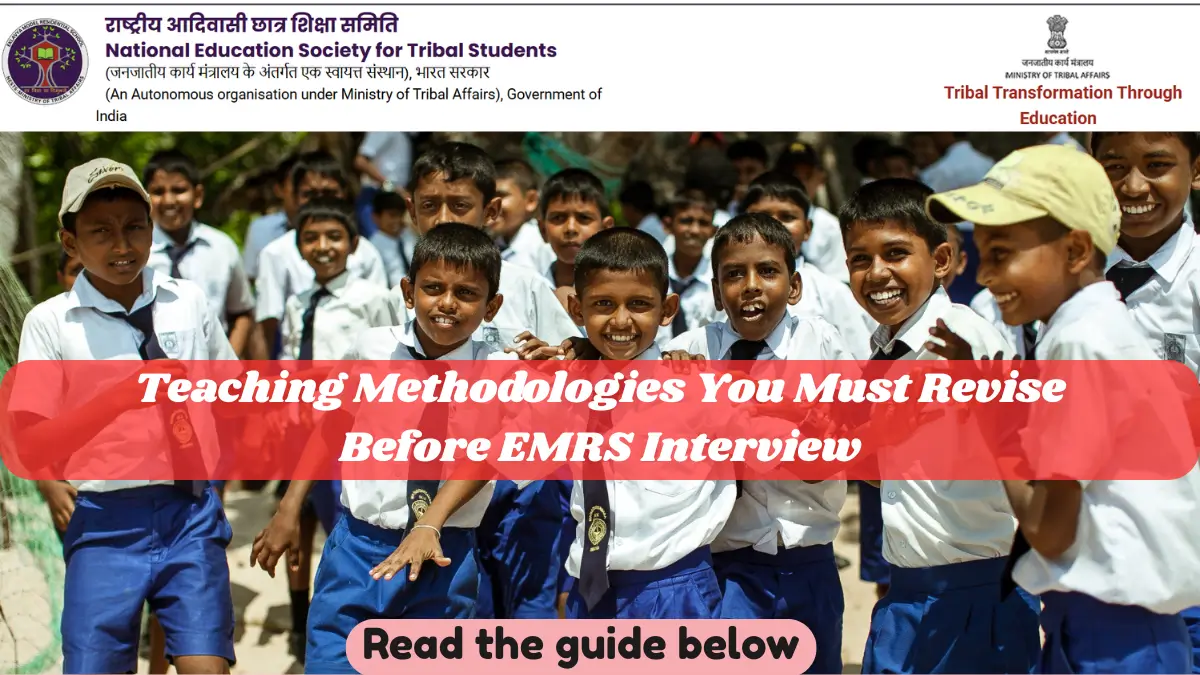
The Eklavya Model Residential Schools (EMRS) interview tests not just your subject knowledge but also how well you understand teaching. The interview panel wants to know if you can teach tribal and rural students in a simple, effective, and inclusive way. That is why knowing the right teaching methodologies is very important. Whether you are appearing for a TGT, PGT, or Principal post, you must be clear about how modern teaching works. This article covers the most important methods you should revise before your EMRS interview.
Student-Centred vs Teacher-Centred Learning
In an EMRS interview, one of the most common topics is the difference between old and new ways of teaching. Old-style teaching kept the teacher at the centre – the teacher talked and students listened. Modern education, as suggested by NCF 2005, believes that the student must be active in the learning process. You must be able to explain which approach is better for tribal children and why.
| Aspect | Teacher-Centred | Student-Centred |
|---|---|---|
| Role of teacher | Instructor / Authority | Facilitator / Guide |
| Role of student | Passive listener | Active learner |
| Focus | Syllabus completion | Concept understanding |
| Best for EMRS? | Less preferred | Highly recommended |
| Example method | Lecture method | Project-based learning |
Activity-Based and Experiential Learning
EMRS students come from tribal backgrounds and may not have had access to high-quality schools before. Activity-based learning helps them understand concepts by doing things, not just reading or listening. This approach is also linked to the ideas of great educators like John Dewey, who said “learning by doing” is the best method. Interviewers often ask how you would make a topic interesting for first-generation learners.
- Activity-Based Learning (ABL): Students learn through games, models, and hands-on tasks.
- Experiential Learning (Kolb’s Cycle): Concrete experience – Reflection – Conceptualisation – Experimentation.
- Project-Based Learning (PBL): Students work on real-world problems over a period of time.
- Cooperative Learning: Students work in groups to achieve a shared goal.
- Role Play and Simulation: Students act out situations to understand concepts better.
- Field Trips and Nature Walks: Especially useful in science and social studies for tribal students.
NCF 2005 Principles Every EMRS Candidate Must Know
EMRS follows NCF 2005 closely because it promotes joyful, constructive, and child-friendly learning. You must know the five guiding principles of NCF 2005 and be able to connect them to your classroom practice.
| NCF 2005 Principle | Simple Meaning | Classroom Application |
|---|---|---|
| Connect knowledge to life | Learning must relate to real life | Use local examples while teaching |
| Move away from rote learning | Don’t just memorise, understand | Ask open-ended questions |
| Enrich curriculum | Go beyond textbooks | Use newspapers, stories, games |
| Make exams flexible | Assessment should not create fear | Use projects, portfolios, quizzes |
| Integrate subjects | Connect all subjects together | Teach environment through Maths too |
Inclusive Education and Teaching Diverse Learners
EMRS schools serve students from Scheduled Tribe communities, many of whom are first-generation school-goers. As a teacher, you must know how to handle a classroom with students of different learning levels, languages, and abilities. Inclusive education means making sure no student is left behind.
- Differentiated Instruction: Teach the same topic in different ways for different learners.
- Multi-Level Teaching: Use simple, medium, and advanced tasks in the same classroom.
- Mother Tongue as Bridge: Use the child’s home language to explain new concepts initially.
- Special support for slow learners: Extra attention, peer tutoring, and visual aids.
- Cultural sensitivity: Respect tribal culture and include local examples in lessons.
- Gender-inclusive classroom: Ensure equal participation of boys and girls.
Assessment Methods – Moving Beyond Exams
EMRS follows the Continuous and Comprehensive Evaluation (CCE) model, which means a student is evaluated regularly and in many ways, not just through a final exam. Knowing different assessment types and being able to explain them clearly will impress the interview panel.
| Assessment Type | What It Means | Example |
|---|---|---|
| Formative Assessment | Ongoing, during learning | Class quiz, oral questions, observation |
| Summative Assessment | At the end of a unit or term | Half-yearly and annual exams |
| Portfolio Assessment | Collection of student’s work over time | Drawings, assignments, projects |
| Peer Assessment | Students evaluate each other | Group feedback sessions |
| Self-Assessment | Student reflects on own learning | Learning diary, checklist |
| Rubric-Based Assessment | Clear criteria for grading | Project evaluation sheet |




 GPSTR Apply Online Link 2026 Active, Reg...
 AP DSC Notification 2026 Out: 2,721 Teac...
 UP TGT PGT Eligibility Criteria 2026, Ag...