Table of Contents
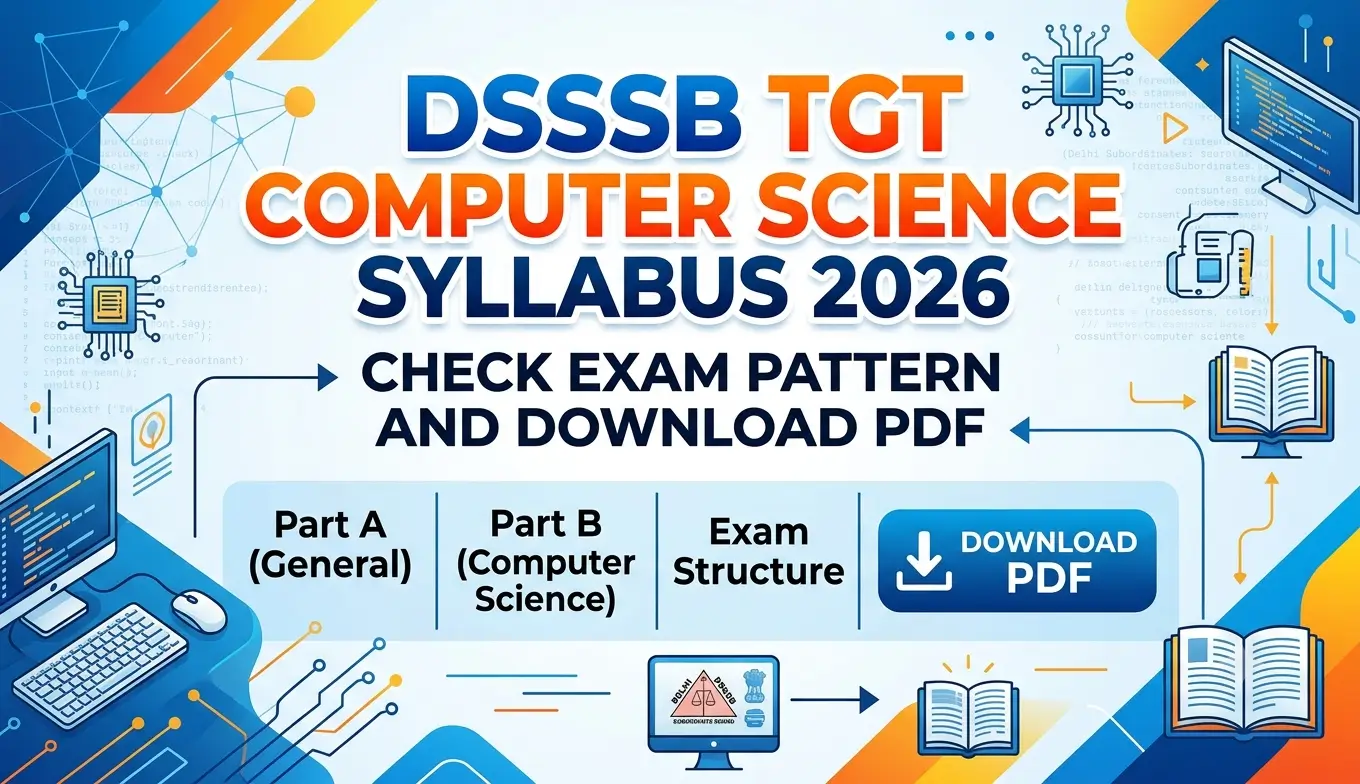
DSSSB TGT Computer Science Syllabus 2026 covers all the key topics that candidates need to study to qualify for the Trained Graduate Teacher post under the Delhi Subordinate Services Selection Board. Knowing the full syllabus helps you plan your preparation in a focused and time-efficient way. This article covers the complete syllabus, exam pattern, marking scheme, and the PDF download link.
DSSSB TGT Computer Science Syllabus 2026
The DSSSB TGT Computer Science syllabus is designed to test both your subject knowledge and your teaching ability. It includes topics from computer systems, programming (Python), networking, databases, data handling, and emerging technologies. Along with the technical subjects, candidates are also tested on general awareness, reasoning, numerical ability, and language skills. Teaching methodology and pedagogy form an important part of Section B of the exam.
DSSSB Computer Science Syllabus: Overview
| Parameter | Details |
|---|---|
| Conducting Body | Delhi Subordinate Services Selection Board (DSSSB) |
| Post Name | Trained Graduate Teacher (TGT) – Computer Science |
| Exam Mode | Online (Computer Based Test) |
| Total Questions | 200 |
| Total Marks | 200 |
| Time Duration | 120 Minutes |
| Negative Marking | Yes (-0.25 per wrong answer) |
| Sections | Section A (General) + Section B (Subject) |
DSSSB TGT Computer Science Syllabus (Topic-Wise)
The subject syllabus in Section B is spread across multiple modules. Below is the topic-wise breakdown of everything you need to cover.
1. Computer Systems and Organization
- Basic Computer Organization: hardware, software, input/output devices, CPU, memory (primary, cache, secondary), memory units (Bit, Byte, KB, MB, GB, TB, PB)
- Types of software: system software (OS, utilities, device drivers), programming tools, language translators (assembler, compiler, interpreter), application software
- Operating System: functions of OS, OS user interface
- Boolean logic: NOT, AND, OR, NAND, NOR, XOR, truth tables, De Morgan’s laws, logic circuits
2. Computer Systems Architecture
- System buses
- Internal memory: RAM, ROM
- Input/Output devices, I/O modules, Programmed I/O, Interrupt-Driven I/O, Direct Memory
- Access, I/O Channels, External Interface
3. Operating Systems
- Introduction to OS, OS organization
- Device Management, Process Management, Scheduling
- Synchronization Principles, Deadlocks
- Memory Management, File Management
4. Computational Thinking and Programming (Part 1)
- Problem-solving steps: analysing, algorithm development, coding, testing, debugging
Flowcharts, pseudocode, decomposition - Python basics: features, execution modes, tokens (keyword, identifier, literal, operator, punctuator), variables, l-value and r-value, comments
- Data types: integer, float, complex, boolean, string, list, tuple, None, dictionary, mutable/immutable types
5. Computational Thinking and Programming (Part 2)
- Functions: built-in, module-defined, user-defined; arguments, default/positional parameters, return values, scope (global/local)
- File handling: text files, binary files, CSV files; open modes (r, r+, w, w+, a, a+); read(), readline(), readlines(), write(), writelines(), seek(), tell()
6. Introduction to Python
- Python interpreter (interactive and script mode), indentation, identifiers, keywords, constants, variables, operators and their precedence
- Dictionary: key-value pairs, creating, initializing, traversing, updating, deleting; methods: len(), dict(), keys(), values(), items(), get(), update(), clear(), del()
7. Computer Networks
- Evolution of networking: ARPANET, NSFNET, Internet
- Data communication: sender, receiver, message, media, protocols, bandwidth, data transfer rate, IP address, Circuit/Packet switching
- Transmission media: Twisted pair, coaxial, and Fibre optic (wired); Radio waves, microwaves, and Infrared (wireless)
- Network devices: Modem, Ethernet card, RJ45, Repeater, Hub, Switch, Router, gateway, and WiFi card
- Network types: LAN, MAN, WAN; Topologies: Star, Bus, Tree, Mesh
- Internet basics: URL, WWW, web, email, Chat, VoIP
8. Database Management
- Database concepts and need; DBMS
- Relational model: relation, attribute, tuple, domain, degree, cardinality
- Keys: candidate key, primary key, alternate key, foreign key
- SQL: DDL, DML, DQL; data types (char, varchar, int, float, date); constraints (not null, unique, primary key); create/use/drop database; show tables/databases
- SQL functions—Math: POWER(), ROUND(), MOD() Text: UCASE(), LCASE(), MID(), LENGTH(), LEFT(), RIGHT(), INSTR(), LTRIM(), RTRIM(), TRIM(); Date: NOW(), DATE(), MONTH(), MONTHNAME(), YEAR(), DAY(), DAYNAME()
- MySQL: creating a database, data types introduction
9. HTML and Web Technologies
- HTML/DHTML: basic tags, creating links, tables, form tags
- Document Object Model (DOM): concept, dynamic HTML
- CSS: introduction, margins
- XML: features, structure, naming rules, element content models, occurrence indicators, DTD
- ASP: constants (string, numeric) and data types (Integer, Float, String, Date, Boolean, Currency, Variant, Object)
10. Data Handling using Pandas
- Python libraries: Pandas, Matplotlib
- Series: creation from array, dictionary, scalar; mathematical operations; head/tail; selection, indexing, slicing
- DataFrames: creation from a dictionary of series, a list of dictionaries, CSV/text files; iteration; add, selecting, delete, and rename rows/columns; Boolean indexing
11. Emerging Trends
- Artificial Intelligence, Machine Learning, Natural Language Processing
- Augmented Reality (AR), Virtual Reality (VR), Robotics
- Big Data and its characteristics, Internet of Things (IoT), Sensors, Smart cities
12. Society, Law, and Ethics / Societal Impacts
- Digital footprints, net etiquette, communication etiquette, social media etiquette
Intellectual Property Rights (copyright, patent, trademark), IPR violations, open-source licensing (Creative Commons, GPL, Apache) - Cybercrime: hacking, eavesdropping, phishing, ransomware, fraud emails, and prevention
- Cyber safety: safe browsing, identity protection, confidentiality, cyber trolls, cyberbullying
Indian IT Act overview, e-waste hazards and management, health concerns related to technology
13. Teaching Methodology and Pedagogy (Education)
- Learning and Teaching
- Language across the curriculum
- Understanding discipline and subject
- Gender, school, and society
- Pedagogy of a school subject
- Knowledge and curriculum
- Assessment for learning
- Creating an inclusive school
- Childhood and growing up
- Drama and Art in Education
DSSSB TGT Computer Science Exam Pattern 2026
The DSSSB TGT Computer Science exam is a single computer-based test (CBT) of 200 questions carrying 200 marks, to be completed in 120 minutes.
| Section | Subject / Component | Number of Questions | Maximum Marks |
|---|---|---|---|
| Section A | General Awareness | 20 | 20 |
| Section A | General Intelligence & Reasoning Ability | 20 | 20 |
| Section A | Arithmetical & Numerical Ability | 20 | 20 |
| Section A | Test of Hindi Language & Comprehension | 20 | 20 |
| Section A | Test of English Language & Comprehension | 20 | 20 |
| Section B | Subject (Computer Science) + Teaching Methodology/Pedagogy | 100 | 100 |
| Total | 200 | 200 |
Time Duration: 2 Hours (Composite—no separate time per section)
Marking Scheme and Key Rules
- Correct answer: +1 mark
- Wrong answer: -0.25 mark (negative marking)
- Unanswered question: 0 (no penalty)
- No separate minimum cut-off for Section A
Minimum Qualifying Marks
| Category | Minimum Qualifying Marks |
|---|---|
| General / EWS | 40% |
| OBC (Delhi) | 35% |
| SC / ST / PwBD | 30% |
DSSSB TGT Computer Science Syllabus Download Link
Candidates should always download the official syllabus PDF to prepare for the exam. The syllabus PDF contains the full subject-wise breakdown and any updates made for the 2026 cycle.



 BPSC TRE 4.0 Syllabus 2026, Check Exam P...
 DAV Syllabus 2026 Out for TGT, PGT Posts...
 CSIR NET Syllabus 2026, Download Subject...