
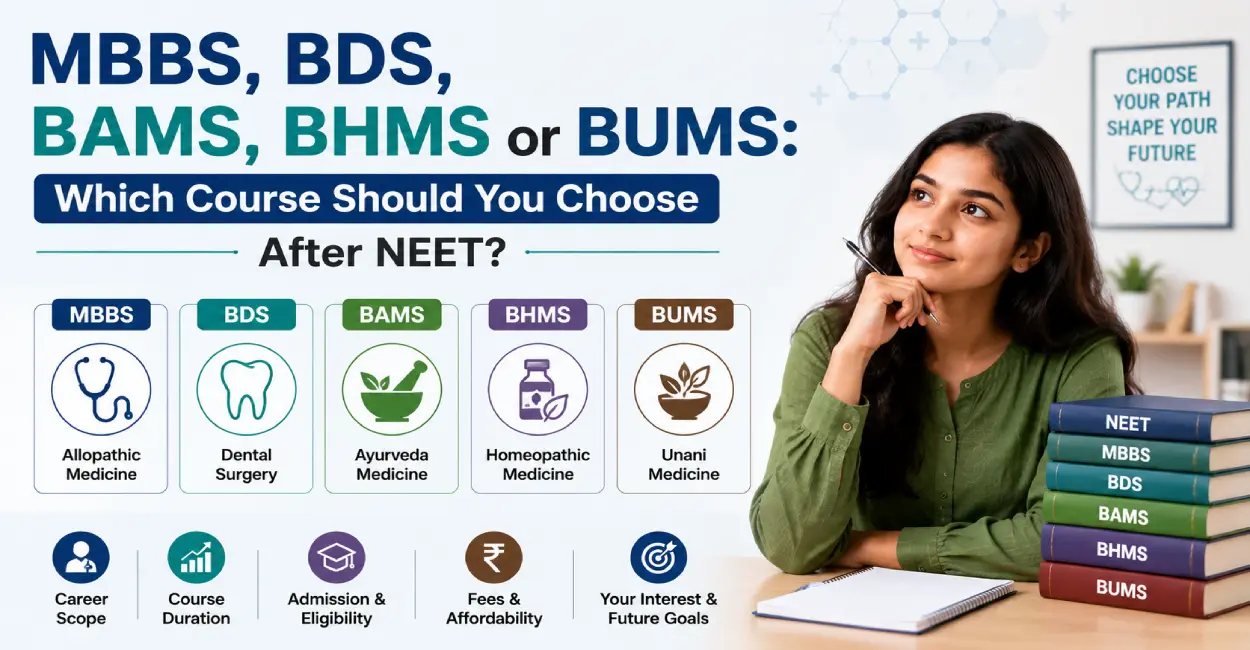
After NEET, one big question starts bothering almost every student, which course should I choose now? Some students want MBBS from the beginning. Some think about BDS. Others start looking at BAMS, BHMS, or BUMS after seeing their marks, rank, budget, or future plans. That is normal. It happens with almost everyone.

The problem is, many students choose a course only by name value. But that is not always the smart way. A course may be good, but it still may not be the right one for you.
In this article, let us understand the difference between MBBS, BDS, BAMS, BHMS, and BUMS in a simple way, so choosing becomes a bit less confusing.
Also Read: NEET Counselling 2026
What are MBBS, BDS, BAMS, BHMS, and BUMS?
Before comparing them, first understand what each course actually means.
MBBS is the main undergraduate medical degree for students who want to study modern medicine and become allopathic doctors.
BDS is for students who want to build a career in dentistry and oral health.
BAMS is the Ayurvedic medicine degree.
BHMS is the undergraduate course in Homoeopathy.
BUMS is the undergraduate course in Unani medicine.
In terms of course duration, MBBS is described by NMC as 4.5 years of academic study followed by 1 year of compulsory rotating internship. BDS is 4 academic years plus 1 year paid rotating internship. BAMS, BHMS, and BUMS are each regulated as 5 years and 6 months courses including a 12-month compulsory internship.
So yes, all of them are serious professional courses. None of them is a small option. But the right choice depends on what kind of doctor you want to become, what kind of system you believe in, and what kind of career you can actually see yourself doing every day.
Also Read: NEET Rank vs College 2026
MBBS vs BDS
MBBS gives you broader exposure. You study medicine, surgery, pathology, anatomy, pharmacology, community medicine, and clinical subjects in a much wider way. Later, you can move into hospital practice, clinical work, postgraduate specialisation, public health, research, and more.
BDS is more focused. It is about teeth, gums, oral diseases, dental surgery, jaw-related issues, and cosmetic dental treatment. If you like precision work, procedures, and a specialised clinical field, BDS can actually be a very solid option.
A lot of students make the mistake of thinking BDS is only a “backup” for MBBS. That thinking is not fair, and honestly, not even correct. Dentistry is a complete field on its own. But yes, if your dream is to treat a wide range of diseases as a physician, MBBS will fit better.
So in simple words:
- Choose MBBS if you want broader medical training and more general clinical exposure.
- Choose BDS if you are comfortable with a focused field and have real interest in dental science.
Also Read: 15 Biggest Mistakes Students Make During NEET Counselling
BAMS vs MBBS
MBBS is the route for modern medicine. BAMS is the route for Ayurveda. So this comparison should not be done only on rank or status. It should be done on interest and long-term fit.
If you choose MBBS, you are entering the mainstream allopathic medical path. It usually involves a long academic journey, intense competition, and often PG preparation later. But it also gives wide recognition and a more direct image of being a doctor in the modern healthcare system.
BAMS, on the other hand, is for students who are open to studying Ayurveda in a structured professional way. It is not just herbs and home remedies, like some people casually think. It is a full degree course with its own curriculum, internship, and professional framework.
Choose MBBS if:
- you strongly want modern medicine
- you want broad hospital-based training
- you are ready for a longer and very competitive path
Choose BAMS if:
- you are genuinely interested in Ayurveda
- you are open to a different medical system
- you do not want to force yourself into a course just for social prestige
Also Read: AIQ vs State Quota in NEET Counselling
Is BHMS a Good Option After NEET?
Yes, BHMS after NEET can be a good option but only for the right student.
BHMS is not a random alternative. It is a proper professional degree in Homoeopathy with a defined structure and compulsory internship under the current regulations.
But the bigger point is this: you should choose BHMS only if you are actually comfortable with studying and practicing Homoeopathy. If you already know that you only want MBBS-type clinical practice, then taking BHMS just because your rank is lower may leave you confused later.
BHMS may suit you if:
- you are interested in Homoeopathy as a system of treatment
- you want to stay in the healthcare field
- you are ready to build your own identity in that stream
Also Read: How to Fill NEET Choice Preferences
What About BUMS After NEET?
BUMS is usually less talked about compared to MBBS, BDS, or BAMS, but for some students it can still be the right path.
BUMS is the degree course in Unani medicine. Like BAMS and BHMS, it also comes under the AYUSH-side counselling structure for eligible seats, and it has its own academic and internship requirements.
If you are considering BUMS, then do not choose it blindly. Learn about the course, the colleges, the language requirements if any, internship exposure, and your long-term comfort with the field.
BUMS may be suitable if:
- you are interested in Unani medicine
- you want a professional medical degree outside MBBS/BDS
- you have researched the course properly, not just looked at the cutoff
That last part matters a lot. Many students see a course name for the first time during counselling and still fill it. That is a bit risky, not gonna lie.
Which Counselling Handles These Courses?
For NEET-qualified candidates, MBBS and BDS seats under the relevant All India Quota and participating institutions are handled through the Medical Counselling Committee (MCC) portal. BAMS, BHMS, and BUMS AIQ UG counselling is handled by AACCC for the AYUSH streams and related participating institutions.
So when you are planning your choices, you should know not only the course but also the counselling route. Small confusion here can create big mess later.
Which Course Should You Choose After NEET?
If you want the most widely recognised path in modern medicine, then MBBS is the obvious choice.
If you are interested in oral healthcare and want a specialised clinical field, BDS can be a very good option. If you believe you would do better in a traditional system of medicine and actually want to study it seriously, then BAMS, BHMS, or BUMS can also be meaningful choices.
The best course is not always the one with the biggest name.
The best course is the one that matches:
- Your interest
- Your rank
- Your budget
- Your patience for the career path
- And the kind of doctor you want to become




 Best Books for CBSE Class 12 Commerce St...
 CBSE Class 12th Accountancy Important Qu...
 CBSE 2026 Preparation Tips for Class 12