Table of Contents
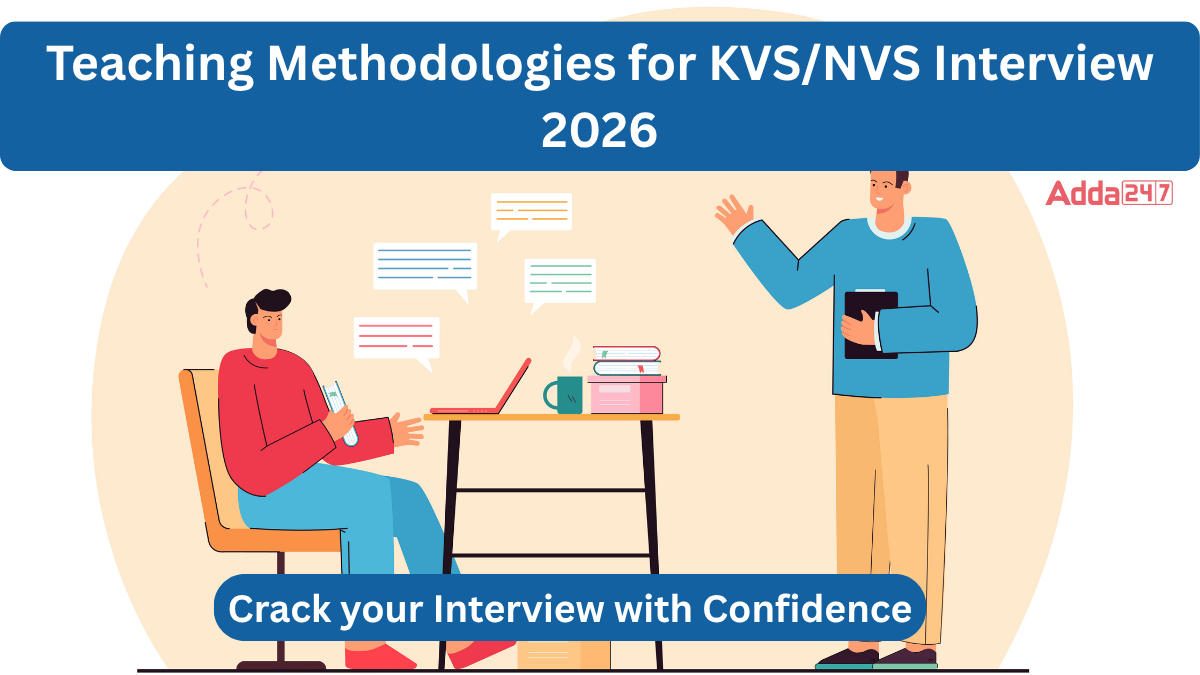
If you are preparing for a KVS or NVS teacher interview, knowing your subject alone is not enough. The interview panel wants to see that you understand how to teach, not just what to teach. Teaching methodologies are the tools and strategies you use to help students learn. Revising these before your interview will boost your confidence and help you answer questions clearly and correctly.
Teaching Methodology and its Importance in KVS/NVS Interview
Teaching methodologies are the planned ways a teacher uses to deliver lessons and help students understand new ideas. In KVS and NVS interviews, you are often asked questions like “How would you teach this concept?” or “Which method would you use for slow learners?” A good teacher does not use just one method, they choose the right method for the right situation. Below are the teaching methods and its feature:
| Teaching Method | Best Used For | Key Feature |
|---|---|---|
| Lecture Method | Introducing new topics | Teacher-centered, quick delivery |
| Discussion Method | Critical thinking | Student participation |
| Demonstration Method | Science/practical subjects | “Show and tell” approach |
| Project Method | Integrated learning | Hands-on, real-life tasks |
| Inductive Method | Teaching rules and concepts | Specific to general |
| Deductive Method | Applying known rules | General to specific |
Student-Centered Teaching Methods for KVS/NVS Interview
Modern education has moved away from “chalk and talk.” KVS and NVS both follow NCF 2005 and NEP 2020, which strongly support student-centered learning. In this approach, the student is active, and the teacher acts as a guide or facilitator. The interview panel may ask you that how will you plan to make your classroom student-friendly and engaging. Knowing these methods will show that you are aligned with current national education policies.
Below are some teaching methods which are Student-Centered :
- Activity-Based Learning: Students learn by doing tasks, games, or experiments. Great for primary classes.
- Cooperative Learning : Students work in small groups to solve a problem together. Builds teamwork and communication.
- Problem-Based Learning (PBL) : Students are given a real-life problem and must find solutions. Develops critical thinking.
- Inquiry-Based Learning : Students ask questions and explore answers themselves. Encourages curiosity.
- Flipped Classroom : Students study content at home and do practice in class. Teacher guides instead of lectures.
- Play-Way Method : Used mainly in early childhood. Learning happens through play and fun activities.
Herbartian Steps (by German Philosopher) and Other Classical Methods
Classical methods are still very relevant in KVS and NVS interviews because these schools follow structured lesson plans. The Herbartian method, in particular, is used as the base for writing lesson plans in teacher training programmes. If your interview includes a demo lesson, knowing these steps will help you plan and deliver it confidently.
The Five Herbartian Steps are:
| Step | Name | What Happens |
|---|---|---|
| 1 | Preparation (Introduction) | Teacher links the new topic to what students already know |
| 2 | Presentation | New content is taught using examples, stories, or visuals |
| 3 | Comparison & Abstraction | Students compare new ideas with old ones |
| 4 | Generalisation | A rule or conclusion is drawn |
| 5 | Application | Students apply the learning to new situations |
Other classical methods include the Socratic Method (learning through questions and answers), the Dalton Plan (self-paced individual work), and the Montessori Method (child-led discovery learning with special materials).
Inclusive and Remedial Teaching Strategies for KVS/NVS Interview
KVS and NVS schools serve diverse classrooms with children from different backgrounds, abilities, and learning speeds. The interview panel often asks how you would handle students with learning difficulties or how you would include all students in your lesson. So candidates should know various methods of inclusive teaching which are taught in teacher training courses and candidate need to only revise it and apply it in class:
- Remedial Teaching: Extra help given to students who are falling behind. Uses simpler language, more examples, and more practice.
- Differentiated Instruction : The same topic is taught in different ways for different learners. One student may read, another may draw, another may act it out.
- Peer Tutoring : Stronger students help weaker ones. Both benefit, the helper revises, the learner gets personal attention.
- Multi-Sensory Teaching : Using sight, sound, touch, and movement together to teach a concept.
- IEP (Individualized Education Plan) : A special plan made for students with disabilities to help them learn at their own pace.
Technology-Integrated Teaching Methods for KVS/NVS Interview
KVS schools are part of the Digital India initiative and use smart classrooms, DIKSHA portal, and e-content regularly. NVS also promotes ICT-based learning in its schools. During your interview, you may be asked how you would use technology to make a lesson more interesting. Below are some tools, you should know and how it helps in teaching:
| Technology Tool | How It Helps in Teaching |
|---|---|
| DIKSHA App | Free digital content aligned with NCERT curriculum |
| Smart Board/Interactive Board | Makes lessons visual and engaging |
| Educational Videos (YouTube) | Explains concepts with animation and storytelling |
| Google Forms/Quizzes | Quick and easy assessment tool |
| Mind Mapping Tools (MindMeister) | Helps students organise thoughts visually |
| Virtual Labs (OLABS) | Online science experiments for schools without lab facilities |

 Important Pedagogy Questions Asked in KV...
 NCERT-Based Questions in KVS/NVS Intervi...
 Top 50 KVS/NVS Interview Questions with ...