Table of Contents
The Central Board of Secondary Education (CBSE) conducted the CTET 2026 Shift 2 examination on 7 February 2026 from 2:30 pm to 5:00 pm. A large number of teaching aspirants appeared for the exam, aiming to qualify for upper primary teaching positions across India. Soon after the exam ended, candidates began sharing their experiences, highlighting the question pattern, overall difficulty level, and section-wise distribution.
This article brings you a detailed CTET Exam Analysis 2026 for Shift 2 (7 February), focusing on Paper II. It covers real-time student feedback, section-wise difficulty analysis, good attempt estimates, and expected performance trends. The insights shared here are based on candidate reactions and patterns observed from recent CTET examinations, helping aspirants get a clear and practical understanding of the Shift 2 paper.
Also Check : CTET Question Paper and CTET Answer Key
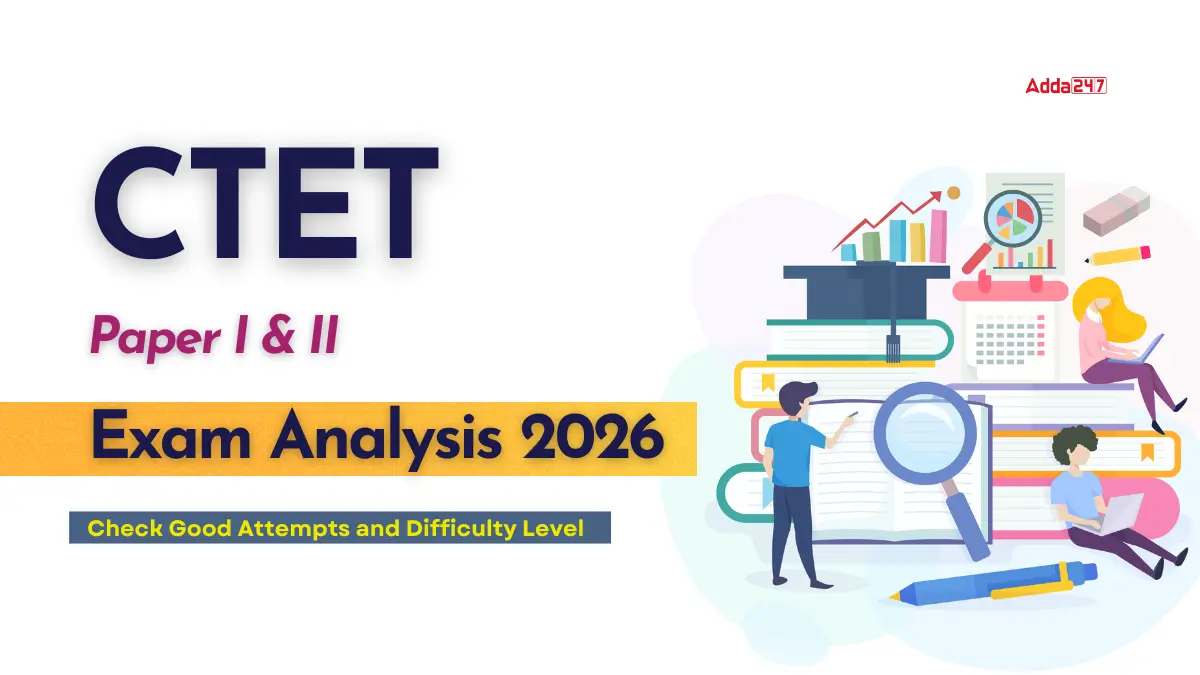
CTET Exam Analysis 2026
CTET 2026 marks the 21st edition of the Central Teacher Eligibility Test and was conducted in offline, OMR-based mode across multiple exam centres in two shifts. Shift 2 was held for Paper I, meant for candidates aspiring to teach Classes I to V.
The paper included 150 multiple-choice questions, each carrying 1 mark, with a total duration of 150 minutes. As per the CTET exam pattern, there was no negative marking, allowing candidates to attempt all questions without the risk of penalty. Based on early candidate feedback, the paper remained largely NCERT-centric, followed a familiar structure, and stayed in line with previous CTET exam trends, making it predictable for well-prepared aspirants.
Student Review of CTET Exam 7 Feb Shift 2
Candidates who appeared in Shift 2 described the paper as balanced and manageable, especially for those who prepared strictly from NCERT books and previous year CTET papers.
- Paper was concept-driven and focused more on teaching understanding than direct facts
- Child Development & Pedagogy tested deep clarity of theories, not definitions
- Frequent questions from Piaget, Vygotsky, Gardner, and Kohlberg
- Gender socialisation, inclusion, learning disabilities, and gifted learners were key themes
- Formative assessment and reflective teaching appeared multiple times
- Hindi section focused on language acquisition and classroom application
- Strong emphasis on communicative language teaching and multilingual classrooms
- Grammar questions were context-based, not rule-memorisation
- Reading comprehension included factual, inferential, and cause–effect questions
- Mathematics was balanced but concept-heavy rather than calculation-heavy
- Questions linked maths learning to real-life situations and child experiences
- Pedagogical understanding was more important than speed in Maths
- NEP 2020 and foundational numeracy concepts were clearly reflected
- English section mixed language theory with literature comprehension
- Questions from sociolinguistics, LAD, morphemes, and early language development
- Poetry and prose questions required interpretation of tone, theme, and symbolism
- EVS focused on observation, environment, culture, and pedagogy
- Assertion–Reason questions tested scientific and logical reasoning
- Teaching strategies like storytelling, discussion, and hands-on learning were highlighted
- Overall difficulty level was moderate to slightly difficult
- Paper favoured candidates with conceptual clarity and teaching-oriented preparation
CTET Exam 2026 Good Attempts and Difficulty Level
The CTET Exam 2026 Paper II was rated easy to moderate by most candidates, with a healthy range of good attempts across all sections. Overall, candidates could comfortably attempt 115–130 questions, making this shift favourable for those with strong NCERT-based preparation.
| CTET Paper II Overall Good Attempts and Difficulty Level | ||
| Subject | Difficulty Level | Good Attempts |
| Child Development & Pedagogy | Easy to Moderate | 22-26 |
| English Language | Easy | 23-27 |
| Hindi Language | Easy | 23-27 |
| Mathematics | Moderate | 18-22 |
| Science | Easy to Moderate | 17-21 |
| Social Studies | Moderate | 15-19 |
| Overall | Easy to Moderate | 115-130 |
CTET Exam Analysis 2026 for Shift 2 (Paper II)
CTET Paper II required deeper subject understanding along with teaching methodology.
Child Development & Pedagogy
- Piaget’s preoperational stage, egocentrism and illogical cause–effect thinking
- Gender typing and internalisation of gender roles
- Vygotsky’s scaffolding within the Zone of Proximal Development
- Progressive education and student-centred, experiential learning
- Kohlberg’s stage-wise moral development vs continuous development
- Role of private speech in cognitive development (Vygotsky)
- Interpersonal intelligence and emotional understanding (Gardner)
- Family as the primary agent of gender socialisation
- Formative assessment as assessment for learning
- Dysgraphia as a specific learning disability related to writing
- Cognitive, social and emotional needs of gifted children
- Inclusive teaching strategies for learning disabilities
- Sensory integration needs in Autism Spectrum Disorder
- Teacher self-reflection and bias awareness in inclusive education
- Print-rich classroom and early literacy development
- Reflective thinking as a core practice of progressive education
- Language facilitating thinking through think-aloud strategies
- Constructivist belief in respecting socio-cultural diversity
- Active engagement through inquiry, exploration and questioning
- Cause-and-effect reasoning in understanding evaporation
- Intrinsic motivation driven by internal satisfaction
- Constructivist teaching using rich materials, not verbal dominance
- Performance avoidance goal orientation and fear of failure
- Promoting critical thinking through independent questioning
- Interaction of heredity and environment in development
- Multidimensional and multidirectional nature of development
- Biological basis of speech development (assertion–reason)
- Language milestones at around five years of age
- Transition from private speech to inner speech (Vygotsky)
- Piaget’s cognitive development in four distinct stages
Hindi
- मातृभाषा विकास – भाषा अर्जन
- सक्रिय श्रवण (Active Listening)
- कविता शिक्षण में बहुविध गतिविधियाँ
- बहुभाषी कक्षा में शिक्षक की भूमिका
- व्याकरण परीक्षण के प्रकार
- लेखन विकास का स्क्रिबलिंग चरण
- सम्प्रेषणात्मक भाषा-शिक्षण का आधार
- उपाख्यानात्मक अभिलेख (Anecdotal Record)
- भाषा अधिगम में व्याकरण की भूमिका
- संवेदनशील / क्रिटिकल अवधि सिद्धांत
- संदर्भ आधारित व्याकरण-शिक्षण
- भाषा-समृद्ध कक्षा का निर्माण
- क्रैशन का द्वितीय भाषा अर्जन सिद्धांत
- ग्रेडिंग और क्रम निर्धारण का सिद्धांत
- अनुकरण आधारित भाषा गतिविधि
- गद्यांश का मुख्य भाव
- संदर्भानुसार शब्दार्थ
- पर्यावरण चेतना से संबंधित प्रश्न
- भिन्न शब्द की पहचान
- संज्ञा का भेद (भाववाचक संज्ञा)
- कारण-परिणाम आधारित प्रश्न
- अनुमानात्मक बोध (Inferential comprehension)
- संज्ञा का लिंग-वचन निर्धारण
- गद्यांश से तथ्यात्मक प्रश्न
- बुद्धिमत्ता का प्रमाण नहीं
- बुद्धिमान प्राणियों का सही समूह
- भाषा सीखना – बौद्धिक क्षमता का प्रमाण
- मानव शिशु का संज्ञानात्मक विकास
- शब्दों के पर्यायवाची
- संधि-विच्छेद

Mathematics
- Formation of greatest and smallest numbers using given digits
- Application of fractions in real-life sharing situations
- Combined use of LCM and HCF in number problems
- Unitary method for cost and expenditure calculations
- Capacity measurement and litre–millilitre conversion
- Volume comparison of cube and cuboid in packing situations
- Weight calculation using mixed units (kg and g)
- Identifying lines of symmetry in geometric shapes
- Rotational symmetry in letters without line symmetry
- Faces, edges and vertices of 3D solid shapes
- Interpreting data from tables and comparing values
- Recognising and extending multiplicative number patterns
- Identification and summation of prime numbers
- Simplification of algebraic expressions using patterns
- Finding and summing common factors excluding 1
- Least effective classroom practices in mathematics teaching
- Assessment linked to children’s culture and experiences
- Purpose of contextual word problems in mathematics
- Importance of data handling and uncertainty (A–R)
- Learning outcomes not expected at Class III level
- Additive identity and misconceptions about zero
- Goals of primary mathematics curriculum, curiosity and exploration
- Place value errors while writing numbers from words
- Van Hiele Level 2, analytical thinking in geometry
- Use of local knowledge and ethnomathematics in learning
- NEP 2020 focus on Foundational Literacy and Numeracy
- Conservation of volume despite change in shape
- Pedagogical strategies to correct place value errors
- Identifying augmentation structure in addition word problems
- Pre-number concepts like classification and ordering
English
- Multilingual speaker (speaks more than two languages)
- Sociolinguistics as a field of study
- Scope of contrastive analysis
- Grammar Translation Method (use of mother tongue)
- Note-making as a precision writing skill
- Voice expression and tone assessment
- Flexible seating arrangement in classroom pedagogy
- Effective communication skills
- Importance of listening in communication
- Objective of teaching English grammar
- Writing topics for primary-level learners
- Diagnostic assessment for identifying learner differences
- Chomsky’s Language Acquisition Device (LAD)
- Morpheme as the smallest meaningful unit
- Cooing stage in early language development
- Theme of the poem Still I Rise
- Poet’s attitude and tone in poetry
- Meaning of “a past rooted in pain”
- Repetition as a poetic device
- Simile as a figure of speech
- Symbolic meaning of “huts of history’s shame”
- Factual comprehension (True/False statements)
- Identifying incorrect statement from a passage
- Adjective (relative) clause identification
- Sentence type – Exclamatory sentence
- Antonym of a given word
- Meaning of an idiomatic expression
- Identification of the narrator
- Central activity/event in the passage
- Cause of conflict in the prose passage
EVS
- Insectivorous plants and habitat, pitcher plant (Nepenthes)
- Traditional houses of Srinagar, houseboats vs hill houses
- Structure and roles in a beehive
- Social behaviour and herd structure of elephants
- Al-Biruni’s observations on water management
- Forest Rights Act, minimum residence requirement
- Domestication of animals as a gradual process (A–R)
- Animals reared in the Harappan civilisation
- Newly formed states and Union Territories in recent history
- Indian sportsperson Karnam Malleswari and her sport
- Origin and features of Madhubani painting
- Scientific reasons for cow dung floor coating (A–R)
- Calculation of average speed of a moving train
- Housing features of Leh and Ladakh region
- Meaning of the local term “Torang” and its state
- Core knowledge required for an effective EVS teacher
- Pedagogical response to children’s curiosity in EVS
- Age-appropriate scientific explanation in EVS teaching
- Role of storytelling in EVS learning
- Encouraging creativity and expression in children’s drawings
- Learning plant diversity through observation and senses
- Nature of EVS as observation- and experiment-based
- Key ideas of NCF 2005 related to EVS
- Teaching day and night using concrete models
- Multicultural perspectives in EVS learning
- Importance of discussion as a teaching strategy in EVS
- Process skills developed through leaf collection activities


 CTET Exam Analysis 2026 for Shift 1 (7 F...
 KVS NVS Exam Analysis 2026 Out, Check At...
 NTA UGC NET Exam Analysis 2026 Out for 5...