Table of Contents
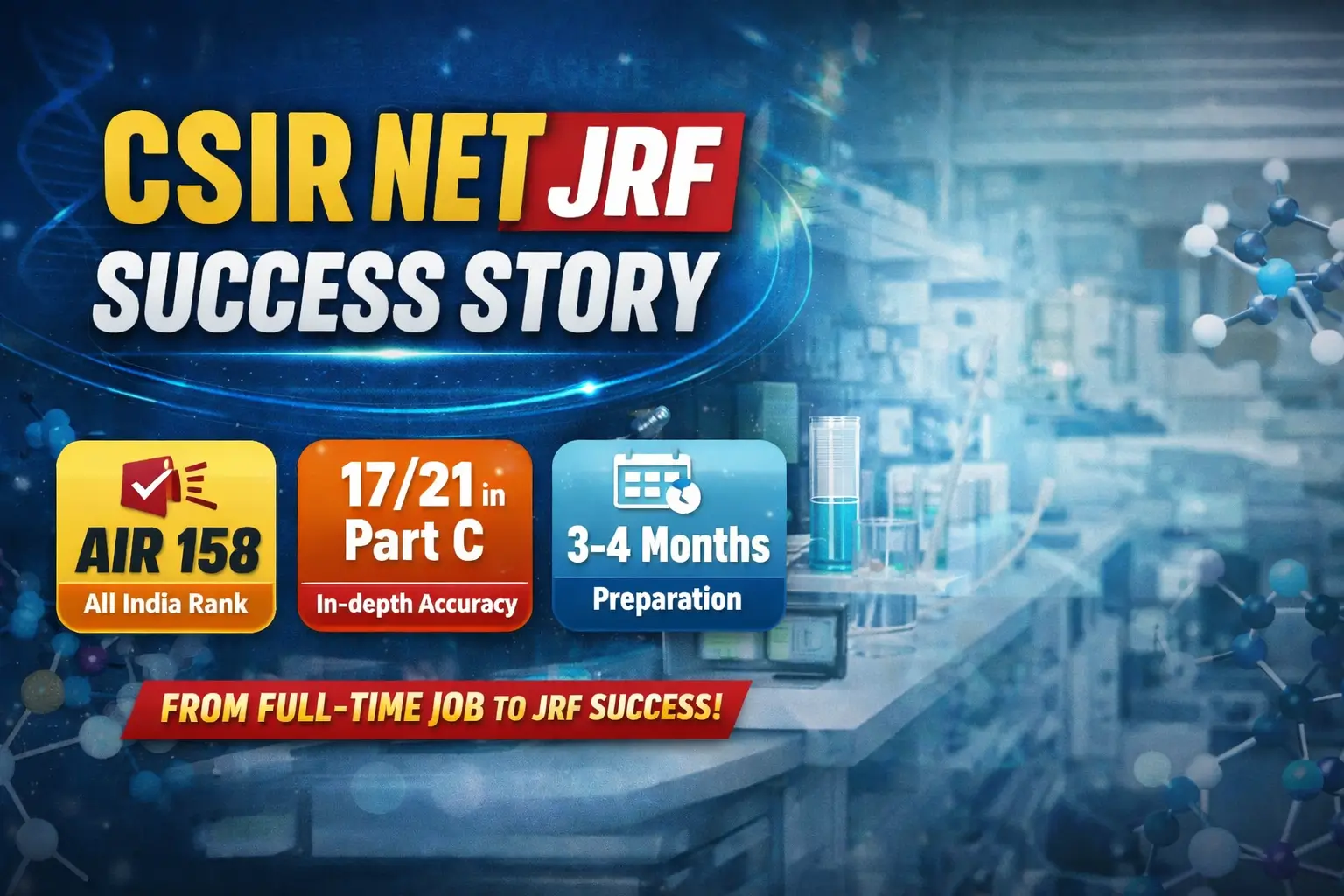
Cracking the CSIR NET JRF in a limited preparation window while working full-time is a challenge many aspirants struggle with. Siddharth Kesari turned that challenge into a milestone achievement. In the December 2025 session, he secured JRF Category I with All India Rank 158, delivering an exceptional performance i.e. especially in Part A and Part C. His journey is not just about clearing an exam. It is about strategic preparation, intelligent unit selection, disciplined revision, and unwavering confidence.
From Limited Time to National Rank: How It Began
Siddharth started preparing in September, right after completing his master’s degree in Biotechnology. With the December 2025 exam ahead, he had only three to four months in hand. Many aspirants would consider that insufficient. He saw it differently.
Instead of trying to complete all 13 units, he selected those aligned with his academic strengths. Molecular Biology and Cell Biology were already strong areas for him. He began there. Then he moved to Genetics, Plant Physiology, Animal Physiology, and other core subjects. Out of eight targeted units, he thoroughly completed seven. And those seven units were enough to secure a JRF.
NET Result Highlights: What Made the Difference
Siddharth’s result reflects both accuracy and clarity:
- JRF Category I Qualified
- All India Rank: 158
- Part C Attempted: 21 Questions
- Part C Correct: 17 Questions
- Part A Correct: 13 Questions
Section-Wise Strategy: Part A as a Score Booster and Part C as the Rank Decider
Siddharth’s CSIR NET December 2025 performance was not accidental. It was built on a clear section-wise strategy. He identified early that Part A could serve as a scoring cushion, while Part C would determine his final rank. Instead of treating all sections equally, he optimized his preparation according to weightage, difficulty level, and his own strengths. This structured approach helped him secure JRF Category I with AIR 158.
| Section | Strategy Focus | Questions Attempted | Correct Answers | Key Outcome |
|---|---|---|---|---|
| Part A | Strong aptitude practice and revision series | — | 13 | Boosted overall score significantly |
| Part B | Moderate attempt, topic-wise improvement | — | Faced some negatives | Identified weak areas for analysis |
| Part C | Concept clarity and advanced problem-solving | 21 | 17 | Major contributor to AIR 158 |
Working Professional Strategy: 4–5 Hours Daily
During preparation, Siddharth was working as a government lab technician from 10:30 AM to 5:30 PM. Despite this schedule, he studied consistently for 4–5 hours daily. He maintained discipline for three to four months without burnout. Short, focused sessions after work and productive use of small breaks made a big difference. His journey proves that consistent hours matter more than long study days.
Smart Preparation Model: PYQs and Mistake-Based Revision
With limited time available, Siddharth relied heavily on:
- Solving the last 10 years’ previous year questions
- Topic-wise mistake analysis
- Revising only weak areas instead of entire units
For example, he strengthened Hardy-Weinberg concepts where he made errors but avoided revising topics he had already mastered. His mock test scores ranged between 80–90 marks. Instead of getting discouraged, he used them purely for analysis and improvement.
How CSIR Adda 247 Helped Him Achieve JRF
Siddharth credited CSIR Adda 247 for providing structured and exam-focused guidance during his preparation.
- Part A Mastery: The dedicated revision series strengthened his aptitude and reasoning skills, helping him secure 13 correct questions in Part A.
- Concept Clarity for Part C: Subject-wise revision lectures improved his understanding of core topics, contributing to 17 correct answers out of 21 attempts in Part C.
- Focused Preparation in Limited Time: The concise and structured sessions helped him revise efficiently within just three to four months.
- Confidence Through Practice: Regular practice discussions and exam-oriented guidance kept him aligned with the latest pattern and improved his accuracy.
The platform supported him not just with content, but with clarity, consistency, and confidence—key factors behind his JRF Category I success with AIR 158.
Key Advice for June 2026 Aspirants
Siddharth’s recommendations are practical and result-oriented:
- Do not ignore Part A. Aim for maximum accuracy.
- Strengthen conceptual units like Molecular Biology and Cell Biology.
- If time is limited, target selective units deeply.
- Solve at least 10 years of PYQs.
- Use mock tests as analytical tools, not confidence breakers.

 NTA GAT-B and BET Syllabus 2026, Check E...
 How Many Teaching Jobs Are Available Aft...
 UPTET vs SUPER TET – Difference and Ca...