Table of Contents
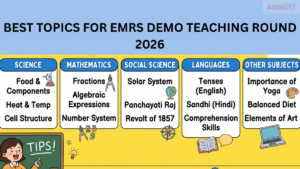
The Demo Teaching round in EMRS selection is your one big chance to show what kind of teacher you are. It is not just about your subject knowledge, the panel watches how you manage the class, talk to students, and handle real teaching situations. This article gives you simple, clear tips to help you prepare well and perform your best on demo day.
What the EMRS panel looks for in demo teaching
Before you prepare, you must understand what the selection panel is actually checking during your demo class. EMRS schools serve tribal students from rural backgrounds, so the panel wants to see if you can connect with these students in a warm and simple way. Your body language, tone, classroom rules, and the way you handle student questions all matter equally.
| What the panel observes | Why it matters |
|---|---|
| How you start the class | First impression shows your confidence and preparation |
| How you manage student attention | Shows your ability to keep tribal rural students engaged |
| How you give instructions | Clear instructions show good classroom leadership |
| How you handle noise or disturbance | Panel checks your patience and discipline skills |
| How you close the class | A proper closure shows lesson planning ability |
| Your use of teaching aids or blackboard | Shows creativity and preparation for low-resource classrooms |
How to start your demo class with confidence
The first two minutes of your demo class are the most important. A strong start tells the panel that you are prepared, calm, and in control. Many candidates lose marks simply because they begin poorly, they look nervous, skip the greeting, or jump straight into the topic without any warm-up. Practice your opening lines at home until they feel completely natural.
- Greet students warmly: Start with a simple “Good morning, class” and ask everyone to sit comfortably. This small gesture shows respect.
- Introduce yourself briefly: Tell students your name and Ask trigger questions Instead of saying “Today we will learn about photosynthesis,” you ask: “Why do plants look green? What do you think plants eat? Where does their food come from?” Students start thinking and guessing.
- Do a quick warm-up: Ask one simple question related to the topic from daily life. This activates prior knowledge and gets students thinking.
- State the learning objective: Tell students clearly what they will learn by the end of the class. This gives them direction and helps them focus.
- Maintain eye contact: Look at the students (or panel) naturally- avoid reading from notes or staring at the blackboard during your introduction.
Classroom engagement tips during the demo lesson
EMRS students come from tribal communities where rote learning has been common, so the panel is especially impressed when a teacher uses participatory and activity-based methods. Simple actions like asking questions, using the blackboard creatively, or doing a short group activity can make a big difference. The goal is to make sure every student feels involved, not just the ones sitting in front.
| Engagement strategy | How to use it in demo class | Time needed |
|---|---|---|
| Question and answer | Ask 2-3 simple questions during the lesson and call different students to answer | 2-3 minutes |
| Think-pair-share | Give a small question, let students discuss with a partner, then share with class | 3-4 minutes |
| Blackboard activity | Ask a student to write a word or draw a diagram on the board | 2 minutes |
| Real-life connection | Relate the topic to something from local tribal life or nature around them | 1-2 minutes |
| Quick recap mid-class | Stop halfway and ask “What have we learned so far?” to check understanding | 1-2 minutes |
Managing discipline and student behaviour during demo
Even in a demo class of 10–15 minutes, you may face small discipline challenges, students talking, not paying attention, or behaving restlessly. How you handle these moments is closely watched by the EMRS panel. They want a teacher who is firm but kind, and who never uses harsh or negative language with students.
| Situation | Recommended response | What to avoid |
|---|---|---|
| Student is talking to a classmate | Walk closer to that student and make eye contact, do not stop teaching | Scolding or calling out loudly |
| Student gives a wrong answer | Say “Good try! Can anyone add to this?”, never say “Wrong!” | Making the student feel ashamed |
| Students seem bored or distracted | Switch activity, ask a question or write something on the board | Continuing in the same way and ignoring the issue |
| Shy student does not respond | Smile and say “Take your time, it’s okay”, move on gently | Forcing or pressuring the student |
| Whole class is noisy | Pause, stand calmly at the front, wait for silence, then continue | Raising your voice or showing frustration |
How to end your demo class and leave a strong impression
Many candidates do not plan their lesson closure properly and either end abruptly or run out of time. The last two minutes of your demo class should feel purposeful, not rushed. A good closure leaves the panel with a clear picture of your teaching ability and makes you stand out from other candidates. Practice ending on time every single time you rehearse.
- Summarise the lesson: Briefly recap the 2–3 main points you covered. You can ask students to tell you what they learnt – this is even better.
- Ask a closing question: Give one simple question based on the lesson to check understanding. It shows that you care about learning outcomes.
- Give a simple homework or reflection task: Mention one small task students can do at home – even if it is just “think about one example from real life.”
- Thank the students and the panel: End with a polite “Thank you, class”- it shows warmth and professionalism at the same time.
- Stick to the time limit: Never go over the allotted time. Finishing on time shows self-discipline and good planning, both are valued highly in EMRS selection.

 Gujarat TAT HS Question Paper 2026 OUT, ...
 UP Education Commission’s Recruitment ...
 Best Topics for EMRS Demo Teaching Round...