Table of Contents
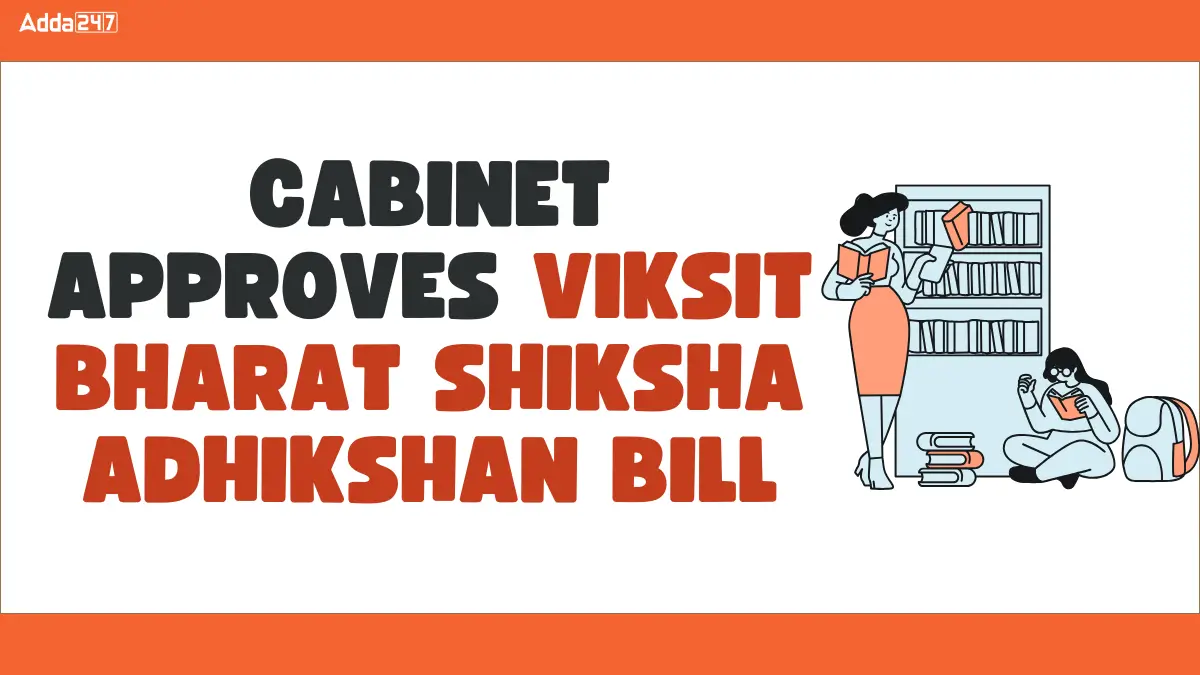
India is preparing for its most significant higher education reform in decades. The Union Cabinet has approved the Viksit Bharat Shiksha Adhikshan Bill, a sweeping legislation that will restructure how universities and colleges are regulated across the country.
Earlier known as the Higher Education Commission of India (HECI) Bill, the renamed bill signals the government’s intent to move decisively towards a single, streamlined regulatory framework, as envisioned under the National Education Policy (NEP) 2020.
Viksit Bharat Shiksha Adhikshan Bill: Overview
| Key Aspect | Details |
|---|---|
| Name of the Bill | Viksit Bharat Shiksha Adhikshan Bill |
| Earlier Name | Higher Education Commission of India (HECI) Bill |
| Approved By | Union Cabinet of India |
| Core Objective | Establish a single higher education regulator |
| Bodies to Be Replaced | UGC, AICTE, NCTE |
| Institutions Covered | All non-medical and non-law higher education institutions |
| Excluded Streams | Medical and Legal Education |
| Policy Alignment | National Education Policy (NEP) 2020 |
| Funding Authority | Department of Higher Education, Ministry of Education |
| Parliamentary Status | To be introduced in Winter Session of Parliament |
What Is the Viksit Bharat Shiksha Adhikshan Bill?
The Viksit Bharat Shiksha Adhikshan Bill proposes the creation of a unified higher education regulator that will take over the regulatory roles currently performed by three separate statutory bodies:
- University Grants Commission for general higher education
- All India Council for Technical Education for technical courses
- National Council for Teacher Education for teacher training
Why Is the Government Replacing UGC, AICTE and NCTE?
For a long time, colleges and universities in India had to follow rules from different regulators for different courses. This often created confusion and extra paperwork. Many rules overlapped, and institutions had to seek approval from multiple bodies for the same work. The new bill aims to fix these problems by bringing everything under one regulator. It is meant to solve issues like:
- Same work being checked by multiple authorities
- Delays in getting approvals and decisions
- Different standards for different courses
- Too much paperwork and compliance pressure on institutions
How the New Unified Regulator Will Function
The proposed Commission will focus strictly on regulation, accreditation, and academic standards. Importantly, it will not control funding. Financial responsibilities will remain with the Department of Higher Education under the Ministry of Education. This separation is intended to prevent conflicts of interest and ensure that academic regulation remains independent of funding decisions.
Four Functional Verticals Under the New Framework
In line with NEP 2020, the new regulatory structure will operate through four clearly defined verticals.
| Vertical | Name of the Body | Key Responsibility | Scope of Work |
|---|---|---|---|
| Vertical 1 | National Higher Education Regulatory Council | Regulation of higher education institutions | Regulates all higher education institutions except medical and legal education |
| Vertical 2 | National Accreditation Council | Quality assurance and accreditation | Accredits institutions and programmes to ensure academic quality |
| Vertical 3 | General Education Council | Academic standards and learning outcomes | Frames curriculum norms, learning outcomes, and academic benchmarks |
| Vertical 4 | Higher Education Grants Council | Funding-related decisions | Recommends grants and funding, while financial control remains with the government |
What Is Excluded From the New Regulator?
Medical and legal education institutions will remain outside the purview of the new Commission. They will continue to be governed by their respective professional councils, recognising the specialised nature of these fields.
From HECI to Viksit Bharat Shiksha Adhikshan
The idea of a unified regulator dates back to 2018, when the draft HECI Bill was first circulated. That proposal sought to repeal the UGC Act but faced resistance over concerns of centralisation and institutional autonomy. NEP 2020 revived the concept with a more balanced approach, recommending:
- Clear separation of regulation and funding
- Reduced duplication of roles
- Stronger quality assurance mechanisms
What Happens to UGC NET December 2025 Exam?
Following the Cabinet’s approval of the Viksit Bharat Shiksha Adhikshan Bill, aspirants may have concerns about UGC NET. However, the reform does not affect the UGC NET December 2025 examination in any manner.
- No change in exam schedule or syllabus
- Exam remains valid for eligibility
- NTA to continue conducting the exam
- NET certificates remain fully valid
- Policy reform does not impact exams
What Universities, Teachers and Students Can Expect
| Stakeholder | What to Expect |
|---|---|
| Universities & Institutions | Fewer regulatory hurdles and simpler approval processes |
| Universities & Institutions | Clear and uniform compliance rules |
| Universities & Institutions | Greater focus on quality teaching and academic outcomes |
| Teachers | Uniform academic and evaluation standards |
| Teachers | More transparent and accountable systems |
| Students | Better credibility and recognition of degrees |
| Students | A fair, transparent, and student-friendly education system |



 UPTET OTR Registration 2026, Check Here ...
 DSSSB Login @Dsssbonline.nic.in, DSSSB R...
 How Many Teaching Jobs Are Available Aft...