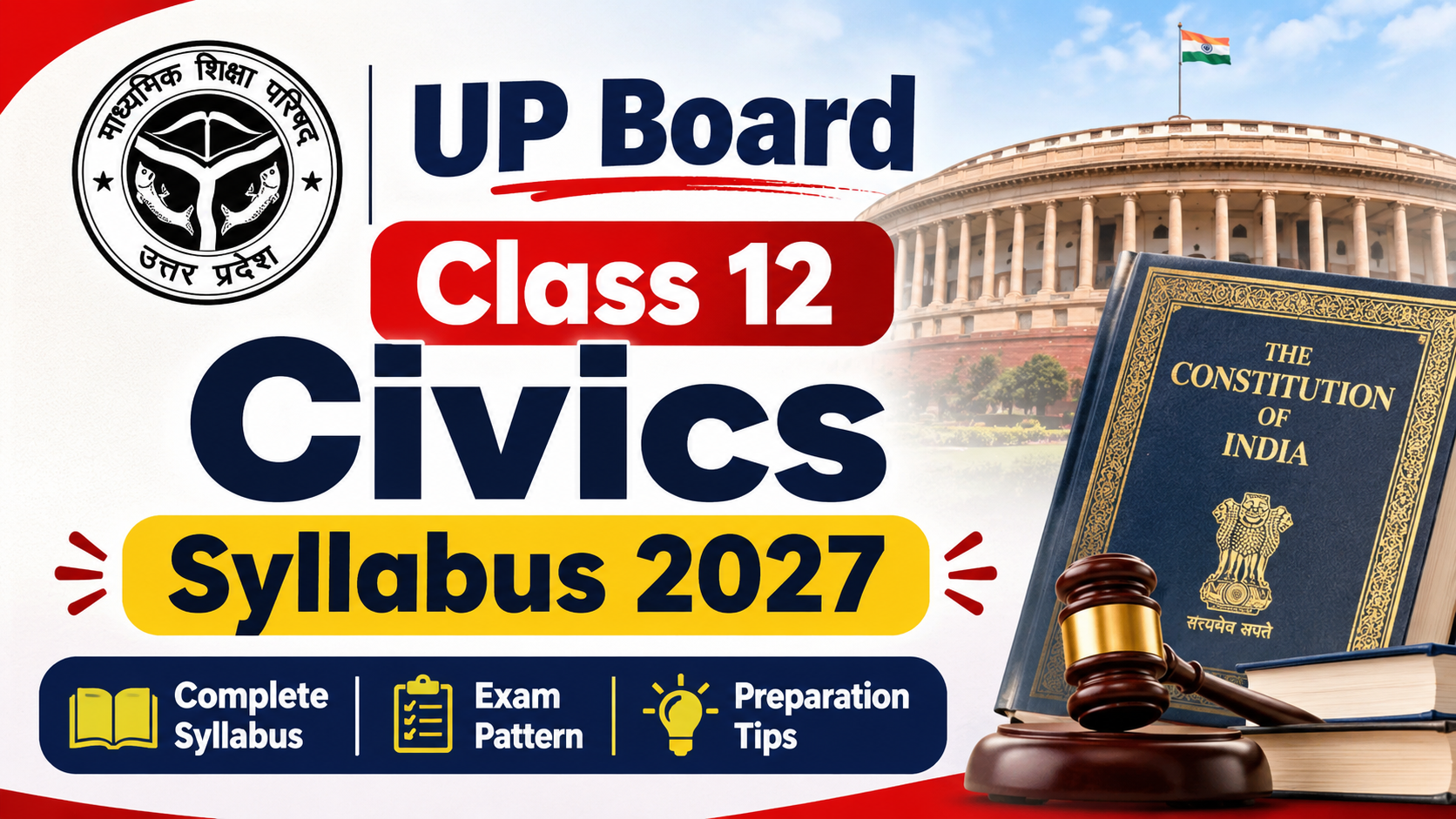
The Uttar Pradesh Madhyamik Shiksha Parishad (UPMSP) has released the UP Board Class 12th Civics Syllabus 2027 for students preparing for the upcoming board examinations. The syllabus helps students to understand the chapters, important topics, practical work and marking scheme prescribed by the board.
The UP Board Class 12 Civics examination is conducted by the Uttar Pradesh Madhyamik Shiksha Parishad (UPMSP) as part of the Intermediate Board Examination. The subject, also known as Political Science or Nagrik Shastra, has a total weightage of 100 marks.
The examination is conducted in offline mode (pen-and-paper format). The paper tests students’ understanding of political concepts, historical developments, democratic institutions and international relations.
UP Board Class 12 Civics Syllabus 2026-27: Overview
The UP Board Class 12 Civics syllabus 2026-27 is prescribed by UPMSP for the academic session 2026-27. The subject is divided into two main sections, each carrying 50 marks. The UP Board Class 12 Civics (Political Science) examination is conducted for 100 marks, with a duration of 3 hours.
| Particulars | Details |
| Board Name | Uttar Pradesh Madhyamik Shiksha Parishad (UPMSP) |
| Examination | UP Board Class 12 Board Examination 2026 |
| Subject | Civics (Political Science) |
| Sections | Section A & B |
| Total Units | 6 |
| Class | 12th / Intermediate |
| Exam Mode | Offline |
| Total Marks | 100 |
| Official Website | upmsp.edu.in |
UP Board Class 12 Civics Syllabus 2026-27: Subject Structure
The syllabus is divided into two sections that cover political developments at the national and international levels.
| Section | Name | Total Marks |
| Section A | Contemporary World Politics | 50 |
| Section B | Politics in Independent India | 50 |
| Total | 100 |
Section A: Contemporary World Politics
This section focuses on international political developments, global organisations, security issues, environmental concerns and globalisation.
Unit-wise syllabus:
| Unit | Chapters / Topics | Marks |
| Unit I | The End of Bipolarity, Contemporary Centres of Power, Contemporary South Asia | 20 |
| Unit II | International Organisations, Security in the Contemporary World | 15 |
| Unit III | Environment and Natural Resources, Globalisation | 15 |
| Total | 50 |
Topics covered:
- Unit I – Disintegration of the Soviet Union, rise of new countries, China’s economic growth, European Union, ASEAN and South Asian political developments.
- Unit II – United Nations, international organisations, traditional and non-traditional security, human rights and migration.
- Unit III – Environmental movements, natural resource conflicts, rights of indigenous people and economic, cultural and political globalisation.
Section B: Politics in Independent India
This section deals with India’s political journey after independence, including nation-building, elections, foreign policy, democratic challenges and regional movements.
Unit-wise syllabus:
| Unit | Chapters / Topics | Marks |
| Unit IV | Challenges of Nation-Building, Era of One-Party Dominance | 16 |
| Unit V | Politics of Planned Development, India’s Foreign Relations, Congress System: Challenges and Restoration | 18 |
| Unit VI | Crisis of Democratic Order, Regional Aspirations, Recent Changes in Indian Politics | 16 |
| Total | 50 |
Topics covered:
- Unit IV – Partition, rehabilitation of refugees, integration of princely states, reorganisation of states and Congress dominance.
- Unit V – Five-Year Plans, Nehru’s foreign policy, India-China War of 1962, India-Pakistan Wars of 1965 and 1971, and changes in the Congress system.
- Unit VI – Emergency, Gujarat and Bihar movements, regional parties, Punjab crisis, Kashmir, North-East India and coalition politics.
UP Board Class 12 Civics Exam Pattern 2027
Understanding the examination pattern helps students know how many questions they need to attempt and how marks are distributed across different question types.
According to the official UPMSP syllabus, the Civics examination carries 100 marks and includes 32 questions.
| Type of Questions | Number of Questions | Marks per Question | Total Marks |
| Multiple Choice Questions | 10 | 1 | 10 |
| Very Short Answer | 10 | 2 | 20 |
| Short Answer – I | 6 | 5 | 30 |
| Short Answer – II | 4 | 6 | 24 |
| Long Answer | 2 | 8 | 16 |
| Total | 32 | 100 |
Note: Students should follow the latest official UPMSP syllabus and examination instructions. The question distribution above is taken from the 2026-27 official Civics syllabus, not the older pattern mentioned in the reference article.
UP Board Class 12 Civics Syllabus 2027: Marking Scheme
The Civics syllabus carries 100 marks, equally divided between Contemporary World Politics and Politics in Independent India. However, the marks allotted to individual units are different.
| Section | Unit | Marks |
| A | Unit I | 20 |
| A | Unit II | 15 |
| A | Unit III | 15 |
| B | Unit IV | 16 |
| B | Unit V | 18 |
| B | Unit VI | 16 |
| Total | 6 Units | 100 |
Students should give proper attention to all six units while preparing for the examination. Unit I carries the highest weightage of 20 marks, followed by Unit V with 18 marks.
UP Board Class 12 Civics Preparation Strategy 2026–27
Preparing for the UP Board Class 12 Civics examination becomes easier when students follow a smart and organised study approach. Instead of simply memorising political events and definitions, students should focus on understanding concepts, connecting historical developments and practising answer writing. Here are some different and effective preparation strategies to help students score good marks.
1. Prepare a Political Timeline
Create a timeline of important political events, such as India’s independence, the formation of the Planning Commission, the Emergency and the disintegration of the Soviet Union. This will help you remember important dates and understand the sequence of events.
2. Study Through Real-Life Examples
Connect textbook topics with real political situations. For example, while studying democracy, understand how elections, political parties and government institutions work in India. This makes theoretical concepts easier to understand.
3. Turn Every Chapter into Questions
After completing a chapter, prepare 5–10 questions from its important topics. Practise answering them without looking at your textbook. This will help you identify weak areas and improve your understanding.
4. Use Comparison Tables for Difficult Topics
Some Civics chapters include similar political concepts that students may find confusing. Prepare comparison tables to understand the differences clearly.
For example:
- Traditional Security vs Non-Traditional Security
- Bipolarity vs Unipolarity
- National Political Parties vs Regional Political Parties
- Globalisation vs Liberalisation
5. Practise Answer Writing with a Structure
Do not write lengthy paragraphs without proper organisation. Divide your answers into three parts:
- Introduction: Briefly explain the topic.
- Main Body: Write important points with explanations and examples.
- Conclusion: End with a relevant summary.
6. Follow a Weekly Revision Challenge
Instead of revising the entire syllabus just before examinations, divide your preparation into weekly targets. Complete selected chapters, revise previously studied topics and solve practice questions every week.
7. Learn Important Political Terms
Prepare a separate list of important terms such as sovereignty, federalism, coalition government, globalisation, disarmament and liberalisation. Learn their meanings and practise using them in answers.
8. Test Your Preparation with Mock Papers
Once you complete the syllabus, solve UP Board model papers under examination-like conditions. Set a timer, follow the question paper format and check your answers to understand where you need improvement.
9. Give Equal Attention to Both Sections
The Civics syllabus contains two major sections, each carrying 50 marks. Therefore, do not focus only on Indian Politics or Contemporary World Politics. Prepare both sections properly to maintain balanced performance.
The UP Board Class 12 Civics syllabus 2025-26 covers important topics related to Indian politics, international relations, democracy and global developments. Students should understand all six units, follow the prescribed syllabus and practise previous year question papers regularly. A proper study plan, regular revision and consistent answer-writing practice can help students prepare confidently for the UP Board Class 12 Civics examination.
UP Board Class 12 Civics 2026-27: FAQs
Q1. How many units are included in the UP Board Class 12 Civics syllabus 2026-27?
Ans. The syllabus includes six units divided into two sections: Contemporary World Politics and Politics in Independent India.
Q2. How many marks is the UP Board Class 12 Civics exam worth?
Ans. The Civics examination carries a total of 100 marks.
Q3. What is the subject code for UP Board Class 12 Civics?
Ans. The subject code for Class 12 Civics is 130.
Q4. Which unit carries the highest weightage in the Civics syllabus?
Ans. Unit I, covering the End of Bipolarity, Contemporary Centres of Power and Contemporary South Asia, carries the highest weightage of 20 marks.
Q5. How many questions are asked in the UP Board Class 12 Civics examination?
Ans. According to the official 2026-27 syllabus, the examination includes 32 questions of different types.
Q6. Is practical examination included in UP Board Class 12 Civics?
Ans. The official syllabus specifies a total of 100 marks for the written Civics examination and does not list a separate practical examination.
Q7. Where can students download the UP Board Class 12 Civics syllabus PDF?
Ans. Students can download the syllabus from the official UPMSP website at upmsp.edu.in.
The UP Board Class 12 Civics syllabus 2025-26 covers important topics related to Indian politics, international relations, democracy and global developments. Students should understand all six units, follow the prescribed syllabus and practise previous year question papers regularly. A proper study plan, regular revision and consistent answer-writing practice can help students prepare confidently for the UP Board Class 12 Civics examination.

 UP Board Class 12 Business Studies Sylla...
 CBSE Class 12 Accountancy Syllabus 2026-...
 UP Board Class 10 Time Table 2027, Check...