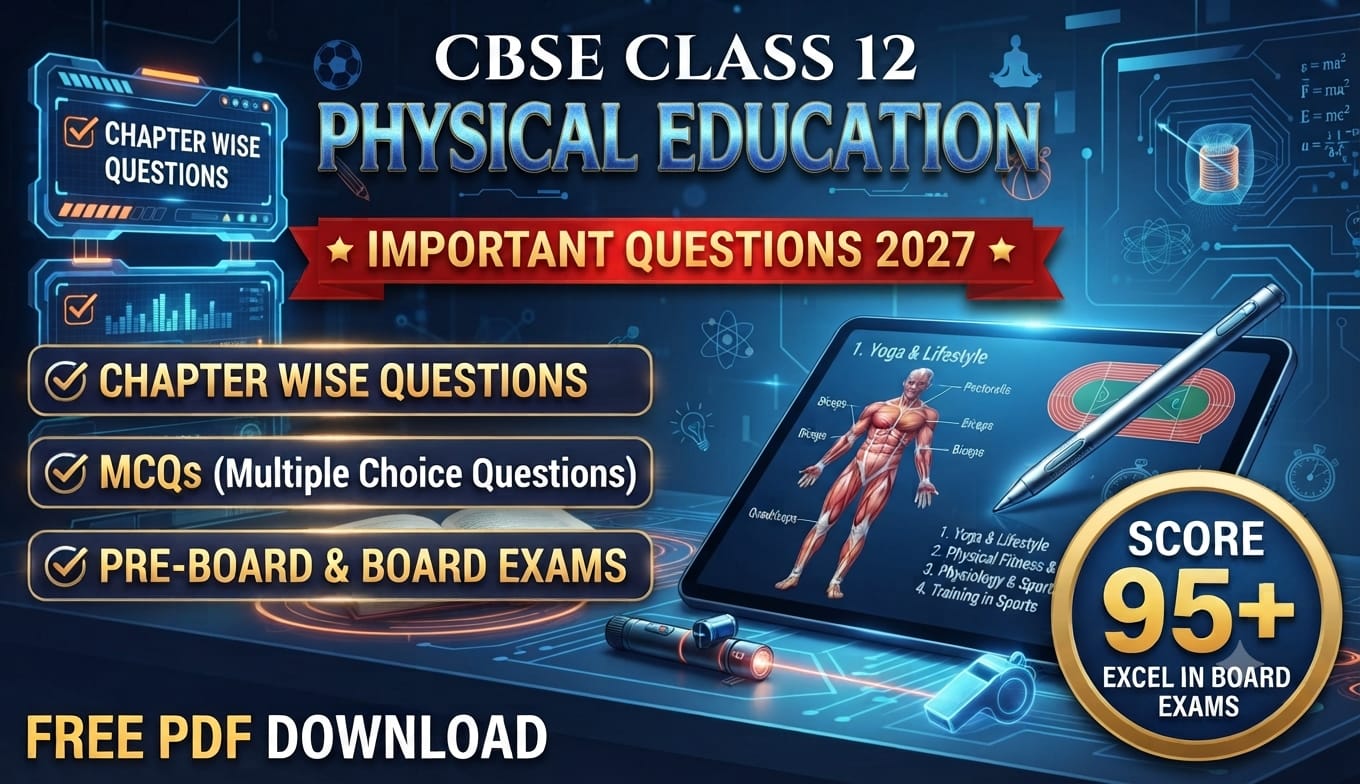
Physical Education is an important subject for CBSE Class 12 students. With the right preparation strategy, students can understand the concepts, revise important topics and practise different types of questions before the board examination. To help students prepare effectively, we have compiled the CBSE Class 12 Physical Education Important Questions 2027 based on the latest CBSE syllabus for the 2026–27 academic session. This article covers all 10 theory units, chapter-wise important questions, MCQs, case-based questions and preparation tips.
CBSE Class 12 Physical Education Important Questions 2027: Overview
To help you streamline your revision for the 2027 board exams, the table below summarises the key structure, marking scheme, and question formats covered in this Class 12 Physical Education guide.
| Particulars | Details |
| Board | Central Board of Secondary Education (CBSE) |
| Class | 12th |
| Subject | Physical Education |
| Subject Code | 048 |
| Academic Session| | 2026–27 |
| Board Exam Year | 2027 |
| Theory Marks | 70 |
| Project Work | 30 |
| Total Marks | 100 |
| Theory Exam Duration | 3 Hours |
| Question Type | MCQs, Short Answer and Long Answer Questions |
| Official Website | cbseacademic.nic.in |
CBSE Class 12 Physical Education Exam Pattern 2027
According to the CBSE Class 12 Physical Education syllabus 2026–27. The theory syllabus includes 10 units covering sports event management, yoga, nutrition, sports injuries, biomechanics, psychology and sports training.
| Particulars | Details |
| Theory Marks | 100 |
| Practical assessment | 30 |
| Total | 100 |
CBSE Class 12 Physical Education Important Questions 2027: Unit-Wise
Practising questions from every unit helps students cover the complete syllabus. Below are important practice questions from all 10 units.
Unit 1: Management of Sporting Events
This unit explains the planning, organisation and management of sports competitions and events.
Important Questions:
1. What is sports event management? Explain its major functions.
2. Describe the five functions of sports event management.
3. Explain the responsibilities of various committees before, during and after a sports event.
4. What is a knockout tournament? Explain its advantages and disadvantages.
5. Differentiate between knockout and league tournaments.
6. Explain the staircase method of preparing fixtures.
7. What is a bye? How is it calculated in a knockout tournament?
8. Explain the meaning and importance of intramural and extramural competitions.
9. What are community sports programmes? Explain their importance.
10. Differentiate between cyclic and tabular methods of league fixture preparation.
Unit 2: Children and Women in Sports
This unit focuses on physical activity, women’s participation in sports, postural deformities and exercise guidelines.
Important Questions:
1. Explain the physical, psychological and social benefits of sports participation for women.
2. What are the common postural deformities? Explain any four.
3. Explain the causes and corrective measures of knock knees and flat feet.
4. What is kyphosis? Explain its causes and corrective exercises.
5. Discuss the importance of physical activity for children.
6. Explain the WHO exercise guidelines for different age groups.
7. What is menarche? Explain its importance in understanding women’s health in sports.
8. What is menstrual dysfunction? How can it affect sports participation?
9. Explain the causes and corrective measures of lordosis and scoliosis.
10. Discuss the importance of equal opportunities for women in sports.
Unit 3: Yoga as a Preventive Measure for Lifestyle Disease
This unit explains the importance of yoga and different asanas for preventing and managing lifestyle-related diseases.
Important Questions:
1. What is yoga? Explain its importance in daily life.
2. How does yoga help in preventing lifestyle diseases?
3. Explain the benefits of yoga for individuals with obesity.
4. Describe suitable yoga practices for managing hypertension.
5. Explain the benefits of yoga for people with diabetes.
6. What is asthma? Explain how yoga may support people with asthma.
7. Explain the procedure and benefits of Tadasana.
8. Describe the procedure, benefits and precautions of Bhujangasana.
9. Explain the benefits and procedure of Pawanmuktasana.
10. Discuss the role of yoga in maintaining physical and mental well-being.
Unit 4: Physical Education and Sports for CWSN
This unit deals with the participation of children with special needs in physical education and sports.
Important Questions:
1. What is the meaning of CWSN?
2. Explain the objectives of adaptive physical education.
3. Discuss the importance of physical activities for children with special needs.
4. What are the major organisations working for the development of sports for persons with disabilities?
5. Explain the role of the Paralympic Games.
6. What are the Special Olympics? Explain their objectives.
7. Differentiate between the Paralympics and Special Olympics.
8. Explain the concept of inclusion in physical education.
9. Discuss the role of teachers in making sports activities accessible to all students.
10. What is the importance of assistive technology in sports?
Unit 5: Sports and Nutrition
This unit focuses on nutrients, balanced diets, eating habits and the importance of nutrition for sports performance.
Important Questions:
1. What is a balanced diet? Explain its importance for sports persons.
2. Differentiate between macronutrients and micronutrients.
3. Explain the functions of carbohydrates, proteins and fats.
4. What are vitamins? Explain the importance of vitamins in the human body.
5. Differentiate between fat-soluble and water-soluble vitamins.
6. Explain the importance of minerals in sports nutrition.
7. What is a nutritive and non-nutritive component of a diet?
8. Explain the importance of hydration for sports persons.
9. What is a pre-competition meal? Explain its importance.
10. Discuss the harmful effects of unhealthy eating habits on sports performance.
Unit 6: Test and Measurement in Sports
This unit covers different fitness tests, measurements and assessment methods used in sports.
Important Questions:
1. What is the importance of test, measurement and evaluation in physical education?
2. Explain the procedure of the Harvard Step Test.
3. What is the purpose of the Rikli and Jones Senior Citizen Fitness Test?
4. Explain the procedure of the Chair Stand Test.
5. Describe the Back Scratch Test.
6. What is the purpose of the Chair Sit and Reach Test?
7. Explain the procedure of the 600-metre run/walk test.
8. What is the importance of the BMI in health assessment?
9. Explain the method of calculating Body Mass Index.
10. Discuss the importance of fitness assessment for sports persons.
Unit 7: Physiology and Injuries in Sport
This unit explains the effects of physical activity on the body and the types, causes and prevention of sports injuries.
Important Questions:
1. What is sports physiology? Explain its importance.
2. Explain the effects of exercise on the muscular system.
3. Discuss the effects of exercise on the cardiovascular system.
4. What are the physiological factors determining physical fitness?
5. Differentiate between aerobic and anaerobic activities.
6. What are soft tissue injuries? Explain with examples.
7. Differentiate between sprain and strain.
8. Explain the meaning and causes of fractures.
9. What are the common methods of preventing sports injuries?
10. Explain the importance of proper warm-up and cool-down exercises.
Unit 8: Biomechanics and Sports
Biomechanics explains the application of mechanical principles to human movement and sports performance.
Important Questions:
1. What is biomechanics? Explain its importance in sports.
2. Explain Newton’s three laws of motion with sports-related examples.
3. What is friction? Explain its importance in sports activities.
4. Explain the concept of projectile motion in sports.
5. What are the different types of levers in the human body?
6. Explain the importance of balance and stability in sports.
7. Differentiate between linear motion and angular motion.
8. What is force? Explain its role in sports performance.
9. Discuss the importance of centre of gravity in maintaining balance.
10. Explain how biomechanics helps improve sports techniques and performance.
Unit 9: Psychology and Sports
This unit focuses on personality, motivation, aggression, self-esteem and psychological factors affecting sports performance.
Important Questions:
1. What is sports psychology? Explain its importance.
2. Explain the different dimensions of personality.
3. What is motivation? Discuss its types.
4. Differentiate between intrinsic and extrinsic motivation.
5. Explain the importance of self-esteem in sports.
6. What is aggression? Explain its types in sports.
7. Discuss the relationship between exercise and mental health.
8. Explain the role of goal setting in improving sports performance.
9. What is team cohesion? Why is it important?
10. Explain the importance of stress management for sports persons.
Unit 10: Training in Sports
This unit explains sports training methods, strength, endurance, speed, flexibility and coordination.
Important Questions:
1. What is sports training? Explain its main objectives.
2. Explain the different methods of developing strength.
3. What is endurance? Describe its different types.
4. Explain the methods of developing speed.
5. What is flexibility? Discuss its importance in sports.
6. Explain the different methods of developing flexibility.
7. What is circuit training? Explain its advantages.
8. Differentiate between continuous training and interval training.
9. What is fartlek training? Explain its importance.
10. Explain the meaning and importance of coordinative abilities.
11. What are the different types of coordinative abilities?
12. Discuss the importance of warm-up and cool-down in sports training.
Important MCQs for Pre- Board& Board 2027
MCQs help students revise important definitions, concepts and facts from all units. Practise the following questions for your pre-board and board examinations.
1. Which of the following is the first function of sports event management?
A. Controlling
B. Planning
C. Directing
D. Staffing
Answer: B. Planning
2. A knockout tournament is also known as:
A. League tournament
B. Elimination tournament
C. Round-robin tournament
D. Cyclic tournament
Answer: B. Elimination tournament
3. Which of the following is a postural deformity?
A. Kyphosis
B. Endurance
C. Flexibility
D. Speed
Answer: A. Kyphosis
4. Which yoga asana is commonly associated with improving posture?
A. Tadasana
B. Shavasana
C. Makarasana
D. None of these
Answer: A. Tadasana
5. Who is known as the father of the Paralympic Games?
A. Pierre de Coubertin
B. Dr. Ludwig Guttmann
C. James Naismith
D. Thomas Bach
Answer: B. Dr. Ludwig Guttmann
6. Which nutrient is mainly responsible for body-building and tissue repair?
A. Carbohydrates
B. Proteins
C. Water
D. Minerals
Answer: B. Proteins
7. Which of the following vitamins is water-soluble?
A. Vitamin A
B. Vitamin D
C. Vitamin C
D. Vitamin E
Answer: C. Vitamin C
8. BMI stands for:
A. Body Mass Index
B. Body Movement Indicator
C. Basic Muscle Index
D. Body Measurement Information
Answer: A. Body Mass Index
9. Which of the following is a soft tissue injury?
A. Sprain
B. Dislocation
C. Fracture
D. None of these
Answer: A. Sprain
10. Newton’s First Law of Motion is also known as:
A. Law of Acceleration
B. Law of Inertia
C. Law of Reaction
D. Law of Gravity
Answer: B. Law of Inertia
11. Which psychological factor helps sports persons achieve their goals?
A. Motivation
B. Confusion
C. Distraction
D. Fear
Answer: A. Motivation
12. Intrinsic motivation comes from:
A. External rewards
B. Personal interest and satisfaction
C. Financial benefits
D. Awards only
Answer: B. Personal interest and satisfaction
13. Which training method involves continuous activity without rest intervals?
A. Interval training
B. Continuous training
C. Circuit training
D. Weight training
Answer: B. Continuous training
14. Which component of physical fitness is related to the range of movement around a joint?
A. Strength
B. Speed
C. Flexibility
D. Endurance
Answer: C. Flexibility
15. Which of the following is a method of developing endurance?
A. Continuous training
B. Only stretching
C. Only meditation
D. Static balance
Answer: A. Continuous training
Important Long Answer Questions for CBSE Class 12 Physical Education 2027
Students should practise descriptive questions to improve their understanding of concepts and answer-writing skills.
1. Explain the functions of sports event management and the responsibilities of different committees.
2. Describe knockout and league tournaments with their advantages and disadvantages.
3. Explain the major postural deformities and their corrective measures.
4. Discuss the importance of yoga in preventing lifestyle diseases.
5. Explain the role of nutrition and a balanced diet in sports performance.
6. Describe the procedure and importance of the Rikli and Jones Senior Citizen Fitness Test.
7. Explain the effects of regular exercise on the muscular and cardiovascular systems.
8. Discuss Newton’s three laws of motion with suitable examples from sports.
9. Explain the different types of motivation and their importance in sports.
10. Describe the methods of developing strength, endurance, speed and flexibility.
Case-Based Questions for Physical Education Board Exam 2027
Case-based questions test students’ ability to apply theoretical concepts to practical situations.
Case Study 1: Sports Event Management
A school is organising an annual sports competition. The sports teacher forms different committees to manage registration, equipment, refreshments, first aid and event arrangements.
Questions:
1. Which function of sports management is reflected in the formation of committees?
2. Mention any two responsibilities of the organising committee.
3. Why is planning important before conducting a sports event?
Case Study 2: Sports and Nutrition
A student participating in athletics follows a balanced diet that includes carbohydrates, proteins, fats, vitamins and minerals. The student also maintains proper hydration during training.
Questions:
1. What is a balanced diet?
2. Which nutrient is the main source of energy for the body?
3. Why is hydration important during physical activity?
Case Study 3: Biomechanics and Sports
A basketball player jumps to shoot the ball towards the basket. The ball follows a curved path before reaching the target.
Questions:
1. Which concept of biomechanics is demonstrated in this situation?
2. What is projectile motion?
3. Mention one factor that can influence the path of a projectile.
Case Study 4: Psychology and Sports
A player sets a personal target to improve performance. The player practises regularly because of personal interest and satisfaction rather than external rewards.
Questions:
1. Which type of motivation is demonstrated?
2. What is goal setting?
3. Explain one benefit of motivation in sports.
Important Topics to Revise for CBSE Class 12 Physical Education 2027
- Important Topics
Functions of management, committees, fixtures, tournaments, community sports - Postural deformities, WHO guidelines, women’s participation, menstrual dysfunction
- Yoga asanas, benefits, precautions, lifestyle diseases
- Adaptive physical education, inclusion, Paralympics, Special Olympics
- Balanced diet, macro and micronutrients, hydration, nutrition for sports persons
- BMI, Harvard Step Test, Rikli and Jones Test, fitness assessment
- Effects of exercise, sports injuries, injury prevention
- Newton’s laws, friction, projectile motion, levers, balance
- Personality, motivation, aggression, self-esteem, team cohesion
- Strength, endurance, speed, flexibility, circuit and interval training
How to Prepare for CBSE Class 12 Physical Education Board Exam 2027?
Students can improve their preparation by following a regular study and revision routine.
1. Complete the Prescribed Syllabus
Start by covering all 10 units included in the CBSE Class 12 Physical Education syllabus. Do not leave any chapter completely unprepared.
2. Focus on Important Definitions
Learn the definitions of important terms such as biomechanics, motivation, endurance, flexibility, balanced diet, sports management and physical fitness.
3. Practise MCQs Regularly
Solve MCQs from every unit to improve your understanding of important concepts and factual information.
4. Prepare Diagrams and Tables
Practise diagrams related to fixtures, yoga asanas, body movements and fitness tests wherever relevant. Tables can also help you revise differences between concepts.
5. Understand Practical Procedures
Pay attention to the procedures, measurements and scoring methods of fitness tests included in the syllabus.
6. Solve the Official Sample Paper
Practise the latest CBSE Class 12 Physical Education Sample Question Paper 2026–27. Check the official marking scheme to understand the expected answer format.
7. Revise High-Weightage Units
Biomechanics and Sports carries 10 marks, while Training in Sports carries 9 marks and Test and Measurement in Sports carries 8 marks. Give these units proper attention, but do not ignore the remaining chapters.
FAQs
Q1. What is the subject code for CBSE Class 12 Physical Education?
The subject code for CBSE Class 12 Physical Education is 048.
Q2. How many marks is the CBSE Class 12 Physical Education theory paper worth?
The theory paper carries 70 marks, while practical assessment carries 30 marks. The total is 100 marks.
Q3. How many units are included in the CBSE Class 12 Physical Education syllabus 2026–27?
The syllabus includes 10 theory units covering sports management, yoga, nutrition, biomechanics, psychology and sports training, among other topics.
Q4. Which unit carries the highest marks in Physical Education Class 12?
Biomechanics and Sports carries the highest unit-wise weightage of 10 marks in the 2026–27 syllabus.






 CBSE Class 12 Political Science Importan...
 CBSE Class 12 Geography Important Questi...
 CBSE Class 12 Psychology Important Quest...