
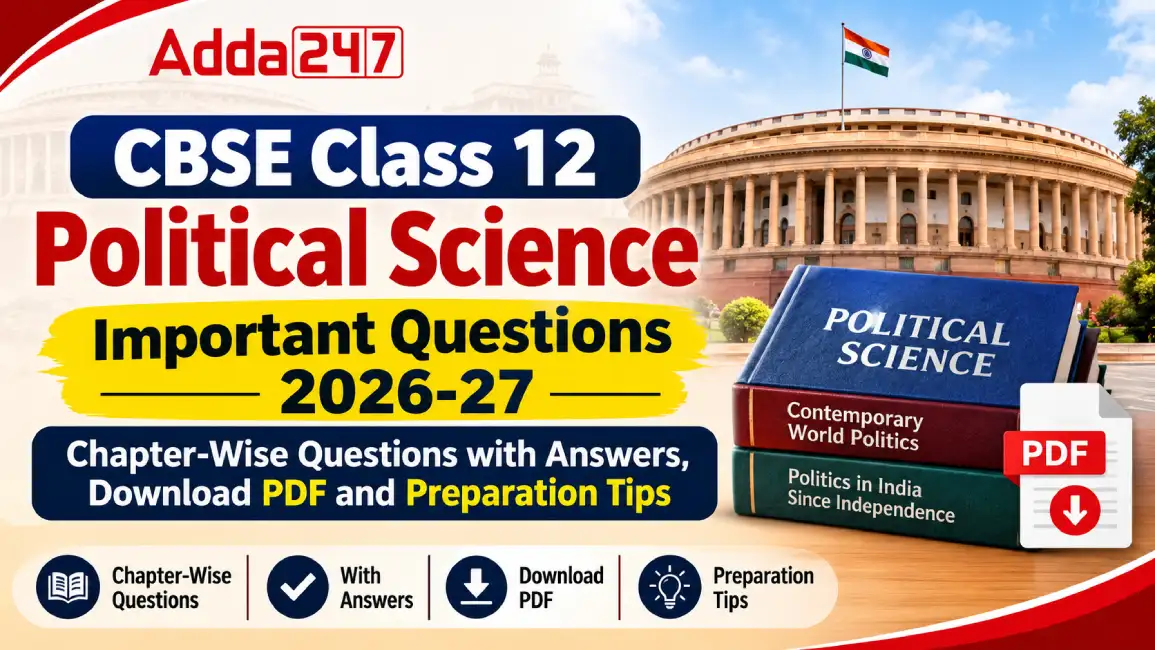
CBSE Class 12 Political Science Important Questions 2026-27 will help students prepare effectively for their upcoming board examinations. Political Science is an important subject for Humanities and Arts students, covering topics related to contemporary world politics, India’s political developments, international relations, democracy and globalisation.
Practicing chapter-wise important questions helps students understand important concepts, revise NCERT topics and improve their answer-writing skills. Students should focus on both parts of the syllabus, Contemporary World Politics and Politics in India Since Independence.
CBSE Class 12 Political Science Important Questions 2026-27: Overview
The following table provides important details about the CBSE Class 12 Political Science examination.
| Particulars | Details |
| Board | Central Board of Secondary Education (CBSE) |
| Class | 12th |
| Subject | Political Science |
| Subject Code | 028 |
| Academic Session | 2026-27 |
| Exam Year | 2027 |
| Subject Stream | Arts/Humanities |
| Study Material | NCERT Textbooks |
| Examination Mode | Offline (Pen and Paper) |
| Official Website | cbse.gov.in |
CBSE Class 12 Political Science Exam Pattern 2026-27
The CBSE Class 12 Political Science examination 2026-27 is conducted for a total of 100 marks, including 80 marks for the theory paper and 20 marks for project work. The theory examination is conducted for 3 hours and includes different types of questions to assess students’ conceptual understanding, analytical skills and knowledge of political developments.
| Question Type | Number of Questions | Marks |
| Objective Type | 12 | 12 |
| Short Answer Type I | 6 | 12 |
| Short Answer Type II | 5 | 20 |
| Passage/Map/Cartoon-Based | 3 | 12 |
| Long Answer Type | 4 | 24 |
| Total Theory Marks | 30 | 80 |
| Project Work | — | 20 |
| Grand Total | — | 100 |
CBSE Class 12 Political Science Syllabus 2026-27: Chapter-Wise Overview
According to the official CBSE Political Science syllabus for the 2026-27 academic session, the Class 12 syllabus is divided into two parts. Each part carries 40 marks in the theory examination, making the total theory paper worth 80 marks. Students also have a 20-mark project assessment.
Part A: Contemporary World Politics
This section focuses on international relations, global political developments, international organisations and environmental issues.
| Chapter Name | Marks |
| The End of Bipolarity | 6 |
| Contemporary Centres of Power | 6 |
| Contemporary South Asia | 6 |
| International Organizations | 6 |
| Security in the Contemporary World | 6 |
| Environment and Natural Resources | 6 |
| Globalisation | 4 |
| Total | 40 |
Part B: Politics in India Since Independence
This section covers India’s political journey after independence, including nation-building, political parties, democratic developments and foreign relations.
| Chapter Name | Marks |
| Challenges of Nation-Building | 6 |
| Era of One-Party Dominance | 4 |
| Politics of Planned Development | 2 |
| India’s External Relations | 6 |
| Challenges to and Restoration of the Congress System | 4 |
| The Crisis of Democratic Order | 4 |
| Regional Aspirations | 6 |
| Recent Developments in Indian Politics | 8 |
| Total | 40 |
CBSE Class 12 Political Science Important Questions 2026-27: Part A
Here are some important practice questions from Contemporary World Politics. These questions cover definitions, major political events, comparisons and analytical concepts.
Chapter 1: The End of Bipolarity
This chapter explains the disintegration of the Soviet Union, the end of the Cold War and the emergence of new countries.
Important Questions:
- What was the Soviet system? Explain its main features.
- What were the major reasons behind the disintegration of the Soviet Union?
- Explain the role of Mikhail Gorbachev in the disintegration of the USSR.
- What was Shock Therapy? Discuss its consequences.
- Explain the consequences of the disintegration of the Soviet Union for world politics.
Sample Answer: Why did the Soviet Union disintegrate?
The Soviet Union disintegrated in 1991 due to several political, economic and social reasons:
- Economic stagnation and declining productivity weakened the Soviet system.
- Political reforms introduced by Mikhail Gorbachev created new demands for change.
- Several republics demanded greater independence.
- The Communist Party lost its political control and public support.
- Nationalist movements increased in different Soviet republics.
As a result, the Soviet Union broke into several independent countries, bringing an end to bipolar world politics.
Chapter 2: Contemporary Centres of Power
This chapter discusses the emergence of new economic and political powers in the world.
Important Questions:
- What is the European Union? Explain its major objectives.
- Discuss the role of ASEAN in international politics.
- Explain the reasons behind China’s emergence as an economic power.
- Compare the European Union and ASEAN.
- Discuss the growing importance of Japan and South Korea in world politics.
Sample Answer: What is ASEAN?
ASEAN stands for the Association of Southeast Asian Nations. It is a regional organisation established in 1967 to promote cooperation among Southeast Asian countries. Its major objectives include:
- Promoting economic growth and regional development.
- Maintaining peace and stability in the region.
- Encouraging cultural and social cooperation.
- Strengthening trade and diplomatic relations among member countries.
Chapter 3: Contemporary South Asia
This chapter focuses on democracy, political conflicts, regional cooperation and relationships among South Asian countries.
Important Questions:
- Explain the major challenges faced by democracy in Pakistan.
- Discuss the political developments in Nepal.
- Explain the ethnic conflict in Sri Lanka.
- Describe the major areas of conflict between India and Pakistan.
- What is SAARC? Explain its objectives and importance.
Sample Answer: What are the main objectives of SAARC?
SAARC stands for the South Asian Association for Regional Cooperation. It was established in 1985 to promote cooperation among South Asian countries.
Its main objectives are:
- Promoting economic and social development.
- Improving the living standards of people.
- Encouraging cooperation in education, science and technology.
- Strengthening regional peace and understanding.
- Promoting mutual trust among member countries.
Chapter 4: International Organizations
This chapter explains the importance of international organisations, particularly the United Nations, in maintaining global peace and cooperation.
Important Questions:
- What are international organisations? Why are they important?
- Explain the main objectives and functions of the United Nations.
- Describe the five permanent members of the UN Security Council.
- Why are reforms needed in the United Nations?
- Explain the functions of the World Health Organization and UNESCO.
Sample Answer: Why are reforms needed in the United Nations?
Reforms are necessary in the United Nations to make it more effective and representative of the present world.
- The current structure does not fully represent today’s global political and economic realities.
- Developing countries need greater representation.
- The Security Council requires changes in its membership.
- The organisation needs stronger mechanisms to address international conflicts.
- Reforms can improve transparency and decision-making.
Chapter 5: Security in the Contemporary World
This chapter explains different types of security threats and the importance of international cooperation.
Important Questions:
- What is traditional security? Explain its main features.
- Differentiate between traditional and non-traditional security.
- What are the major threats to human security?
- Explain the concept of cooperative security.
- Discuss the importance of disarmament in maintaining world peace.
Sample Answer: Differentiate between traditional and non-traditional security.
| Traditional Security | Non-Traditional Security |
| Focuses mainly on military threats. | Focuses on broader threats to human life and society. |
| Protects the sovereignty and territorial integrity of a country. | Focuses on human security and collective well-being. |
| Includes wars and military attacks. | Includes poverty, epidemics and environmental threats. |
| Primarily involves national defence. | Requires national and international cooperation. |
Chapter 6: Environment and Natural Resources
This chapter discusses environmental challenges, natural resources and international efforts to protect the environment.
Important Questions:
- What is sustainable development?
- Explain the major environmental concerns faced by the world.
- What is the importance of the Earth Summit?
- Explain the concept of the global commons.
- Discuss the relationship between environmental protection and international cooperation.
Sample Answer: What is sustainable development?
Sustainable development refers to development that fulfils the needs of the present generation without reducing the ability of future generations to fulfil their own needs.
Its major features are:
- Proper use of natural resources.
- Protection of biodiversity.
- Reduction of pollution.
- Promotion of renewable energy.
- Balance between economic growth and environmental protection.
Chapter 7: Globalisation
This chapter explains the meaning, causes and effects of globalization on different countries.
Important Questions:
- What is globalisation? Explain its major causes.
- Discuss the economic impact of globalisation.
- Explain the cultural consequences of globalisation.
- What is the role of technology in promoting globalisation?
- Discuss the positive and negative effects of globalisation on India.
Sample Answer: What are the major causes of globalization?
Globalisation has increased due to several factors:
- Technology: Development in communication and information technology has connected different countries.
- Transportation: Better transportation facilities have increased international trade.
- Economic liberalisation: Reduced trade restrictions have encouraged global business.
- International organisations: Organisations such as the WTO have supported international economic cooperation.
- Growing interdependence: Countries increasingly depend on each other for goods, services and technology.
CBSE Class 12 Political Science Important Questions 2026-27: Part B
The second part of the syllabus focuses on India’s political developments after independence. These chapters are important for understanding nation-building, democratic institutions, foreign policy and political changes.
Chapter 1: Challenges of Nation-Building
Important Questions:
- What were the major challenges faced by India immediately after independence?
- Explain the process of integration of princely states into India.
- Discuss the circumstances that led to the partition of India.
- Why was the reorganisation of states necessary?
- Explain the role of Sardar Vallabhbhai Patel in national integration.
Sample Answer: What were the major challenges faced by India after independence?
India faced several challenges after gaining independence in 1947:
- National integration: Bringing different princely states together was a major task.
- Partition: The country faced migration and rehabilitation challenges.
- Democracy: Establishing democratic institutions and conducting elections was important.
- Economic development: Poverty, unemployment and low industrial growth required attention.
- Social unity: Maintaining national unity among people from different linguistic, religious and cultural backgrounds was essential.
Chapter 2: Era of One-Party Dominance
Important Questions:
- Why did the Congress Party dominate Indian politics after independence?
- Explain the main features of the Congress system.
- What role did opposition parties play during the one-party dominance period?
- Differentiate between one-party dominance and a one-party system.
- Explain the reasons behind the Congress Party’s electoral success in the early years.
Sample Answer: Why did the Congress Party dominate Indian politics after independence?
The Congress Party dominated Indian politics because:
- It had a strong role in the national freedom movement.
- It enjoyed the support of a large section of the population.
- It had experienced and popular political leaders.
- It had a well-established organisational network.
- It represented different social and political groups.
Chapter 3: Politics of Planned Development
Important Questions:
- What is planned development?
- Explain the objectives of the Planning Commission.
- What were the main objectives of the First Five-Year Plan?
- Differentiate between the capitalist and socialist models of development.
- Why was agriculture given importance in India’s early development plans?
Sample Answer: What was the main objective of planned development in India?
Planned development aimed to improve India’s economic and social conditions through organised government planning.
Its major objectives included:
- Increasing agricultural and industrial production.
- Reducing poverty and unemployment.
- Promoting economic equality.
- Improving infrastructure and public services.
- Achieving balanced regional development.
Chapter 4: India’s External Relations
Important Questions:
- What is the Non-Aligned Movement (NAM)?
- Explain the main principles of India’s foreign policy.
- Discuss India’s relationship with China.
- Explain the major causes of the India-Pakistan conflict.
- What was the significance of the Panchsheel Agreement?
Sample Answer: What were the main objectives of India’s Non-Aligned Movement policy?
India supported the Non-Aligned Movement during the Cold War to maintain an independent foreign policy.
Its main objectives were:
- Avoiding membership in military alliances.
- Maintaining independent decision-making.
- Supporting world peace.
- Promoting cooperation among developing countries.
- Opposing colonialism and racial discrimination.
Chapter 5: Challenges to and Restoration of the Congress System
Important Questions:
- What challenges did the Congress Party face after the death of Jawaharlal Nehru?
- Explain the circumstances behind the split of the Congress Party in 1969.
- What was the significance of the 1967 general elections?
- Discuss the role of Indira Gandhi in restoring Congress dominance.
- Explain the concept of the Grand Alliance.
Sample Answer: Why was the Congress Party split in 1969?
The Congress Party split in 1969 because of growing differences between Indira Gandhi and the party’s senior leadership.
Major reasons included:
- Differences over political and economic policies.
- Conflict regarding the presidential election.
- Disagreement over party leadership.
- Growing tensions between the Prime Minister and senior Congress leaders.
The split resulted in the formation of Congress (O) and Congress (R).
Chapter 6: The Crisis of Democratic Order
Important Questions:
- What were the major reasons behind the Emergency of 1975?
- Explain the consequences of the Emergency on Indian democracy.
- What was the role of the JP Movement?
- Discuss the major lessons learned from the Emergency.
- Explain the political developments after the Emergency was lifted.
Sample Answer: What were the major consequences of the Emergency?
The Emergency declared in 1975 had several consequences for Indian democracy:
- Civil liberties were restricted.
- Press freedom faced limitations.
- Opposition leaders were detained.
- The powers of the government increased.
- The 1977 general election resulted in a major political change and the formation of the Janata Party government.
Chapter 7: Regional Aspirations
Important Questions:
- What are regional aspirations?
- Explain the major political issues in Jammu and Kashmir.
- Discuss the Punjab crisis and its consequences.
- Explain the major demands raised by people in Northeast India.
- How can regional aspirations be addressed within a democratic system?
Sample Answer: What are regional aspirations?
Regional aspirations refer to the political, economic, cultural and social demands raised by people of a particular region.
These demands may include:
- Greater regional autonomy.
- Protection of local language and culture.
- Economic development.
- Better political representation.
- Recognition of regional identity.
Democratic dialogue, constitutional provisions and cooperative federalism can help address these aspirations.
Chapter 8: Recent Developments in Indian Politics
Important Questions:
- Explain the major political developments in India after 1989.
- What is coalition politics? Discuss its importance in India.
- Explain the implementation and political impact of the Mandal Commission recommendations.
- Discuss the rise of the Bharatiya Janata Party in Indian politics.
- What is meant by the growing political consensus in India?
Sample Answer: What is coalition politics?
Coalition politics refers to a political arrangement in which two or more political parties come together to form a government.
Its major features are:
- Multiple political parties participate in government formation.
- Parties work together on a common minimum programme.
- Smaller parties may play an important role in government formation.
- Regional parties gain greater political importance.
- Decisions are generally made through consultation and cooperation.
Download CBSE Class 12 Political Science Important Questions PDF
Students can prepare their own chapter-wise question bank using NCERT exercises, CBSE sample papers and previous years’ question papers. For the latest syllabus and examination resources, refer to these official sources:
- CBSE Class 12 Political Science Syllabus 2026-27 PDF
- CBSE Academic Official Website
- Chapter-Wise Political Science Practice Questions
Benefits of Solving CBSE Class 12 Political Science Important Questions
Practicing important questions regularly can help students improve their understanding of Political Science and prepare for different question formats. Some major benefits are explained below.
- Improves Conceptual Understanding: Regular practice helps students understand political concepts, historical developments and international relations more clearly.
- Identifies Weak Areas: Solving chapter-wise questions helps students identify topics that require additional revision.
- Improves Answer-Writing Skills: Political Science includes descriptive questions. Practicing answers helps students organise their points and explain concepts effectively.
- Makes Revision Easier: Important questions provide a structured way to revise major topics from both parts of the syllabus.
- Builds Exam Confidence: Regular practice helps students become familiar with different question formats and manage their examination time better.
When Should Students Solve Class 12 Political Science Important Questions?
Students can practice important questions at different stages of their board examination preparation.
- After Completing Each Chapter: Solve chapter-wise questions immediately after studying a chapter to check your understanding.
- During Weekly Revision: Practice questions from previously completed chapters to retain important concepts.
- During Full Syllabus Revision: Solve questions from both parts of the syllabus to check your overall preparation.
- Before the Board Examination: Practice sample papers and important questions under a fixed time limit to improve time management.
How to Prepare Using CBSE Class 12 Political Science Important Questions 2027?
Students can use CBSE Class 12 Political Science Important Questions 2027 to revise important topics, practise different question formats and improve their answer-writing skills. To prepare effectively, students should follow a chapter-wise approach and practice questions regularly along with NCERT textbooks.
- Complete NCERT Chapters First: Read both Political Science textbooks carefully and understand the important concepts, political events and developments.
- Practice Chapter-Wise Questions: Solve important questions after completing each chapter. This will help you check your understanding of individual topics.
- Prepare Short and Long Answers: Practice both short-answer and long-answer questions to improve your writing skills and learn how to explain concepts clearly.
- Focus on Important Dates and Events: Make notes of significant political events, agreements, movements, organisations and historical developments for quick revision.
- Solve Previous Year Question Papers: Practice previous years’ board examination questions to understand the question pattern and commonly tested concepts.
- Revise Both Parts Regularly: Give proper attention to Contemporary World Politics and Politics in India Since Independence. Avoid leaving any chapter unprepared.
- Attempt CBSE Sample Papers: Solve the latest sample papers within the prescribed three-hour duration to improve your speed, accuracy and time management.
- Analyze Your Mistakes: After solving questions, check your answers and identify topics that need further revision. Reattempt difficult questions to improve your understanding.
FAQs on CBSE Class 12 Political Science Important Questions 2026-27
Q1. Where can students find CBSE Class 12 Political Science Important Questions 2026-27?
Ans. Students can practice chapter-wise questions from educational resources, NCERT textbooks, previous year papers and CBSE sample papers. They can also use the practice questions provided in this article.
Q2. How many parts are there in the CBSE Class 12 Political Science syllabus?
Ans. The syllabus has two parts: Contemporary World Politics and Politics in India Since Independence. Each part carries 40 marks in the theory examination.
Q3. What is the total marks distribution for CBSE Class 12 Political Science 2026-27?
Ans. The subject carries 100 marks in total, including 80 marks for the theory examination and 20 marks for project work.
Q4. Which chapters carry the highest marks in the Political Science syllabus?
Ans. According to the official 2026-27 syllabus, Recent Developments in Indian Politics carries 8 marks. Several chapters, including The End of Bipolarity, Contemporary Centres of Power, Contemporary South Asia and Challenges of Nation-Building, carry 6 marks each.
Q5. Are NCERT textbooks sufficient for CBSE Class 12 Political Science preparation?
Ans. NCERT textbooks are the prescribed primary study material. Students should study them thoroughly and supplement their preparation with sample papers, previous year questions and answer-writing practice.
Q6. Does CBSE Class 12 Political Science include map-based questions?
Ans. Yes. The official question paper design includes map-based questions, which can be asked from Politics in India Since Independence.
Q7. How can students improve their Political Science scores?
Ans. Students should complete both NCERT textbooks, prepare chapter-wise notes, revise important concepts, practice previous year papers and solve sample questions regularly.










 CBSE Class 12 Geography Important Questi...
 CBSE Class 12 Psychology Important Quest...
 CBSE Class 12 Sociology Important Questi...