
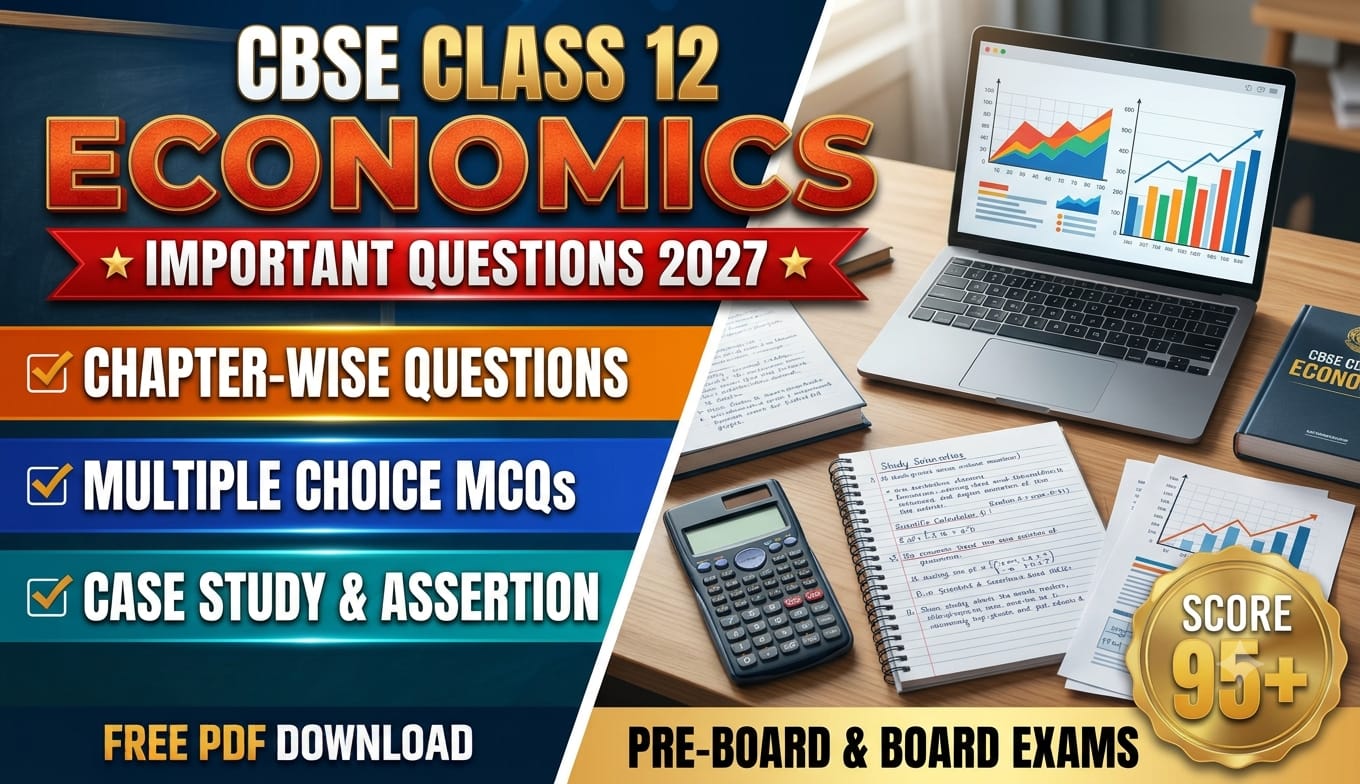
Preparing for the CBSE Class 12 Economics Board Exam 2027 requires a clear understanding of economic concepts, numerical problems, diagrams and real-life applications. Students need to prepare both sections of the subject, Introductory Macroeconomics and Indian Economic Development, to perform well in the examination. To make revision easier, we have provided CBSE Class 12 Economics Important Questions 2027 with chapter-wise questions, MCQs, numerical problems and case-based questions. These questions cover important topics from the prescribed CBSE syllabus for the 2026–27 academic session.
CBSE Class 12 Economics Important Questions 2027: Overview
Students can check the important details of the CBSE Class 12 Economics examination in the table below.
| Particulars | Details |
| Board | Central Board of Secondary Education (CBSE) |
| Class | 12th |
| Subject | Economics |
| Subject Code | 030 |
| Academic Session | 2026–27 |
| Theory Marks | 80 |
| Project/Practical Marks | 20 |
| Total Marks | 100 |
| Theory Exam Duration | 3 Hours |
| Main Sections | Macroeconomics and Indian Economic Development |
| Official Website | cbse.gov.in |
CBSE Class 12 Economics Exam Pattern 2027
The CBSE Class 12 Economics theory examination carries 80 marks, while project work carries 20 marks. The theory paper is divided into two sections of 40 marks each.
- Section A: Introductory Macroeconomics – 40 Marks
- Section B: Indian Economic Development – 40 Marks
- Project Work: 20 Marks
Unit-Wise Marks Distribution
Students should check the unit-wise weightage to understand how marks are distributed across the Economics syllabus.
| Section | Units | Marks |
| Section A: Introductory Macroeconomics | National Income and Related Aggregates | 10 |
| Money and Banking | 6 | |
| Determination of Income and Employment | 12 | |
| Government Budget and the Economy | 6 | |
| Balance of Payments | 6 | |
| Total | 40 | |
| Section B: Indian Economic Development | Development Experience (1947–90) and Economic Reforms since 1991 | 12 |
| Current Challenges Facing Indian Economy | 20 | |
| Development Experience of India: A Comparison with Neighbours | 8 | |
| Total | 40 | |
| Project Work | Economics Project | 20 |
| Grand Total | Theory + Project | 100 |
Important: The marks are assigned to units or groups of topics, not separately to every individual chapter. Students should prepare the complete prescribed syllabus instead of relying only on selected questions.
CBSE Class 12 Economics Question Paper Design 2027
The CBSE question paper design assesses students on conceptual understanding, application and analytical skills.
| Question Category | Marks | Weightage |
| Remembering and Understanding | 32 | 40% |
| Applying | 24 | 30% |
| Analysing, Evaluating and Creating | 24 | 30% |
| Total | 80 | 100% |
CBSE Class 12 Economics Important Questions 2027: Chapter-Wise
The Economics syllabus for Class 12 is divided into two major parts. The following chapter-wise questions cover the important concepts and topics prescribed by CBSE.
Section A: Introductory Macroeconomics
Chapter 1: National Income and Related Aggregates
This chapter covers the basic concepts of macroeconomics, circular flow of income and different methods of calculating national income. Students should also practise numerical questions based on GDP, GNP, NNP and NDP.
Important Questions:
1. Define macroeconomics and explain its scope.
2. Differentiate between final goods and intermediate goods with examples.
3. Explain the difference between stock and flow variables.
4. What is the circular flow of income? Explain the two-sector model.
5. Explain the three methods of calculating national income.
6. Differentiate between Gross Domestic Product (GDP) and Gross National Product (GNP).
7. What is the difference between nominal GDP and real GDP?
8. Explain the concept of GDP deflator.
9. What is depreciation? How does it affect the calculation of national income?
10. Explain why GDP may not be a perfect indicator of economic welfare.
Important Numerical Practice:
1. Calculate GDP at Market Price using the expenditure method when private final consumption expenditure, government final consumption expenditure, gross domestic capital formation and net exports are given.
2. Calculate Gross Value Added when the value of output and intermediate consumption are provided.
3. Find NNP at Factor Cost using the given GDP at Market Price, depreciation, net factor income from abroad and net indirect taxes.
Chapter 2: Money and Banking
This chapter explains the functions of money, money supply, credit creation and the role of the Reserve Bank of India. Students should understand the different monetary policy tools used by the RBI.
Important Questions:
1. Define money and explain its main functions.
2. Explain the problems of the barter system.
3. What is money supply? Explain its main components.
4. Explain the process of credit creation by commercial banks.
5. What is the role of the Reserve Bank of India in the Indian banking system?
6. Explain the functions of the central bank.
7. Differentiate between a central bank and a commercial bank.
8. What is Cash Reserve Ratio (CRR)?
9. Explain the meaning of Repo Rate and Reverse Repo Rate.
10. How does the RBI control credit through monetary policy?
Chapter 3: Determination of Income and Employment
This chapter focuses on aggregate demand, aggregate supply, consumption and saving functions, investment multiplier and equilibrium level of income. Numerical questions are particularly important for revision.
Important Questions:
1. Define aggregate demand and explain its components.
2. What is aggregate supply? Explain its relationship with national income.
3. Differentiate between Average Propensity to Consume (APC) and Marginal Propensity to Consume (MPC).
4. Explain the relationship between MPC and MPS.
5. What is the investment multiplier? Explain its working.
6. Define full employment and involuntary unemployment.
7. What is excess demand? Explain its causes and corrective measures.
8. What is deficient demand? Suggest measures to correct it.
9. Explain the equilibrium level of income using the AD-AS approach.
10. Differentiate between ex-ante and ex-post savings and investment.
Important Numerical Practice:
1. If the consumption function is C = 100 + 0.8Y and investment is ₹200 crore, calculate the equilibrium level of income.
2. Calculate the value of the investment multiplier when MPC is 0.75.
3. If income increases by ₹500 crore and consumption increases by ₹400 crore, calculate MPC and MPS.
4. Calculate the saving function when the consumption function is given.
Chapter 4: Government Budget and the Economy
Government Budget explains how the government collects revenue and spends money to achieve economic objectives. Students should focus on budget components, types of deficits and government functions.
Important Questions:
1. Define government budget and explain its main objectives.
2. Explain the components of government budget.
3. Differentiate between revenue receipts and capital receipts.
4. Differentiate between revenue expenditure and capital expenditure.
5. What is a balanced budget, surplus budget and deficit budget?
6. Define fiscal deficit and explain its implications.
7. What is revenue deficit? How is it calculated?
8. Explain the meaning of primary deficit.
9. Discuss the allocation, distribution and stabilisation functions of the government budget.
10. Explain how government expenditure can help reduce economic inequalities.
Important Numerical Practice:
1. Calculate revenue deficit when revenue expenditure and revenue receipts are given.
2. Find fiscal deficit using total government expenditure and total receipts excluding borrowings.
3. Calculate primary deficit when fiscal deficit and interest payments are provided.
Chapter 5: Balance of Payments
Balance of Payments records the economic transactions of a country with the rest of the world. Students should understand its components, foreign exchange rates and the determination of exchange rates.
Important Questions:
1. Define Balance of Payments (BoP).
2. Explain the main components of the Balance of Payments account.
3. Differentiate between current account and capital account.
4. What is a Balance of Payments deficit?
5. Explain the meaning of foreign exchange rate.
6. Differentiate between fixed and flexible exchange rate systems.
7. What is a managed floating exchange rate system?
8. Explain how demand and supply determine the exchange rate in a free market.
9. What are the merits and demerits of a flexible exchange rate system?
10. Explain the impact of an increase in the price of foreign currency on imports and exports.
Section B: Indian Economic Development
Chapter 6: Development Experience (1947–90) and Economic Reforms Since 1991
This chapter covers the Indian economy before independence, economic planning after independence and major economic reforms introduced in 1991.
Important Questions:
1. Explain the main features of the Indian economy on the eve of independence.
2. What were the common goals of India’s Five-Year Plans?
3. Explain the role of agriculture in the Indian economy after independence.
4. What was the New Agricultural Strategy? Explain its impact.
5. Discuss the role and importance of small-scale industries in India.
6. What was the Industrial Policy Resolution of 1956?
7. Explain the meaning of liberalisation, privatisation and globalisation.
8. Why were economic reforms introduced in India in 1991?
9. Discuss the positive and negative effects of economic reforms.
10. Explain the meaning and importance of Goods and Services Tax (GST).
11. What is disinvestment? Explain its role in economic reforms.
12. Explain the impact of demonetisation on the Indian economy.
Chapter 7: Current Challenges Facing Indian Economy
This unit covers important development-related issues such as human capital formation, rural development, employment and sustainable economic development.
Important Questions:
1. Define human capital formation and explain its importance.
2. Explain the main sources of human capital formation.
3. How does education contribute to economic development?
4. Differentiate between human capital and human development.
5. Explain the importance of rural development in India.
6. What are the major problems related to rural credit and agricultural marketing?
7. Explain the role of cooperatives in rural development.
8. What is agricultural diversification? Why is it important?
9. Explain the meaning and importance of organic farming.
10. Differentiate between formal and informal sectors of employment.
11. What is unemployment? Explain the major employment challenges in India.
12. Define sustainable development and explain its importance.
13. Discuss the impact of economic development on natural resources and the environment.
14. Explain the causes and effects of global warming.
Chapter 8: Development Experience of India – A Comparison with Neighbours
This chapter compares the development experiences of India, China and Pakistan. Students should focus on economic growth, population, sectoral development and human development indicators.
Important Questions:
1. Compare the economic development experiences of India, China and Pakistan.
2. Explain the major economic reforms introduced by China.
3. Discuss the economic development strategy followed by Pakistan.
4. Compare the population growth patterns of India, China and Pakistan.
5. Explain the differences in the sectoral development of these three countries.
6. Compare the human development indicators of India and China.
7. What lessons can India learn from the economic development experience of China?
8. Explain the role of economic reforms in the development of neighbouring countries.
Important MCQs for Pre-Board & Board Exams2027
MCQs are an important part of the Economics question paper. Students should practise objective questions from both Macroeconomics and Indian Economic Development.
Q1. Which of the following is included in the calculation of GDP?
A. Sale of second-hand goods
B. Sale of final goods and services produced during a year
C. Transfer payments
D. Purchase of shares
Q2. Which of the following is a function of money?
A. Medium of exchange
B. Store of value
C. Standard of deferred payments
D. All of the above
Q3. The central bank of India is:
A. State Bank of India
B. Reserve Bank of India
C. Punjab National Bank
D. NABARD
Q4. If MPC is 0.8, the value of the investment multiplier will be:
A. 2
B. 3
C. 4
D. 5
Q5. Which of the following is a capital receipt for the government?
A. Income tax
B. GST
C. Borrowings
D. Fees and fines
Q6. The current account of the Balance of Payments includes:
A. Export and import of goods and services
B. Foreign loans only
C. Sale of shares only
D. Foreign investment only
Q7. Economic reforms in India were introduced in:
A. 1985
B. 1991
C. 1995
D. 2000
Q8. The policy of Liberalisation, Privatisation and Globalisation is commonly known as:
A. Green Revolution
B. LPG Policy
C. Industrial Policy
D. Monetary Policy
Q9. Which of the following is a source of human capital formation?
A. Education
B. Health
C. On-the-job training
D. All of the above
Q10. NABARD is mainly associated with:
A. Rural development and agricultural credit
B. Foreign trade
C. Stock market regulation
D. Industrial licensing
Q11. Organic farming mainly focuses on:
A. Excessive use of chemical fertilisers
B. Use of natural farming practices
C. Increasing industrial pollution
D. Reducing agricultural diversity
Q12. Sustainable development means:
A. Using all available resources immediately
B. Meeting present needs without compromising future generations
C. Increasing production without considering the environment
D. Stopping all economic activities
Answer Key:
Question| Correct Answer
1| B. Sale of final goods and services produced during a year
2| D. All of the above
3| B. Reserve Bank of India
4| D. 5
5| C. Borrowings
6| A. Export and import of goods and services
7| B. 1991
8| B. LPG Policy
9| D. All of the above
10| A. Rural development and agricultural credit
11| B. Use of natural farming practices
12| B. Meeting present needs without compromising future generations
CBSE Class 12 Economics Case-Based Questions 2027
Case-based questions test students’ ability to understand economic situations and apply concepts. Read each situation carefully and answer the questions that follow.
Case Study 1: National Income
An economy produces different goods and services during a financial year. The government calculates the total value of final goods and services produced within the domestic territory of the country. It also considers depreciation and net factor income from abroad to calculate other national income aggregates.
Questions:
1. Identify the economic aggregate that measures the value of final goods and services produced within the domestic territory.
2. What is depreciation?
3. Differentiate between GDP and GNP.
Case Study 2: Money and Banking
The Reserve Bank of India changes certain monetary policy rates to influence the lending capacity of commercial banks. When banks have more funds available for lending, credit creation in the economy may increase.
Questions:
1. Identify the institution mentioned in the case.
2. What is the meaning of CRR?
3. Explain how a reduction in CRR can affect credit creation.
Case Study 3: Government Budget
The government announces additional spending on highways, railways and public infrastructure. It also increases expenditure on education and healthcare to improve the living conditions of citizens.
Questions:
1. Identify any two objectives of the government budget reflected in the case.
2. Differentiate between revenue expenditure and capital expenditure.
3. Explain how government spending can support economic growth.
Case Study 4: Economic Reforms
In 1991, India introduced several economic reforms to address financial difficulties and improve the performance of the economy. These reforms focused on reducing unnecessary government restrictions, encouraging private participation and connecting the Indian economy with global markets.
Questions:
1. Identify the economic policy introduced in 1991.
2. Explain the meaning of liberalisation.
3. State any two benefits of globalisation.
Important Numerical Questions for CBSE Class 12 Economics 2027
Numerical problems require regular practice. Students should revise formulas and solve different types of questions from the Macroeconomics section.
| Topic | Important Numerical Practice |
| National Income | Calculate GDP, GNP, NNP and NDP using the given data |
| Value Added Method | Calculate Gross Value Added using output and intermediate consumption |
| Consumption Function | Calculate consumption and saving at a given income level |
| Investment Multiplier | Calculate multiplier using MPC or MPS |
| Equilibrium Income | Find equilibrium income using consumption and investment functions |
| Government Budget | Calculate revenue deficit, fiscal deficit and primary deficit |
| Money and Banking | Practise simple credit creation and money multiplier questions |
| Balance of Payments | Identify and classify transactions under current and capital accounts |
How to Prepare for CBSE Class 12 Economics Board Exam 2027?
Economics includes theoretical concepts, numerical questions and analytical topics. Students should prepare both sections systematically instead of focusing only on definitions.
Here are some useful preparation tips:
1. Read NCERT Textbooks: Complete the prescribed Macroeconomics and Indian Economic Development textbooks. Pay attention to definitions, explanations and examples.
2. Prepare Chapter-Wise Notes: Make short notes for important concepts such as national income, money supply, government budget, LPG reforms and human capital formation.
3. Practise Numerical Questions: Solve numerical problems regularly, especially from national income, consumption function, multiplier and government budget.
4. Learn Important Formulas: Maintain a separate formula sheet and revise it before attempting numerical questions.
5. Practise Diagrams: Understand and practise relevant diagrams, including circular flow of income, consumption curve, aggregate demand and supply, and foreign exchange market diagrams.
6. Solve Case-Based Questions: Practise questions based on real-life economic situations to improve application skills.
7. Revise Important Differences: Prepare comparisons such as GDP vs GNP, current account vs capital account, fixed vs flexible exchange rate and human capital vs human development.
8. Attempt Sample Papers: Solve the official CBSE sample paper within the three-hour time limit.
9. Check the Marking Scheme: Review the official marking scheme to understand how answers and numerical steps are assessed.
FAQs
Q1. Where can I find CBSE Class 12 Economics Important Questions 2027?
Students can find chapter-wise important questions, MCQs, numerical problems and case-based questions in this article. These questions can be used for pre-board and board exam revision.
Q2. What is the subject code for CBSE Class 12 Economics?
The subject code for CBSE Class 12 Economics is 030.
Q3. How many marks is the CBSE Class 12 Economics theory paper?
The Economics theory paper carries 80 marks, while project work carries 20 marks. The total assessment is 100 marks.
Q4. How many sections are there in the CBSE Class 12 Economics paper?
The theory paper has two sections: Section A – Introductory Macroeconomics and Section B – Indian Economic Development. Each section carries 40 marks.
Q5. Which unit carries the highest weightage in Class 12 Economics?
The unit Current Challenges Facing Indian Economy carries the highest weightage, with 20 marks.









 CBSE Class 12 English Important Question...
 CBSE Class 12 Business Studies Important...
 CBSE Class 12 Accountancy Important Ques...