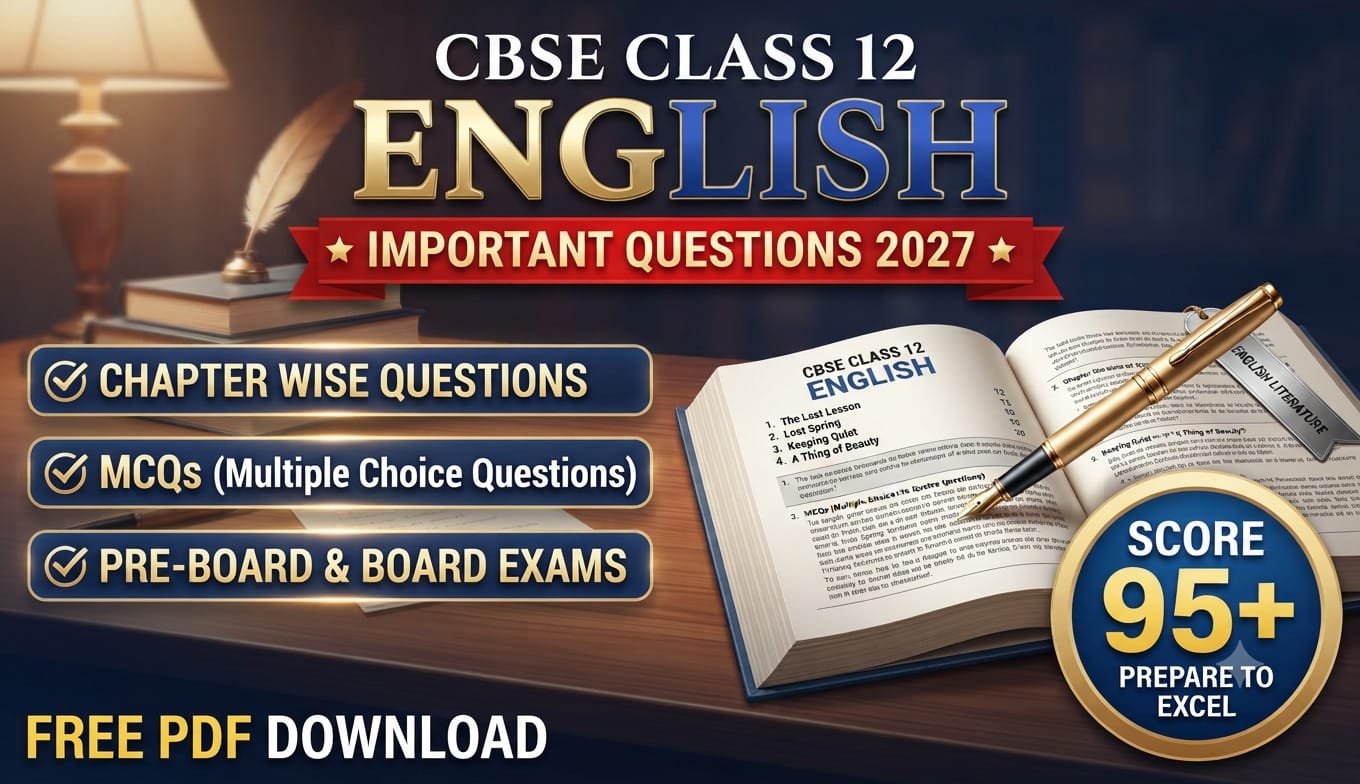
English is an important subject in the CBSE Class 12 Board Examination. To score well, students need to prepare literature, reading comprehension and creative writing skills together. A good understanding of the prescribed NCERT books, important themes, characters and writing formats can make revision easier. For students preparing for the CBSE Class 12 Board Exam 2027, we have compiled CBSE Class 12 English Important Questions 2027 with chapter-wise questions from Flamingo and Vistas, MCQs, extract-based practice, writing topics and preparation tips.
The questions in this article are prepared according to the CBSE English Core syllabus for the 2026–27 academic session. Students can use them for pre-board preparation and final revision. These are practice questions, not guaranteed questions for the board examination.
CBSE Class 12 English Important Questions 2027: Overview
Students can check the important details of the CBSE Class 12 English Core examination below.
| Particulars | Details |
| Board | Central Board of Secondary Education (CBSE) |
| Class | 12th |
| Subject | English Core |
| Subject Code | 301 |
| Academic Session | 2026–27 |
| Theory Marks | 80 |
| Project/Practical Marks | 20 |
| Total Marks | 100 |
| Theory Exam Duration | 3 Hours |
| Official Website | cbse.gov.in |
CBSE Class 12 English Exam Pattern 2027
The CBSE Class 12 English Core theory paper carries 80 marks and is divided into three sections. The remaining 20 marks are allocated to internal assessment.
| Section | Subject Area | Marks |
| Section A | Reading Skills | 22 |
| Section B | Creative Writing Skills | 18 |
| Section C | Literature: Flamingo and Vistas | 40 |
| Theory Total | 80 | |
| Internal Assessment | Listening, Speaking and Project Work | 20 |
| Grand Total | 100 |
Internal Assessment Marks Distribution
| Assessment Component | Marks |
| Listening Skills | 5 |
| Speaking Skills | 5 |
| Project Work | 10 |
| Total | 20 |
Section-Wise Question Pattern
Students should understand the type of questions asked in each section before starting their preparation.
| Section | Topics Covered | Marks |
| A | Unseen factual, descriptive or literary passage and case-based factual passage | 22 |
| B | Notice, invitation and reply, letter writing, article or report writing | 18 |
| C | Extract-based questions, short answers and long answers from Flamingo and Vistas | 40 |
CBSE Class 12 English Important Questions 2027: Chapter-Wise
The literature section carries 40 marks and includes questions from the prescribed NCERT textbooks, Flamingo and Vistas. Students should prepare the themes, characters, important incidents and central ideas of every chapter.
Book 1: Flamingo – Prose Important Questions
Chapter 1: The Last Lesson
The Last Lesson by Alphonse Daudet highlights the importance of language, identity and patriotism through the experience of Franz and his teacher M. Hamel.
Important Questions:
1. Why was Franz afraid of going to school that morning?
2. What announcement did M. Hamel make in the classroom?
3. Why was the last lesson important for the people of Alsace?
4. How did Franz’s feelings towards his school and teacher change?
5. Explain the significance of the title The Last Lesson.
6. What does M. Hamel’s final lesson teach us about the importance of one’s mother tongue?
7. How does the story highlight the relationship between language and national identity?
Chapter 2: Lost Spring
Lost Spring by Anees Jung presents the struggles of underprivileged children who are forced to work instead of enjoying their childhood.
Important Questions:
1. Who is Saheb and what does he search for in garbage?
2. Why did Saheb’s family leave Dhaka?
3. Why was Saheb unhappy even after getting a job at the tea stall?
4. Describe the working conditions of children in the bangle-making industry of Firozabad.
5. Why is Mukesh different from other children in his family?
6. Explain how poverty affects the childhood of Saheb and Mukesh.
7. Justify the title Lost Spring with reference to the chapter.
Chapter 3: Deep Water
Deep Water by William Douglas describes how the author overcomes his fear of water through determination, practice and courage.
Important Questions:
1. How did Douglas develop a fear of water?
2. What happened to Douglas at the YMCA swimming pool?
3. How did the incident at the pool affect his confidence?
4. How did Douglas overcome his fear of water?
5. Why did Douglas decide to learn swimming again?
6. What role did the swimming instructor play in helping Douglas?
7. What message does the chapter Deep Water convey about fear and determination?
Chapter 4: The Rattrap
The Rattrap by Selma Lagerlöf explores human goodness, kindness and the possibility of personal transformation.
Important Questions:
1. Why did the peddler compare the world to a rattrap?
2. How did the peddler earn his living?
3. Why did the peddler steal the crofter’s money?
4. How did the ironmaster mistake the peddler for an old acquaintance?
5. Why did Edla invite the peddler to stay at her house?
6. How did Edla’s kindness bring a change in the peddler?
7. Explain the significance of the title The Rattrap.
8. What message does the story convey about kindness and human relationships?
Chapter 5: Indigo
Indigo by Louis Fischer describes Mahatma Gandhi’s efforts to help the indigo farmers of Champaran and the beginning of an important movement for justice.
Important Questions:
1. Who was Rajkumar Shukla and why did he meet Gandhi?
2. Why were the farmers of Champaran unhappy with the British landlords?
3. What was the sharecropping arrangement followed in Champaran?
4. Why did Gandhi decide to visit Champaran?
5. How did Gandhi respond when the British officials ordered him to leave?
6. What was the significance of the Champaran episode in India’s freedom struggle?
7. Explain how Gandhi helped the farmers gain confidence.
8. What qualities of Mahatma Gandhi are highlighted in the chapter?
Chapter 6: Poets and Pancakes
Poets and Pancakes by Asokamitran provides an account of the working environment at Gemini Studios and the people associated with the film industry.
Important Questions:
1. What was the meaning of the term ‘Pancake’ in the chapter?
2. Why was the make-up department important at Gemini Studios?
3. Who was Subbu and why was he considered an important person at the studio?
4. Describe the role of the office boy at Gemini Studios.
5. Why did the visit of the English poet create confusion at Gemini Studios?
6. What was the significance of the Moral Re-Armament Army’s visit?
7. How does the chapter present the working culture of Gemini Studios?
Chapter 7: The Interview
The Interview by Christopher Silvester explores the different opinions people have about interviews and presents an interview with Umberto Eco.
Important Questions:
1. Why do some people consider interviews an intrusion into their private lives?
2. Explain the different opinions about interviews discussed in the chapter.
3. Who was Umberto Eco?
4. What did Umberto Eco mean by the concept of ’empty spaces’?
5. How did Eco manage his academic work along with writing novels?
6. Why did Umberto Eco become popular among readers?
7. What makes an interview an important source of information?
Chapter 8: Going Places
Going Places by A.R. Barton presents the dreams and fantasies of Sophie, a young girl who imagines a different future for herself.
Important Questions:
1. Who is Sophie and what are her dreams?
2. Why does Sophie want to open a boutique?
3. How does Jansie differ from Sophie?
4. Why does Sophie admire Danny Casey?
5. What does Geoff represent in Sophie’s life?
6. Why does Sophie’s father refuse to believe her story about Danny Casey?
7. Explain the difference between Sophie’s imagination and her actual circumstances.
8. What is the central message of Going Places?
Flamingo – Poetry Important Questions
Poem 1: My Mother at Sixty-Six
My Mother at Sixty-Six by Kamala Das expresses a daughter’s emotions and fear of separation as she notices her ageing mother.
Important Questions:
1. What does the poet notice about her mother while travelling to the airport?
2. Why does the poet compare her mother to a late winter’s moon?
3. What do the young trees and children symbolise in the poem?
4. Why does the poet smile and say goodbye to her mother?
5. Explain the central theme of the poem.
6. How does the poem express the fear of losing a loved one?
Poem 2: Keeping Quiet
Keeping Quiet by Pablo Neruda encourages people to pause, reflect and understand the importance of peace and mutual understanding.
Important Questions:
1. What does the poet mean by counting up to twelve?
2. Why does the poet ask everyone to remain still?
3. How can silence help people understand themselves?
4. Why does the poet say that keeping quiet does not mean complete inactivity?
5. What is the significance of the image of fishermen and the man gathering salt?
6. Explain the message of peace and self-reflection in the poem.
Poem 3: A Thing of Beauty
A Thing of Beauty by John Keats explains how beautiful things provide lasting happiness, comfort and hope.
Important Questions:
1. Why does the poet say that a thing of beauty is a joy forever?
2. How does beauty provide comfort to human beings?
3. What are the things of beauty mentioned in the poem?
4. Explain the meaning of the expression ‘an endless fountain of immortal drink’.
5. How does nature help people overcome sadness?
6. What is the central idea of the poem?
Poem 4: A Roadside Stand
A Roadside Stand by Robert Frost highlights the economic struggles of rural people and the unequal relationship between villages and cities.
Important Questions:
1. Why did the rural people establish a roadside stand?
2. What were the expectations of the people who ran the roadside stand?
3. Why were the city people indifferent towards the roadside stand?
4. Explain the contrast between rural and urban life in the poem.
5. What does the poet mean by the false promises made to rural people?
6. How does the poem highlight economic inequality?
7. Explain the central message of A Roadside Stand.
Poem 5: Aunt Jennifer’s Tigers
Aunt Jennifer’s Tigers by Adrienne Rich explores the restrictions faced by women and their desire for freedom through the image of embroidered tigers.
Important Questions:
1. What do Aunt Jennifer’s tigers symbolise?
2. Why are the tigers described as fearless and confident?
3. What does the heavy wedding band represent?
4. How does Aunt Jennifer’s artwork reflect her inner feelings?
5. Explain the contrast between Aunt Jennifer and her tigers.
6. What is the central theme of the poem?
7. How does the poem highlight the struggle for women’s freedom?
Book 2: Vistas – Important Questions
Chapter 1: The Third Level
The Third Level by Jack Finney explores the relationship between imagination, reality and the desire to escape the pressures of modern life.
Important Questions:
1. What was the third level at Grand Central Station?
2. Why did Charley want to visit Galesburg?
3. What did Sam think about Charley’s experience?
4. How did Charley discover the third level?
5. What was the significance of the letter written by Sam?
6. Explain the theme of escapism in the story.
7. Is the third level a reality or an imaginary experience? Explain with reference to the story.
Chapter 2: The Tiger King
The Tiger King by Kalki is a satirical story about the arrogance of rulers, the misuse of power and the irony of fate.
Important Questions:
1. Why was the Maharaja called the Tiger King?
2. What prediction was made about the king’s death?
3. Why did the king decide to hunt tigers?
4. How did the king try to prove the astrologer’s prediction wrong?
5. Why did the Maharaja marry a princess from a state with a large tiger population?
6. How did the hundredth tiger become important in the story?
7. Explain the irony in the death of the Tiger King.
8. What does the story reveal about the misuse of power?
Chapter 3: Journey to the End of the Earth
Journey to the End of the Earth by Tishani Doshi describes a journey to Antarctica and explains the importance of understanding climate change and environmental conservation.
Important Questions:
1. Why is Antarctica considered an important place for studying the Earth’s history?
2. What is the significance of the geological history of Antarctica?
3. How does the author describe the experience of visiting Antarctica?
4. What is the role of phytoplankton in the Antarctic ecosystem?
5. How does climate change affect the Antarctic region?
6. Why is Antarctica important for understanding the future of our planet?
7. What message does the chapter convey about environmental protection?
Chapter 4: The Enemy
The Enemy by Pearl S. Buck presents the conflict between humanity and national loyalty through the story of Dr. Sadao and an injured American soldier.
Important Questions:
1. Who was Dr. Sadao and why was he living in Japan?
2. Why did Dr. Sadao and Hana decide to help the injured American soldier?
3. How did the servants react to Dr. Sadao’s decision?
4. Why did Dr. Sadao inform the General about the American soldier?
5. Why did the General fail to send his private assassins?
6. How did Dr. Sadao help the American soldier escape?
7. Explain the conflict between professional duty and patriotism in the story.
8. What does the story teach us about humanity?
Chapter 5: On the Face of It
On the Face of It by Susan Hill explores loneliness, self-acceptance and the importance of looking beyond physical appearance.
Important Questions:
1. Who is Derry and why does he avoid meeting people?
2. How did Mr Lamb lose his leg?
3. Why does Derry dislike people staring at him?
4. How does Mr Lamb change Derry’s attitude towards life?
5. What does Mr Lamb mean when he says that people should look at things differently?
6. Why does Derry decide to return to Mr Lamb’s garden?
7. Explain the importance of positive thinking in the play.
8. How does the play challenge society’s attitude towards physical differences?
Chapter 6: Memories of Childhood
This chapter contains two autobiographical accounts: The Cutting of My Long Hair by Zitkala-Sa and We Too Are Human Beings by Bama. Both accounts highlight discrimination and the struggle for dignity.
Important Questions:
1. Why was Zitkala-Sa uncomfortable at the boarding school?
2. Why did Zitkala-Sa resist having her hair cut?
3. How did the school authorities treat the children?
4. What incident made Bama realise the existence of caste discrimination?
5. Why was Bama shocked after observing the elderly man carrying a food packet?
6. What advice did Annan give Bama?
7. How did education become a way of resisting discrimination?
8. Compare the experiences of Zitkala-Sa and Bama.
9. What common message do both autobiographical accounts convey?
CBSE Class 12 English Important MCQs 2027
MCQs help students revise important characters, themes, authors and literary concepts. Practise the following questions from Flamingo and Vistas.
Q1. Who is the author of ‘The Last Lesson’?
A. Anees Jung
B. Alphonse Daudet
C. William Douglas
D. Louis Fischer
Q2. Who is the central character in ‘Lost Spring’?
A. Sophie
B. Mukesh
C. Franz
D. Charley
Q3. Who wrote ‘Deep Water’?
A. William Douglas
B. A.R. Barton
C. Jack Finney
D. Asokamitran
Q4. What does the peddler compare the world to in ‘The Rattrap’?
A. A garden
B. A prison
C. A rattrap
D. A marketplace
Q5. Who played an important role in bringing Gandhi to Champaran?
A. Rajkumar Shukla
B. Subbu
C. Geoff
D. Mukesh
Q6. Who is the poet of ‘Keeping Quiet’?
A. John Keats
B. Pablo Neruda
C. Robert Frost
D. Kamala Das
Q7. What do Aunt Jennifer’s tigers represent?
A. Fear and weakness
B. Freedom and confidence
C. Poverty and struggle
D. Anger and revenge
Q8. Who is the main character in ‘The Third Level’?
A. Sam
B. Charley
C. Mr Lamb
D. Dr Sadao
Q9. Why was the Maharaja called the Tiger King?
A. He protected tigers
B. He was known for hunting tigers
C. He owned a tiger farm
D. He worked as a forest officer
Q10. Who wrote ‘The Enemy’?
A. Pearl S. Buck
B. Susan Hill
C. Kalki
D. Jack Finney
Q11. Who is the poet of ‘A Roadside Stand’?
A. Adrienne Rich
B. Robert Frost
C. John Keats
D. Pablo Neruda
Q12. What does Mr Lamb encourage Derry to do?
A. Avoid meeting people
B. Stay inside his house
C. Develop a positive attitude towards life
D. Stop talking to others
Q13. Who wrote ‘My Mother at Sixty-Six’?
A. Kamala Das
B. Adrienne Rich
C. Robert Frost
D. Pablo Neruda
Q14. Which character helps the peddler understand the value of kindness in ‘The Rattrap’?
A. Sophie
B. Edla Willmansson
C. Jansie
D. Franz
Q15. What is the main theme of ‘Journey to the End of the Earth’?
A. Industrial development
B. Environmental awareness and climate change
C. Urban lifestyle
D. Political conflict
Answer Key:
Question| Correct Answer
1| B. Alphonse Daudet
2| B. Mukesh
3| A. William Douglas
4| C. A rattrap
5| A. Rajkumar Shukla
6| B. Pablo Neruda
7| B. Freedom and confidence
8| B. Charley
9| B. He was known for hunting tigers
10| A. Pearl S. Buck
11| B. Robert Frost
12| C. Develop a positive attitude towards life
13| A. Kamala Das
14| B. Edla Willmansson
15| B. Environmental awareness and climate change
CBSE Class 12 English Important Writing Questions 2027
Creative Writing Skills carries 18 marks in the theory paper. Students should practise the prescribed formats and stay within the word limits mentioned in the question.
1. Notice Writing – 4 Marks
Practise the following notice-writing topics:
1. Your school is organising an inter-school debate competition. Draft a notice inviting students to participate.
2. Write a notice informing students about a career guidance seminar organised by your school.
3. Your school is organising a cleanliness drive. Draft a notice asking students to register as volunteers.
4. Write a notice announcing an educational trip for Class 12 students.
2. Invitation and Reply – 4 Marks
Important practice topics:
1. Draft a formal invitation inviting a guest speaker to address students at a career counselling programme.
2. Write a formal reply accepting an invitation to attend your school’s annual function.
3. Draft an informal invitation inviting your friend to your birthday celebration.
4. Write a polite reply declining an invitation due to a prior commitment.
3. Letter Writing – 5 Marks
Students should practise both letters to the editor and job application letters with biodata or a resume.
Important Practice Questions:
1. Write a letter to the editor of a newspaper expressing concern about increasing plastic pollution in your city.
2. Write a letter to the editor suggesting ways to improve road safety and traffic management.
3. Draft a job application for the post of a content writer in a reputed organisation, along with your biodata.
4. Write a letter to the editor highlighting the importance of mental health awareness among students.
4. Article and Report Writing – 5 Marks
Important Article Writing Topics:
1. Importance of Digital Education in Modern India.
2. Role of Youth in Environmental Protection.
3. Importance of Reading Habits Among Students.
4. Social Media: Advantages and Disadvantages.
5. Importance of Mental Health Awareness in Schools.
Important Report Writing Topics:
1. Report on an annual sports day organised by your school.
2. Report on a tree plantation drive conducted by students.
3. Report on an inter-school cultural competition.
4. Report on a road safety awareness campaign.
5. Report on a career guidance seminar organised in your school.
CBSE Class 12 English Reading Skills: Important Practice Areas
Reading Skills carries 22 marks. Students should practise unseen passages regularly because these questions test comprehension, vocabulary, interpretation and analytical ability.
| Reading Practice Area | What Students Should Prepare |
| Unseen Passage | Main idea, supporting details, vocabulary and inference |
| Case-Based Factual Passage | Understanding information presented through text, charts and data |
| MCQs | Correct interpretation of the passage |
| Short Answers | Clear responses based on information in the passage |
| Vocabulary | Meaning of words using contextual clues |
| Analytical Questions | Writer’s purpose, tone and conclusions |
Preparation Tip: Practise reading a passage within a fixed time. Read the questions carefully and locate the relevant information before writing your answers.
How to Prepare for CBSE Class 12 English Board Exam 2027?
English preparation requires regular reading, writing and revision. Students should focus on all three sections rather than spending all their time on literature.
1. Read NCERT Textbooks: Complete all prescribed chapters and poems from Flamingo and Vistas. Understand the themes, characters and important events.
2. Prepare Chapter-Wise Notes: Write short summaries of each chapter and note down important character traits, themes and messages.
3. Practice Extract-Based Questions: Solve questions based on prose and poetry extracts to improve interpretation and comprehension.
4. Revise Writing Formats: Practise notice, invitation, reply, letter, article and report writing with the correct format and word limit.
5. Improve Reading Skills: Read unseen passages regularly and practise questions based on inference, vocabulary and analysis.
6. Practise MCQs: Revise authors, characters, themes and important details from the prescribed books.
7. Write Answers in Your Own Words: Keep answers relevant to the question and support your points with examples from the text.
8. Solve Previous-Year Papers: Practise previous-year question papers to understand the style and level of questions.
9. Attempt the Official Sample Paper: Solve the CBSE 2026–27 sample paper in three hours to assess your preparation.
10. Check the Marking Scheme: Understand the expected answer structure and how marks are awarded.
FAQs
Q1. Where can I find CBSE Class 12 English Important Questions 2027?
Students can find chapter-wise important questions from Flamingo and Vistas, MCQs, writing practice topics and reading comprehension preparation areas in this article.
Q2. What is the subject code for CBSE Class 12 English Core?
The subject code for CBSE Class 12 English Core is 301.
Q3. How many marks is the CBSE Class 12 English theory paper?
The English Core theory paper carries 80 marks, while internal assessment carries 20 marks. The total assessment is 100 marks.
Q4. Which books are prescribed for CBSE Class 12 English Core 2027?
The prescribed NCERT textbooks are Flamingo and Vistas.
Q5. How many marks does the literature section carry in Class 12 English?
The literature section carries 40 marks in the CBSE Class 12 English Core theory examination.






 CBSE Class 12 Economics Important Questi...
 CBSE Class 12 Business Studies Important...
 CBSE Class 12 Accountancy Important Ques...