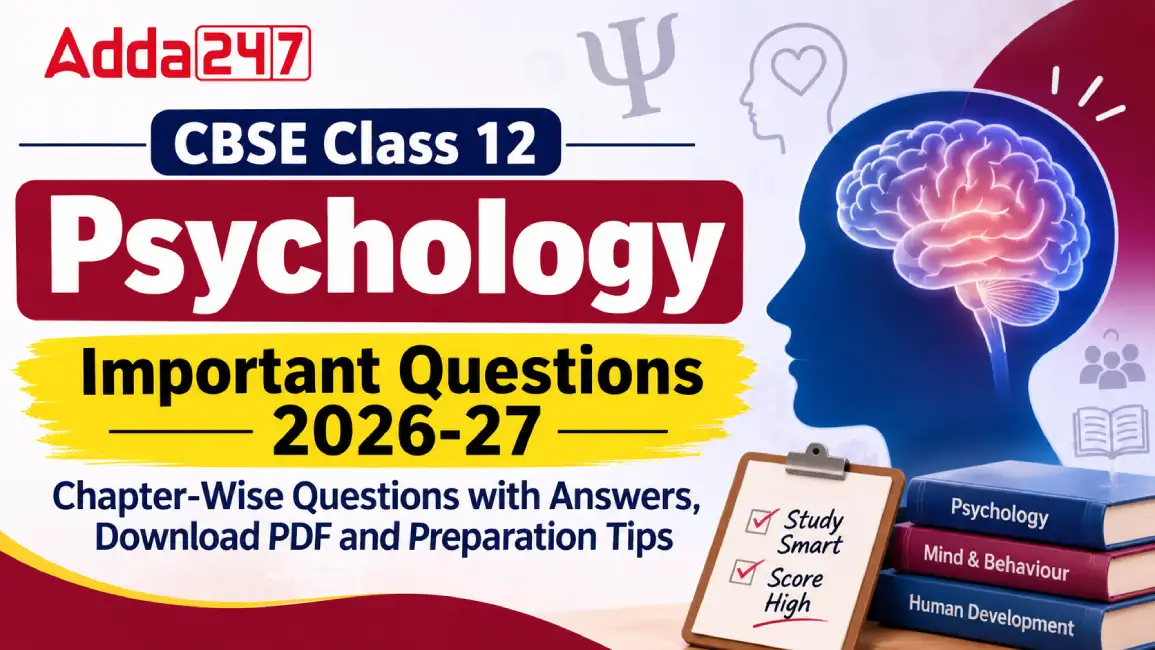
CBSE Class 12 Psychology is an important subject for students interested in understanding human behaviour, mental processes, personality, emotions and social relationships. To score well in the board examination, students should understand the concepts given in the NCERT textbook and practice different types of questions regularly.
The CBSE Class 12 Psychology Important Questions 2026–27 provide a useful way to revise important concepts from every chapter. These questions cover objective-type, short-answer and long-answer formats to help students understand how psychological concepts can be asked in the examination.
Students can use these questions for chapter-wise revision, practice writing well-structured answers and improve their understanding of important theories, psychologists and concepts before the board examination.
CBSE Class 12 Psychology Important Questions 2026-27: Overview
The CBSE Class 12 Psychology question paper for the 2026-27 academic session will be based on the latest syllabus prescribed by CBSE. The theory paper carries 70 marks and has a duration of 3 hours. Students should prepare all seven units and practice different types of questions, including short-answer, application-based and long-answer questions.
| Particulars | Details |
| Board | Central Board of Secondary Education (CBSE) |
| Class | 12th |
| Subject | Psychology |
| Subject Code | 037 |
| Academic Session | 2026-27 |
| Exam Mode | Offline (Pen and Paper) |
| Theory Exam Marks | 70 |
| Practical Exam Marks | 30 |
| Theory Exam Duration | 3 Hours |
| Total Marks | 100 |
| Official Website | cbse.gov.in |
CBSE Class 12 Psychology Unit-Wise Weightage 2026-27
Students should understand the unit-wise marks distribution before starting their preparation. According to the CBSE 2026-27 Psychology curriculum, the theory paper is divided into seven units.
| Unit | Chapter/Topic | Marks |
| Unit I | Variations in Psychological Attributes | 13 |
| Unit II | Self and Personality | 13 |
| Unit III | Meeting Life Challenges | 9 |
| Unit IV | Psychological Disorders | 12 |
| Unit V | Therapeutic Approaches | 9 |
| Unit VI | Attitude and Social Cognition | 8 |
| Unit VII | Social Influence and Group Processes | 6 |
| Total | 70 |
CBSE Class 12 Psychology : 2 Marks Questions
Two-mark questions generally require short and precise answers. Students should focus on definitions, characteristics, differences and basic psychological concepts.
- What is meant by individual differences in human functioning?
- Define emotional intelligence.
- What is the concept of self in psychology?
- Differentiate between personal and social identity.
- What is stress? Mention its two major sources.
- Define psychological disorders.
- What is meant by psychotherapy?
- Define attitude and mention its three components.
- What is social influence?
- Explain the meaning of group identity.
CBSE Class 12 Psychology : 3 Marks Questions
Three-mark questions usually require explanations with relevant points or examples. Students should practise writing answers in a structured format.
- Explain any three factors that influence intelligence.
- Describe the major characteristics of personality.
- Explain the different types of stress.
- Discuss three common symptoms of psychological disorders.
- Explain the importance of therapeutic relationships in psychotherapy.
- Describe the factors responsible for attitude formation.
- Explain the actor-observer effect with an example.
- What are the major conditions responsible for group formation?
- Explain any three methods of coping with stress.
- Differentiate between conformity and compliance.
CBSE Class 12 Psychology : 4 Marks Questions
Four-mark questions require a detailed explanation of concepts. Students should support their answers with suitable examples wherever necessary.
- Explain the different theories of intelligence.
- Discuss the major approaches to understanding personality.
- Explain the role of life skills in managing everyday challenges.
- Describe the different types of anxiety disorders.
- Explain the main approaches used in the treatment of psychological disorders.
- Discuss the factors that influence attitude change.
- Explain the relationship between social cognition and social behaviour.
- Describe the different types of social influence with examples.
- Explain the role of self-esteem in personality development.
- Discuss the importance of coping strategies in dealing with stressful situations.
CBSE Class 12 Psychology : 6 Marks Questions
Long-answer questions require a clear understanding of the topic. Students should explain each point properly and include examples wherever required.
- Explain the different theories of intelligence, including the triarchic theory and theory of multiple intelligences.
- Discuss the major approaches to personality and explain how personality can be assessed.
- What is stress? Explain the different sources of stress and various methods of coping with it.
- Explain psychological disorders and discuss their major categories.
- Describe the different therapeutic approaches used to treat psychological disorders.
- Explain the concept of attitude. Discuss the factors responsible for attitude formation and attitude change.
- What is group polarisation? Explain the factors responsible for this phenomenon.
- Discuss the importance of social influence and group processes in human behaviour.
CBSE Class 12 Psychology Chapter-Wise Important Questions 2026-27
Chapter-wise preparation helps students revise the complete syllabus systematically. The following questions cover the seven units included in the CBSE Class 12 Psychology syllabus.
Unit 1: Variations in Psychological Attributes
This unit focuses on intelligence, aptitude, creativity, emotional intelligence and individual differences.
Important Questions:
- What are psychological attributes? Explain their major characteristics.
- Describe the different methods used for assessing psychological attributes.
- Explain the major psychometric theories of intelligence.
- What is emotional intelligence? Discuss its importance in daily life.
- Differentiate between aptitude and intelligence.
- Explain the relationship between creativity and intelligence.
- Describe Sternberg’s triarchic theory of intelligence.
- Explain Gardner’s theory of multiple intelligences.
Unit 2: Self and Personality
This unit explains the concept of self, personality development and different approaches to understanding personality.
Important Questions:
- What is self? Explain its different aspects.
- Describe the cognitive and behavioural aspects of self.
- Explain the major approaches to the study of personality.
- Discuss Freud’s psychoanalytic theory of personality.
- Explain the humanistic approach to personality.
- What are the different methods of personality assessment?
- Differentiate between projective and self-report measures.
- Explain the role of culture in shaping personality.
Unit 3: Meeting Life Challenges
This unit deals with stress, its causes, effects and different ways of managing life challenges.
Important Questions:
- What is stress? Explain its major sources.
- Describe the different effects of stress on human health.
- Explain the different types of stress.
- What are the major coping strategies used to manage stress?
- Explain the role of social support in managing stress.
- What are life skills? Discuss their importance in dealing with challenges.
- Explain the relationship between stress and psychological well-being.
- Describe the importance of positive thinking in managing stressful situations.
Unit 4: Psychological Disorders
This unit covers the meaning, classification, symptoms and different categories of psychological disorders.
Important Questions:
- What is abnormal behaviour? Explain its major characteristics.
- Describe the historical development of the understanding of psychological disorders.
- Explain the major categories of psychological disorders.
- What are anxiety disorders? Explain their common features.
- Differentiate between obsessive-compulsive disorder and phobic disorder.
- Explain the symptoms and characteristics of mood disorders.
- What are schizophrenia spectrum and other psychotic disorders?
- Explain the major causes of psychological disorders.
Unit 5: Therapeutic Approaches
This unit focuses on different methods used in psychotherapy and the relationship between therapists and clients.
Important Questions:
- What is psychotherapy? Explain its major characteristics.
- Describe the psychodynamic approach to psychotherapy.
- Explain the behavioural approach to treatment.
- What is cognitive therapy? Explain its major principles.
- Describe the humanistic-existential approach to psychotherapy.
- Explain the importance of therapeutic relationships.
- What are the ethical principles followed by psychotherapists?
- Differentiate between individual and group therapy.
Unit 6: Attitude and Social Cognition
This unit explains how people develop attitudes, form opinions and understand the behaviour of others.
Important Questions:
- What is an attitude? Explain its major components.
- Describe the factors responsible for attitude formation.
- Explain the process of attitude change.
- What is social cognition? Discuss its importance.
- Explain the concept of attribution in social psychology.
- Differentiate between interpersonal and intrapersonal communication.
- What are stereotypes? Explain their effects on social behaviour.
- Explain the relationship between attitudes and behaviour.
Unit 7: Social Influence and Group Processes
This unit focuses on group behaviour, social influence, cooperation, competition and leadership.
Important Questions:
- What is a group? Explain its major characteristics.
- Describe the different stages of group formation.
- Explain the factors responsible for group cohesion.
- What is social loafing? Explain with an example.
- Differentiate between conformity and compliance.
- Explain the concept of group polarisation.
- What is leadership? Describe its major styles.
- Explain the differences between cooperation and competition.
Download CBSE Class 12 Psychology Important Questions PDF
Students can prepare their own chapter-wise question bank using NCERT exercises, CBSE sample papers and previous years’ question papers. For the latest syllabus and examination resources, refer to these official sources:
- CBSE Class 12 Psychology Syllabus 2026-27 PDF
- CBSE Academic Official Website
- Chapter-Wise Psychology Practice Questions
Benefits of Practicing CBSE Class 12 Psychology Important Questions
Practicing important questions regularly can help students prepare more effectively for the board examination.
- Better Conceptual Understanding: Students can understand important psychological theories and concepts through regular practice.
- Improved Answer Writing: Practicing different question formats helps students organize their answers properly.
- Effective Revision: Chapter-wise questions make it easier to revise important topics before examinations.
- Better Time Management: Solving questions within a fixed time helps students manage the examination duration.
- Identification of Weak Areas: Regular practice helps students identify topics that need more attention.
Preparation Tips for CBSE Class 12 Psychology Important Questions 2026-27
Preparing for the CBSE Class 12 Psychology Board Exam 2027 requires a clear understanding of psychological concepts, theories, definitions and their practical applications. Students should focus on all seven units and practise different types of questions to improve their preparation. Here are some useful preparation tips for scoring well in the examination.
- Understand the NCERT Textbooks: Read both prescribed Psychology textbooks carefully. Focus on important concepts, definitions, theories, examples and psychological approaches explained in the chapters.
- Prepare Unit-Wise Notes: Make short notes for every unit, including important definitions, psychologists’ names, theories, characteristics and differences. These notes will help with quick revision before the examination.
- Focus on Important Topics: Give proper attention to topics such as Intelligence, Personality, Stress Management, Psychological Disorders, Therapeutic Approaches, Attitude and Social Influence. Also, revise other syllabus topics regularly.
- Practice Case-Based Questions: Psychology examinations often test the application of concepts through real-life situations. Practice case-based questions to understand how psychological theories and concepts apply to different situations.
- Learn Important Theories and Approaches: Prepare major theories of intelligence, personality approaches, psychological therapies and concepts related to social behaviour. Understand their meaning, features and practical applications.
- Solve Previous Year Question Papers: Practice previous years’ questions to understand the examination pattern, question styles and important concepts. It will also help you identify topics that require additional revision.
- Attempt CBSE Sample Papers: Solve the latest CBSE Class 12 Psychology sample paper within the prescribed time. Check your answers using the official marking scheme to understand the expected answer format.
- Revise Practical Topics: Do not ignore the practical portion, which carries 30 marks. Prepare case profiles, psychological test administration, interpretation, practical files and viva questions according to the CBSE guidelines.
- Improve Answer-Writing Skills: Write answers in clear and organised points. Use suitable headings, correct psychological terminology and relevant examples wherever necessary.
- Follow a Regular Revision Schedule: Divide your study time between theory, important questions, practical preparation and revision. Regular practice will help you understand concepts and improve your confidence.
FAQs
Q1. Where can I find CBSE Class 12 Psychology important questions for 2026-27?
Ans. Students can find chapter-wise important questions for CBSE Class 12 Psychology in this article. They can also practize questions from NCERT textbooks, previous year papers and official CBSE sample papers.
Q2. How many units are included in the CBSE Class 12 Psychology syllabus 2026-27?
Ans. The CBSE Class 12 Psychology syllabus contains seven units, covering psychological attributes, personality, life challenges, psychological disorders, therapeutic approaches, attitudes and social influence.
Q3. How many marks are allotted to the Psychology theory paper?
Ans. The CBSE Class 12 Psychology theory examination carries 70 marks, while the practical examination carries 30 marks.
Q4. Are important questions enough to prepare for the Psychology board examination?
Ans. No. Important questions are useful for revision and practice, but students should complete the prescribed NCERT syllabus and practize sample papers and previous year question papers as well.
Q5. Which units carry the highest marks in CBSE Class 12 Psychology 2026-27?
Ans. Variations in Psychological Attributes and Self and Personality carry 13 marks each, making them the highest-weightage units in the theory examination.
Q6. Where can I download the official CBSE Class 12 Psychology sample paper?
Ans. Students can download the official Psychology sample paper and marking scheme from the CBSE Academic website under the Class XII Sample Question Paper 2026-27 section.
Q7. How should students prepare for long-answer questions in Psychology?
Ans. Students should understand the concepts thoroughly, prepare explanations of important theories, use relevant examples and organize answers into clear points.






 CBSE Class 12 Political Science Importan...
 CBSE Class 12 Geography Important Questi...
 CBSE Class 12 Sociology Important Questi...