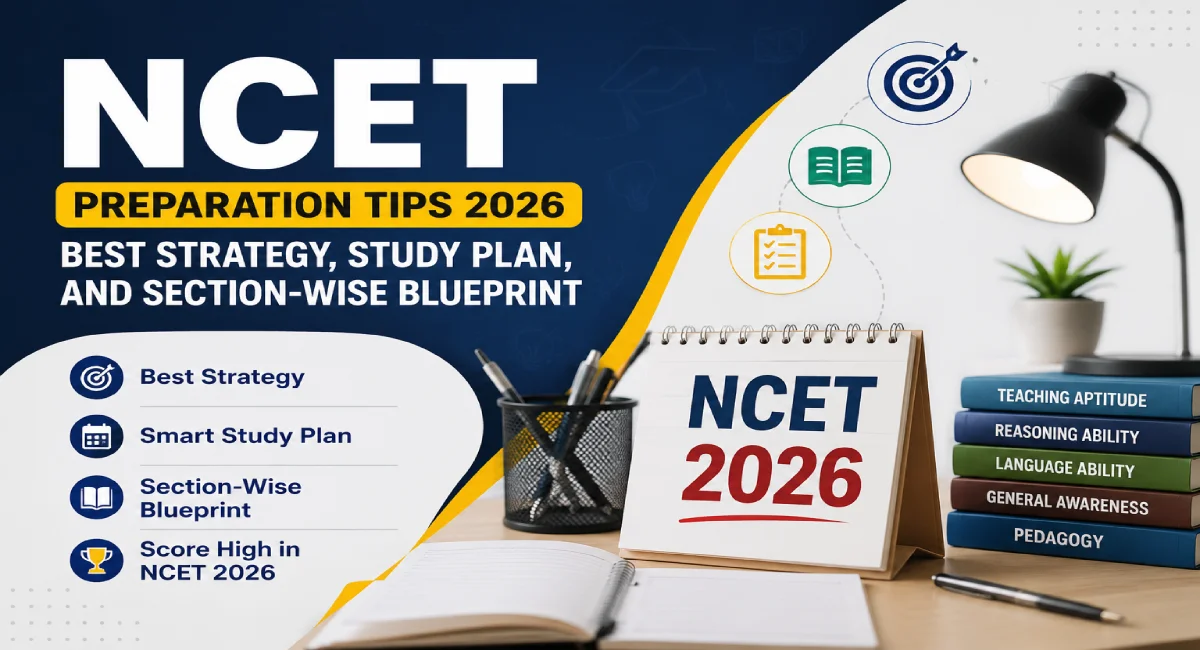
The National Common Entrance Test (NCET), conducted by the National Testing Agency (NTA), is the gateway to the 4-Year Integrated Teacher Education Programme (ITEP) offered by top Central and State Universities, IITs, NITs, and RIEs.
With the competition rising every year, clearing NCET 2026 requires a balanced approach combining subject mastery, pedagogical understanding, and test-taking speed. Below is your complete, step-by-step strategy to crack the exam.
Understand the NCET 2026 Exam Pattern & Scheme
Before diving into books, understand the structure of the Computer-Based Test (CBT):
- Total Duration: 180 Minutes (3 Hours)
- Total Questions: 181 Questions (Candidates attempt 160)
- Marking Scheme: +4 for correct answers | -1 for wrong answers | 0 for unattempted
| Section | Subject / Test | Total Questions | Questions to Attempt |
| Section 1 | Language 1 (From 38 languages) | 23 | 20 |
| Language 2 (Different from L1) | 23 | 20 | |
| Section 2 | Domain-Specific Subject 1 | 28 | 25 |
| Domain-Specific Subject 2 | 28 | 25 | |
| Domain-Specific Subject 3 | 28 | 25 | |
| Section 3 | General Test (Compulsory) | 28 | 25 |
| Section 4 | Teaching Aptitude (Compulsory) | 23 | 20 |
| Total | 181 | 160 |
Section-Wise Preparation Strategy
Section 1: Languages (Language 1 & Language 2)
This section tests your reading comprehension, vocabulary, and basic grammar.
- Reading Comprehension (RC): Practice reading 2 passage sets daily. Focus on identifying main themes, inferences, and context-based meanings.
- Vocabulary: Build a daily word list for synonyms, antonyms, idioms, and one-word substitutions.
- Grammar: Revise core Class 10/12 grammar rules (tenses, subject-verb agreement, error spotting, and sentence correction).
Section 2: Domain-Specific Subjects
Questions are aligned strictly with the Class 12 NCERT curriculum.
- Master NCERTs: Read NCERT textbooks line-by-line for your three chosen domain subjects. Pay attention to boxed text, diagrams, summary points, and exercise questions.
- Chapter-Wise MCQs: Solve 30–40 multiple-choice questions after finishing every chapter.
- Formula & Concept Sheets: Maintain short notes containing definitions, reaction mechanisms, formulas, and dates for quick revisions.
Section 3: General Test
This section evaluates general awareness and analytical reasoning.
- Quantitative Ability: Focus on Class 8–10 level Mathematics — percentages, ratios, averages, time & work, simple/compound interest, and basic mensuration.
- Logical & Analytical Reasoning: Master series completion, coding-decoding, blood relations, direction tests, Venn diagrams, and syllogisms.
- General Knowledge & Current Affairs: Track current affairs over the past 6 to 8 months with a specific focus on national education policies (NEP 2020), awards, science, and key government schemes.
Section 4: Teaching Aptitude
Teaching Aptitude evaluates your pedagogical awareness and orientation toward education.
- Pedagogical Theories: Learn fundamental child development and learning theories (e.g., Bloom’s Taxonomy, Constructivism, Vygotsky’s ZPD).
- Classroom Management: Practice situational judgment questions. Choose options that favor child-centric, inclusive, and positive learning environments.
- Educational Policies: Understand the structural framework and foundational goals of NEP 2020.
Ideal 8-Week NCET Study Plan
| Timeframe | Key Focus & Milestones |
| Weeks 1–2 | Map syllabus; build core concepts in Domain 1 & Languages; practice daily RCs. |
| Weeks 3–4 | Complete Domain 2; start General Test Quant & Reasoning foundations; cover basic Teaching Aptitude theories. |
| Weeks 5–6 | Complete Domain 3; attempt full-length timed sectional tests; practice 1 full mock test per week. |
| Week 7 | Solve Previous Year Question papers (PYQs); review weak topics; take 2 full-length mocks. |
| Week 8 | Focus strictly on error log revision, formula sheets, key shortcuts, and final speed sets. |
Key Tips to Score High in NCET 2026
- Leverage Question Choice: You do not need to attempt every question. Utilize the internal choice (e.g., attempt 25 out of 28 in Domain Subjects) to skip high-risk or time-consuming questions.
- Maintain an Error Log: Note down every mistake made during mock tests. Categorize errors into conceptual mistakes, rushed reads, or calculation mistakes to avoid repeating them.
- Master Time Allocation: Aim for ~1 minute per question. Spend less time on Teaching Aptitude and Languages so you can dedicate more time to numerical questions in the Domain and General Test sections.
- Beware of Negative Marking: Guesswork can penalize your score due to the -1 negative marking. Use educated elimination methods rather than blind guessing.
Detailed Subject-Wise Breakdown for Top NCET Domain Subjects
The NTA designs the NCET domain-specific section strictly based on the Class 12 NCERT curriculum. Each domain paper comprises 28 questions, out of which you must attempt 25. Below is the core chapter and topic breakdown for the most popular domain subjects across Science, Commerce, and Humanities streams.
Science Stream: Physics
- Electrostatics & Current Electricity: Electric charges, fields, Gauss’s law, capacitance, Ohm’s law, Kirchhoff’s laws, Wheatstone bridge, and drift velocity.
- Magnetic Effects & Magnetism: Biot-Savart law, Ampere’s circuital law, moving coil galvanometer, magnetic properties of matter, and hysteresis.
- Electromagnetic Induction & AC: Faraday’s laws, Lenz’s law, LCR series circuits, resonance, transformers, and AC generators.
- Optics (Ray & Wave): Reflection, refraction, total internal reflection, optical instruments (telescopes/microscopes), Young’s double-slit experiment, diffraction, and polarization.
- Modern Physics: Photoelectric effect, Bohr’s atomic model, radioactivities, nuclear fission/fusion, and semiconductor electronics (diodes, logic gates).
Chemistry
- Physical Chemistry: Solutions & colligative properties, electrochemistry (Nernst equation, conductance), and chemical kinetics (rate laws, order of reaction).
- Inorganic Chemistry: Coordination compounds (IUPAC nomenclature, bonding, isomerism) and d- & f-block elements (lanthanoids/actinoids).
- Organic Chemistry: Haloalkanes & Haloarenes, Alcohols, Phenols & Ethers, Aldehydes, Ketones & Carboxylic Acids, and Organic Compounds Containing Nitrogen (Amines).
- Biomolecules & Polymers: Carbohydrates, proteins, nucleic acids (DNA/RNA), and primary vs. secondary structures.
Mathematics / Applied Mathematics
- Algebra: Matrices & Determinants (operations, inverse, solving system of linear equations) and Relations & Functions.
- Calculus: Continuity and Differentiability, Applications of Derivatives (tangents/normals, maxima/minima), Indefinite & Definite Integrals, and Applications of Integration (area under simple curves).
- Differential Equations & Vectors: Order and degree, variable separable method, 3D Geometry (lines, planes, shortest distance), and Vector Algebra.
- Probability & Linear Programming: Conditional probability, Bayes’ theorem, probability distribution, and LPP graphical solutions.
Biology
- Reproduction: Sexual reproduction in flowering plants and human reproductive systems.
- Genetics & Evolution: Mendelian inheritance, Molecular Basis of Inheritance (DNA replication, transcription, translation), and theories of evolution.
- Biology & Human Welfare: Human health and diseases, immunity, micro-organisms in human welfare, and biotechnology principles.
- Ecology & Environment: Organisms and populations, ecosystems, biodiversity conservation, and environmental issues.
Commerce Stream: Accountancy / Bookkeeping
- Accounting for Partnership Firms: Reconstitution of partnership (admission, retirement, death of a partner), dissolution, goodwill valuation, and profit-sharing ratios.
- Company Accounts: Accounting for share capital (issue, forfeiture, reissue of shares) and issue/redemption of debentures.
- Financial Statement Analysis: Comparative and common-size statements, accounting ratios (liquidity, solvency, profitability), and Cash Flow Statement (operating, investing, financing activities).
Business Studies
- Principles & Functions of Management: Planning, Organizing, Staffing, Directing, and Controlling.
- Business Finance & Markets: Financial Management (capital structure, working capital), Financial Markets (money market, stock exchange, SEBI).
- Marketing & Consumer Protection: Marketing mix (4 Ps), consumer rights, and the Consumer Protection Act.
Economics
- Introductory Microeconomics: Consumer equilibrium, demand & elasticity, producer behavior, supply, and forms of market.
- Introductory Macroeconomics: National income accounting, money & banking, determination of income & employment, government budget, and Balance of Payments (BoP).
- Indian Economic Development: Development strategies post-1947, 1991 economic reforms (LPG), and current challenges facing the Indian economy (poverty, human capital, rural development).
Humanities / Arts Stream: History
- Ancient India (Themes 1): Harappan Archaeology, early states and economies (Caste, Class, and Kinship), and early cultural developments (Buddhism & Jainism).
- Medieval India (Themes 2): Agrarian relations (Ain-i-Akbari), Vijayanagara Empire, and Bhakti-Sufi traditions.
- Modern India (Themes 3): Colonialism and rural society, 1857 Revolt, Mahatma Gandhi and the Nationalist Movement, Framing of the Indian Constitution.
Political Science
- Contemporary World Politics: Cold War era, alternative centers of power (EU, ASEAN, BRICS), contemporary South Asia, international organizations (UN), and globalization.
- Politics in India Since Independence: Challenges of nation-building, era of one-party dominance, politics of planned development, India’s foreign policy, Democratic Resurgence, and recent political trends.
History / Geography / Sociology / Psychology Highlights
- Geography: Fundamentals of Human Geography (human activities, transport/communication, world population) and India: People and Economy (resources, agriculture, spatial development).
- Sociology: Structure of Indian Society (demographics, social institutions, caste, rural-urban transformations, and social movements).
- Psychology: Variations in psychological attributes, self and personality, coping with stress, psychological disorders, and therapeutic approaches.
High-Yield Revision Strategy for Domain Subjects
- Focus 80% on NCERT Class 12: NTA extracts direct factual statements and diagrams directly from NCERT textbooks.
- Prioritize High-Weightage Numerical / Assertion-Reason Questions: Practice direct numerical problems for Physics, Chemistry, and Accountancy, and Assertion-Reason MCQs for History, Political Science, and Biology.
- Solve Chapter-End Exercises: Do not skip the exemplar or exercise problems given at the end of Class 12 chapters.




 MHT CET Law Exam Pattern 2027 – 3-Year...
 How to Start MHCET Law 2027 Preparation,...
 CUET PG LLB Preparation 2027, Strategy a...