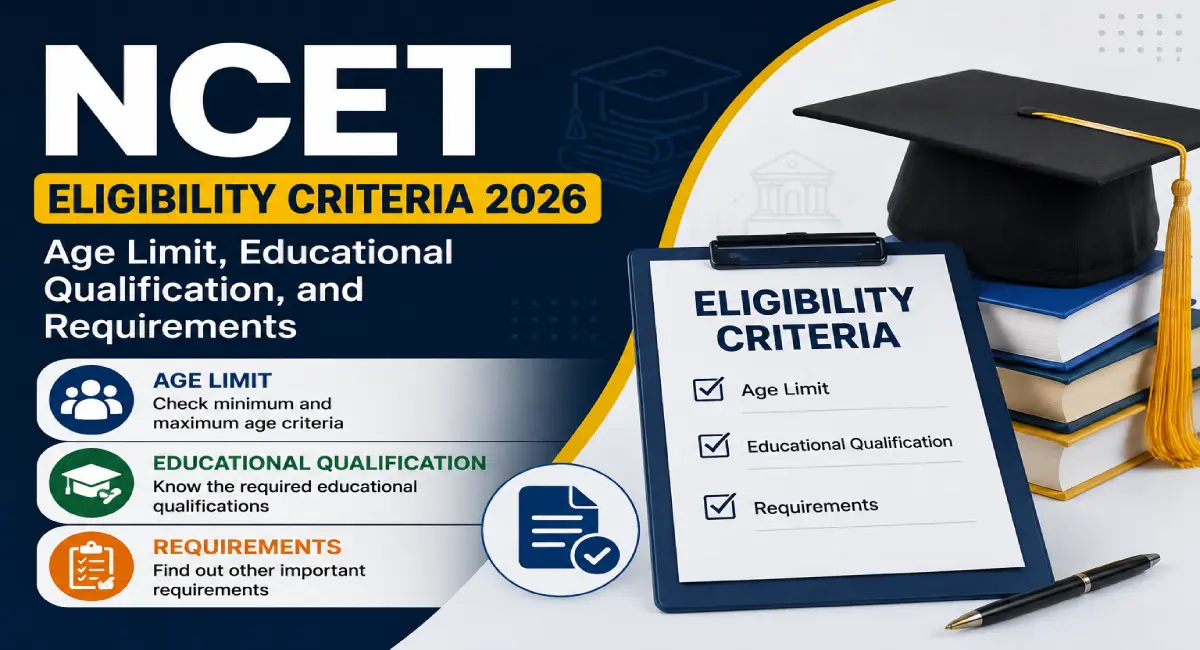
The National Common Entrance Test (NCET), administered by the National Testing Agency (NTA), is the single entrance examination for admission into the 4-Year Integrated Teacher Education Programme (ITEP). Designed for students aiming to build a career in teaching right after school, ITEP enables candidates to complete a dual-degree program (B.A. B.Ed, B.Sc. B.Ed, or B.Com. B.Ed) in four years instead of five.
To secure a seat across premier participating central institutes, state universities, and national education centres, candidates must fulfill the prescribed qualification, age, and subject criteria.
NCET 2026 Eligibility Criteria: Overview
| Requirement Parameter | Official Standard |
| Qualifying Examination | Passed or currently appearing in Class 12 / 10+2 / Equivalent |
| Minimum Qualifying Marks | 50% for General/OBC; 45% for reserved categories (SC/ST/PwD) |
| Upper Age Limit | No upper age limit set by the testing agency |
| Nationality | Indian Citizens, OCIs, NRIs, and Foreign Nationals |
| Stream Eligibility | Open to Science, Commerce, Arts, and Vocational backgrounds |
Detailed Age Limit Criteria
- No Upper Age Cap: There is no maximum age limit to register or sit for the exam. Anyone who has completed Class 12 or is taking their final board exams can apply.
- Institutional Conditions: While the national testing agency maintains no age barrier, individual participating universities may apply specific age guidelines during final counselling.
Educational Qualifications & Recognized Examination Boards
Candidates seeking admission to the 4-year integrated teacher training course must fulfill the following educational norms:
Minimum Educational Standard
- Candidates must have passed their Class 12 (10+2) or equivalent qualifying exam from a recognized board, OR
- Candidates appearing for their Class 12 final board examinations in 2026 are eligible to apply provisionally.
Recognized Qualifying Boards
- Central & State Boards: CBSE, CISCE, State Higher Secondary Boards, or Intermediate Education Boards.
- Open Schooling System: Senior Secondary certification from recognized open schools (such as NIOS) with a minimum of 5 academic subjects.
- Foreign Education: Students passing Class 12 outside India must obtain an Equivalence Certificate from the Association of Indian Universities (AIU).
Minimum Aggregate Marks & Category Relaxation
While passing Class 12 allows students to take the entrance test, individual participating universities apply standard NCTE minimum academic cutoffs for final admission:
- General / EWS / OBC-NCL Candidates: Must secure a minimum of 50% aggregate marks in Class 12.
- SC / ST / PwD Candidates: Benefit from a 5% relaxation, requiring a minimum of 45% aggregate marks in Class 12.
Stream Alignment and Subject Selection Rules
To qualify for specific undergraduate teaching streams, candidates must map their test paper selections in the entrance application to their Class 12 subjects:
- B.Sc. B.Ed: Applicants must choose Domain Subjects from the Science stream (Physics, Chemistry, Mathematics, or Biology) studied in Class 12.
- B.Com. B.Ed: Applicants must select Domain Subjects from the Commerce stream (Accountancy, Business Studies, or Economics).
- B.A. B.Ed: Open to students from Arts, Science, or Commerce streams. Arts aspirants typically select Humanities domain subjects (History, Political Science, Geography, Sociology, or Economics).
Key Recommendation for Applicants
Always choose domain papers in your application form that align with the core subjects you studied in Class 12. Participating universities verify this subject mapping strictly during seat allocation and document verification.


 MHT CET Law Exam Pattern 2027 – 3-Year...
 How to Start MHCET Law 2027 Preparation,...
 CUET PG LLB Preparation 2027, Strategy a...