Correct option is C
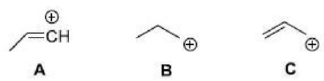
Least stable carbocation will have the highest hydride affinity.
Carbocation A: The tropylium ion or cycloheptatrienyl cation is an aromatic species with a formula of [C7H7]+.
Aromatic compounds
Aromatic compounds or arenes are organic compounds "with a chemistry typified by benzene" and "cyclically conjugated." Aromatic compounds are now defined as cyclic compounds satisfying Hückel's Rule.
In organic chemistry, Hückel's rule predicts that a planar ring molecule will have aromatic properties if it has 4n + 2 π-electrons, where n is a non-negative integer. A cyclic ring molecule follows Hückel's rule when the number of its π-electrons equals 4n + 2, although clear cut examples are really only established for values of n = 0 up to about n = 6.
Criteria for simple aromatics are:
1.the molecule must have 4n + 2 (a so-called "Hückel number") π electrons (2, 6, 10,...) in a conjugated system of p orbitals (usually on sp2-hybridized atoms, but sometimes sp-hybridized);
2.the molecule must be (close to) planar (p orbitals must be roughly parallel and able to interact, implicit in the requirement for conjugation);
3.the molecule must be cyclic (as opposed to linear);
4.the molecule must have a continuous ring of p atomic orbitals (there cannot be any sp3 atoms in the ring, nor do exocyclic p orbitals count)
A major contribution to the stability of aromatic systems results from the delocalization of electrons in these molecules.
Carbocation B and C:
Hyperconjugation (σ-conjugation or no-bond resonance) refers to the delocalization of electrons with the participation of bonds of primarily σ-character. Usually, hyperconjugation involves the interaction of the electrons in a sigma (σ) orbital (e.g. C–H or C–C) with an adjacent unpopulated non-bonding p or antibonding σ* or π* orbitals to give a pair of extended molecular orbitals.

The three C–H σ bonds of the methyl group(s) attached to the carbocation can undergo the stabilization interaction but only one of them can be aligned perfectly with the empty p-orbital, depending on the conformation of the carbon–carbon bond. Donation from the two misaligned C–H bonds is weaker. The more adjacent methyl groups there are, the larger hyperconjugation stabilization is because of the increased number of adjacent C–H bonds.
The inductive effect in a molecule is a local change in the electron density due to electron-withdrawing or electron-donating groups elsewhere in the molecule, resulting in a permanent dipole in a bond. The halogen atoms in an alkyl halide are electron withdrawing while the alkyl groups have electron donating tendencies. If the electronegative atom (missing an electron, thus having a positive charge) is then joined to a chain of atoms, typically carbon, the positive charge is relayed to the other atoms in the chain. This is the electron-withdrawing inductive effect, also known as the -I effect. In short, alkyl groups tend to donate electrons, leading to the +I effect.