

Becoming a Nursing Officer in India is a regulated process that combines formal nursing education, mandatory registration with a nursing council, and qualification through competitive examinations conducted at the central or state level. The system is uniform in principle but varies significantly in eligibility rules depending on whether the recruitment is central or state-based.
How To Become A Nursing Officer?
In this article, we have are going to take a look at every essential aspect of the journey—educational pathways, clinical experience requirements, registration rules, age criteria, and both central and state-level recruitment differences—so that aspirants can understand the complete process of becoming a Nursing Officer without confusion.
1. Educational Qualification Pathways
The foundation of eligibility begins with completing an INC-recognized nursing qualification. There are three primary routes.
i. B.Sc. Nursing / B.Sc. (Hons.) Nursing (4 years)
This is the most straightforward and widely accepted pathway. Candidates completing this degree from an INC-approved institution become eligible for both central and state nursing officer exams after obtaining registration. Importantly, no prior clinical experience is required for this category.
ii. Post Basic B.Sc. Nursing (2 years)
This is designed for candidates who have already completed GNM. After completion, these candidates are treated at par with B.Sc. Nursing graduates and generally do not face additional experience requirements for recruitment.
iii. GNM (General Nursing and Midwifery – 3.5 years)
GNM is also a valid entry route but comes with additional conditions in most central recruitments. While it provides eligibility, it is not independently sufficient for major exams unless supported by clinical experience.
A key requirement for GNM candidates is:
- 2 years of clinical experience
- Experience must be in a hospital with minimum 50 beds
- Experience must be acquired after qualification and registration
This condition is especially important for central-level recruitments.
2. Mandatory Registration Requirement
Educational qualification alone does not make a candidate eligible for recruitment. Every candidate must be registered as a Registered Nurse (RN) and Registered Midwife (RM) with either a State Nursing Council or the Indian Nursing Council.
Registration must be:
- Fully completed before the application cutoff date
- Active and valid at the time of document verification
- Not provisional in most recruitment cases
In recent years, the system has been further strengthened through the Nurses Registration & Tracking System (NRTS), which generates a NUID (Nurses Unique Identification Number). This helps standardize verification across states and central institutions.
3. Age Criteria and Relaxations
Age eligibility depends on the recruiting body and is strictly calculated as per the notification cutoff date.
Central-level age limits vary as follows:
| Exam/Institution | Age Limit |
| AIIMS NORCET | 18–30 years |
| DSSSB | 18–32 years |
| ESIC | 21–37 years |
| RRB Paramedical | 21–40 years |
Age relaxations are provided as per government norms:
- SC/ST: 5 years
- OBC (NCL): 3 years
- PwBD: 10 years (higher for reserved combinations)
- Ex-servicemen: as per service duration rules
4. Major Recruitment Pathways in India
The recruitment structure is broadly divided into central government institutions and state government health departments.
Central Government Recruitment
Central exams are open to candidates from all states without domicile restrictions. These are considered the most competitive and stable career pathways.
Key institutions include:
- AIIMS NORCET
- ESIC
- DSSSB
- RRB
These recruitments generally follow a written exam-based selection process. For example, AIIMS NORCET includes a prelims stage followed by mains, where advanced clinical understanding and scenario-based questions are tested.
State Government Recruitment
State-level recruitment is more complex due to local rules involving domicile, language, and registration transfers. Each state follows its own medical or public service recruitment board.
Unlike central jobs, eligibility here often depends on regional factors such as:
- State nursing council registration
- Domicile certificate
- Language proficiency requirements
- Category-based reservation rules
5. State-Specific Eligibility Differences
To understand how eligibility changes across India, here is a structured comparison of key states:
| State | Registration Requirement | Special Conditions |
| Uttar Pradesh | UP Nurses & Midwives Council | Registration transfer required for outsiders |
| Punjab | Punjab Nursing Council | Punjabi language required (Class 10) |
| Madhya Pradesh | MP Nursing Council | Domicile preferred for reservation benefits |
| Uttarakhand | Uttarakhand Nursing Council | Domicile required for relaxation benefits |
| Rajasthan | Any INC/state council initially | Must shift to RNC before joining |
In most state systems, candidates from outside the state are allowed to apply but are placed in the General/Unreserved category, even if they belong to reserved categories in their home state.
6. Registration Transfer Between States
When a candidate applies outside their home state, a formal transfer process is often required. This typically involves obtaining a No Objection Certificate (NOC) from the existing council and transferring registration to the new state nursing council.
This step is usually mandatory before final appointment, not always before application, but missing it can disqualify a candidate during joining.
7. Step-by-Step Path to Become a Nursing Officer
The complete journey can be understood in a structured progression:
- First, the candidate completes a recognized nursing qualification such as B.Sc Nursing, Post Basic B.Sc Nursing, or GNM. If the candidate is from GNM, they must complete the required clinical experience before moving forward.
- Next, the candidate obtains RN & RM registration from the nursing council, which is essential for legal eligibility. Without this, no application is valid.
- After this, candidates may optionally enroll in the NRTS system to obtain a unique identification number that helps streamline verification.
- The next step is selecting the recruitment pathway—either central exams like NORCET, ESIC, RRB, DSSSB or state-level exams depending on eligibility.
- Finally, selection is done through a written examination followed by document verification, where qualification, experience, and registration are strictly checked before final appointment.
8. Key Eligibility Checklist
To simplify, a candidate must ensure the following before applying:
- Valid INC-recognized nursing qualification
- Active RN & RM registration
- Required clinical experience (if GNM)
- Age within prescribed limits
- Compliance with state-specific rules (if applicable)
- Valid documentation before cutoff date
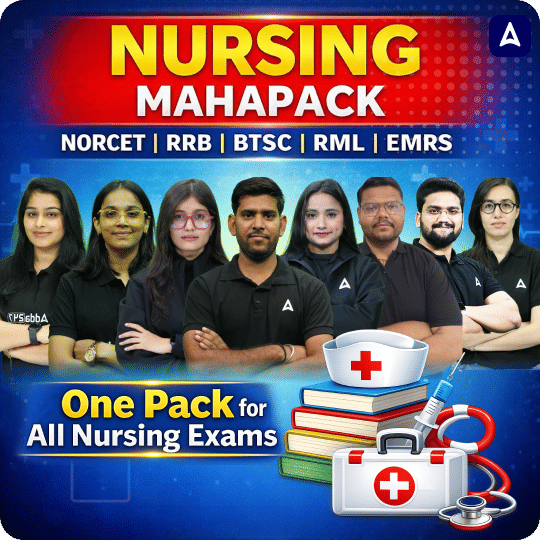
Final Understanding
The pathway to becoming a Nursing Officer in India is not a single-track process but a multi-layered eligibility system combining education, statutory registration, and recruitment-specific compliance rules.
Central institutions such as AIIMS NORCET offer uniform national eligibility, while state-level systems introduce additional requirements like domicile, language proficiency, and registration transfer obligations.
Ultimately, success depends not only on exam preparation but also on correctly aligning eligibility with the specific recruitment system being targeted.




 TNPSC Group 4 Previous Year Question Pap...
 How many application forms Received for ...
 UPSSSC Inter Level Recruitment 2026 Noti...
 Adda247 Job portal has complete information about all Sarkari Jobs and Naukri Alerts, its latest recruitment notifications, from all state and national level jobs and their updates.