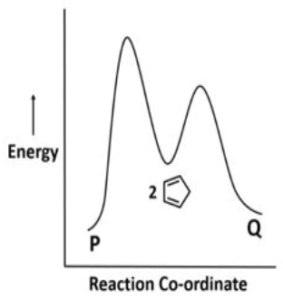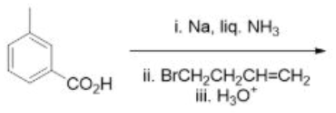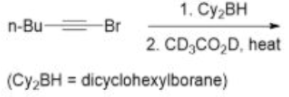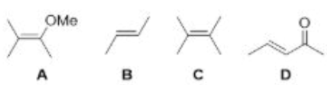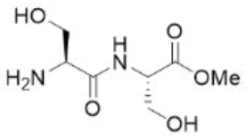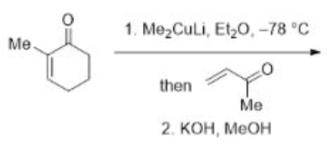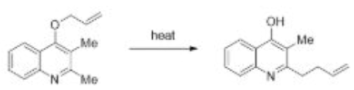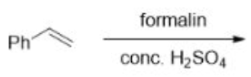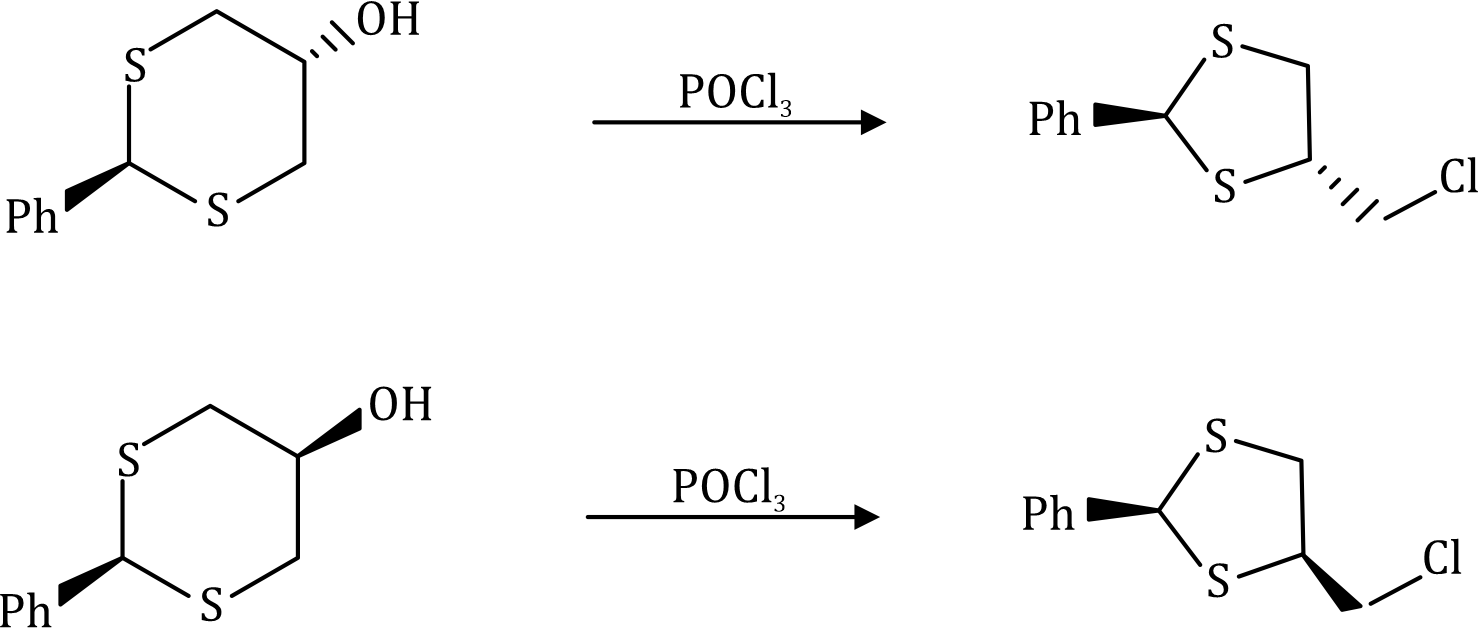
Correct option is B
An enantioselective reaction is one in which one enantiomer is formed in preference to the other, in a reaction that creates an optically active product from an achiral starting material, using either a chiral catalyst, an enzyme or a chiral reagent. The degree of selectivity is measured by the enantiomeric excess. An important variant is kinetic resolution, in which a pre-existing chiral center undergoes reaction with a chiral catalyst, an enzyme or a chiral reagent such that one enantiomer reacts faster than the other and leaves behind the less reactive enantiomer, or in which a pre-existing chiral center influences the reactivity of a reaction center elsewhere in the same molecule.
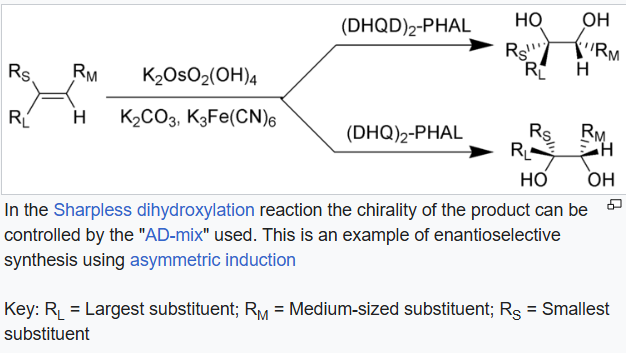
A diastereoselective reaction is one in which one diastereomer is formed in preference to another (or in which a subset of all possible diastereomers dominates the product mixture), establishing a preferred relative stereochemistry. In this case, either two or more chiral centers are formed at once such that one relative stereochemistry is favored, or a pre-existing chiral center (which needs not be optically pure) biases the stereochemical outcome during the creation of another. The degree of relative selectivity is measured by the diastereomeric excess.
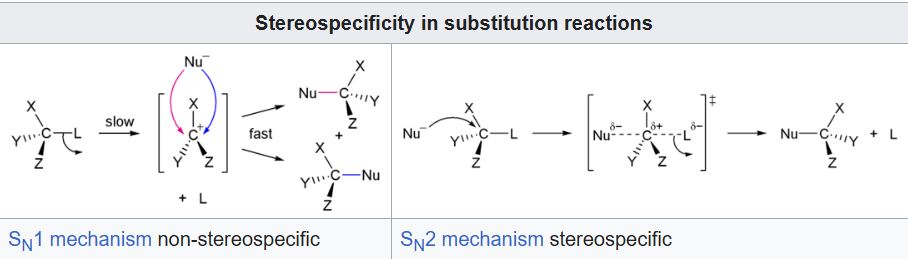
In chemistry, stereospecificity is the property of a reaction mechanism that leads to different stereoisomeric reaction products from different stereoisomeric reactants, or which operates on only one (or a subset) of the stereoisomers.
A stereospecific mechanism specifies the stereochemical outcome of a given reactant, whereas a stereoselective reaction selects products from those made available by the same, non-specific mechanism acting on a given reactant. Given a single, stereoisomerically pure starting material, a stereospecific mechanism will give 100% of a particular stereoisomer (or no reaction), although loss of stereochemical integrity can easily occur through competing mechanisms with different stereochemical outcomes. A stereoselective process will normally give multiple products even if only one mechanism is operating on an isomerically pure starting material.
The term stereospecific reaction is ambiguous, since the term reaction itself can mean a single-mechanism transformation (such as the Diels–Alder reaction), which could be stereospecific, or the outcome of a reactant mixture that may proceed through multiple competing mechanisms, specific and non-specific. In the latter sense, the term stereospecific reaction is commonly misused to mean highly stereoselective reaction.
Chiral synthesis is built on a combination of stereospecific transformations (for the interconversion of existing stereocenters) and stereoselective ones (for the creation of new stereocenters), where also the optical activity of a chemical compound is preserved.
The quality of stereospecificity is focused on the reactants and their stereochemistry; it is concerned with the products too, but only as they provide evidence of a difference in behavior between reactants. Of stereoisomeric reactants, each behaves in its own specific way. Stereospecificity towards enantiomers is called enantiospecificity.
Information Booster
In stereochemistry, diastereomers (sometimes called diastereoisomers) are a type of stereoisomer. Diastereomers are defined as non-mirror image, non-identical stereoisomers. Hence, they occur when two or more stereoisomers of a compound have different configurations at one or more (but not all) of the equivalent (related) stereocenters and are not mirror images of each other. When two diastereoisomers differ from each other at only one stereocenter, they are epimers.
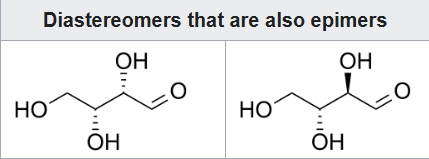
Diastereomers differ from enantiomers in that the latter are pairs of stereoisomers that differ in all stereocenters and are therefore mirror images of one another.