arrow
arrow
arrow
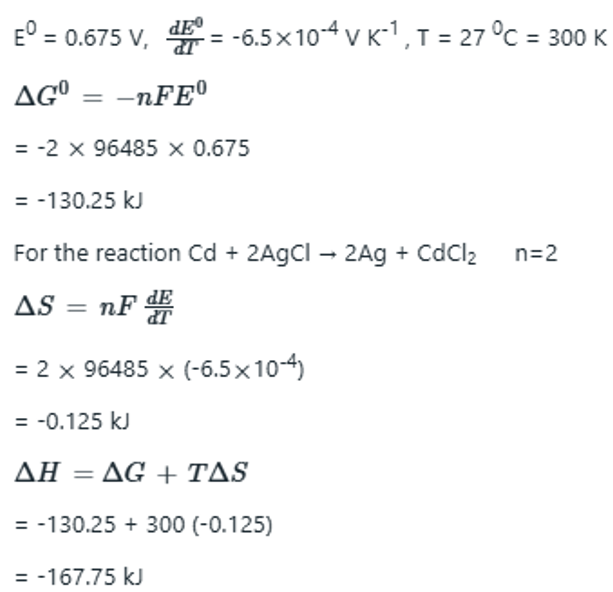
For the cell Cd ∣ CdCl2 ∣∣ AgCl ∣ Ag; Ecell∘=0.675 V and dEcell∘dT=−6.5×10⁻⁴ V K−1 at 27∘C. ΔH (kJ mol−1) value for the 
Question

For the cell Cd CdCl2 AgCl Ag; Ecell=0.675 V and dEcelldT=6.5×10⁴ V K1 at 27C. ΔH (kJ mol1) value for the reaction Cd+2AgCl2Ag+CdCl2 is closest to:\text{Cd} \, | \, \text{CdCl}_2 \, || \, \text{AgCl} \, | \, \text{Ag} ; \, E^\circ_{\text{cell}} = 0.675 \, \text{V} \, \text{and} \, \frac{dE^\circ_{\text{cell}}}{dT} = - 6.5 \times 10^{-4} \, \text{V K}^{-1} \, \text{at} \, 27^\circ \text{C}. \, \Delta H \, (\text{kJ mol}^{-1}) \, \text{value for the reaction} \, \text{Cd} + 2\text{AgCl} \rightarrow 2\text{Ag} + \text{CdCl}_2 \, \text{is closest to:}


A.

-168

B.

-123

C.

-95

D.

-234

Correct option is A

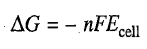
The free energy change accompanying a cell reaction can be obtained from the emf of the cell through the relation

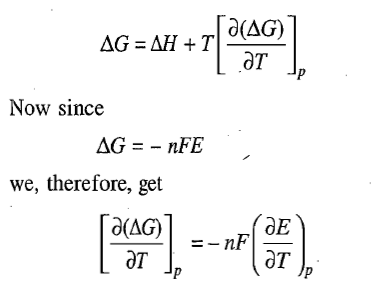
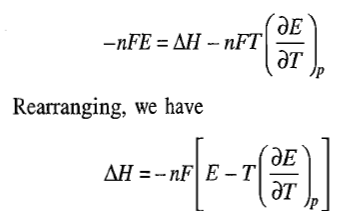
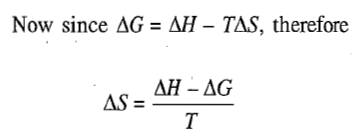
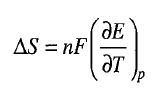
The changes in enthalpy and entropy of the cell reaction can also be determined if the temperature dependence of the emf of the cell is available. For this, we make use of the Gibbs-Helmholtz equation:


Similar Questions

test-prime-package

Access ‘CSIR NET Chemical Sciences’ Mock Tests with

  • 60000+ Mocks and Previous Year Papers
  • Unlimited Re-Attempts
  • Personalised Report Card
  • 500% Refund on Final Selection
  • Largest Community
students-icon
354k+ students have already unlocked exclusive benefits with Test Prime!
test-prime-package

Access ‘CSIR NET Chemical Sciences’ Mock Tests with

  • 60000+ Mocks and Previous Year Papers
  • Unlimited Re-Attempts
  • Personalised Report Card
  • 500% Refund on Final Selection
  • Largest Community
students-icon
354k+ students have already unlocked exclusive benefits with Test Prime!
Our Plans
Monthsup-arrow