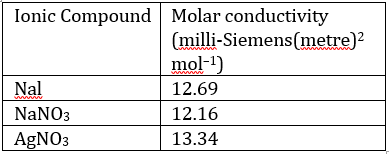
Correct option is C
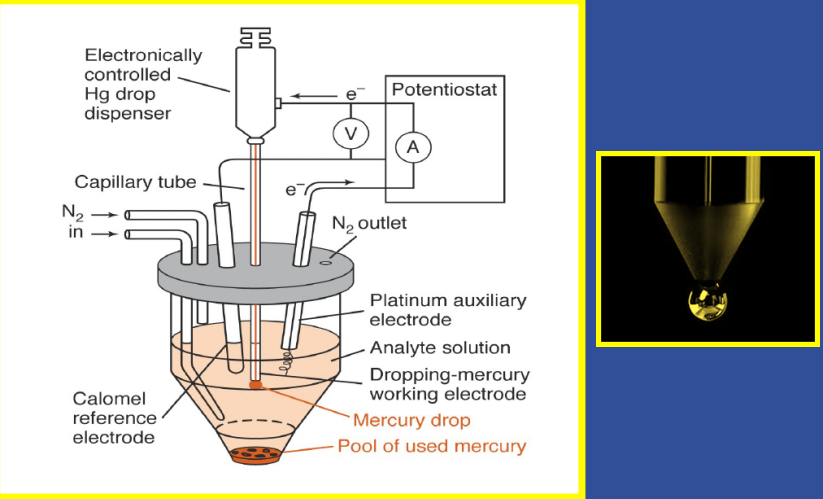
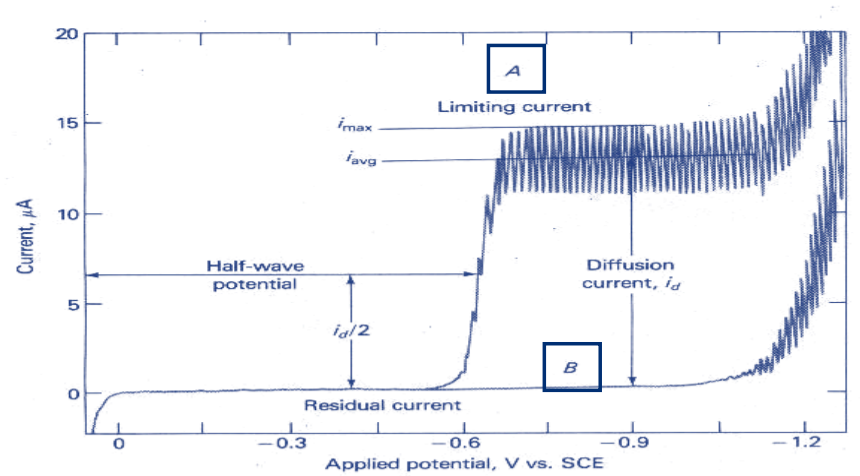
Polarography is a method of analysis in which the solution to be analyzed is electrolyzed under diffusion controlled condition. The graph of current (generated) as a function of voltage (applied) is known as POLAROGRAM. The technique is known as POLAROGRAPHY. It can be used for qualitative as well as quantitative analysis (inorganic, organic and biological samples) without the requirement of prior separation step (in most of the cases). Polarography uses regularly renewed mercury drop electrode for analysis.
Working
Electrolyte is a dilute solution of electro active material tobe analyzed in a suitable medium containing excess ofsupporting electrolyte. Consider a polarographic cell, containing a solution ofcadmium chloride, to which an external E.M.F is applied. The positively charged ions present in the solution will beattracted towards the mercury drop of the droppingmercury electrode (DME).The total current flowing through the cell maybe regarded as being the “ sum of the electricaland diffusive forces.” When the applied voltage is increased and thecurrent is recorded a graph will obtained.
Factors affecting limiting current
RESIDUAL CURRENT = Faradic Current + Condenser current
MIGRATION CURRENT: The electro active material reaches the surface of electrode by two processes
a. The first involves the migration of charge particles in the electrical fields caused by the potential difference existing between the electrode surface and the solution.
b. The second involves the diffusion of particles.
DIFFUSION CURRENT: Diffusion current is directly proportional to the concentration of the electro active material.
KINETIC CURRENT: The limited current may be affected by the rate of non electrode reaction called kinetic current.
Differential pulse polarography is a polarographic technique that use a series of discrete potential steps rather than a linear potential ramp to obtain the experimental polarogram.
Gelatin has been used in the differential-pulse polarographic determination and identification of synthetic colouring matters in drugs and cosmetics. Gelatin was shown to have a pronounced effect on the peak currents, and a lesser effect on the peak potentials, of some of the colouring matters, and these effects could be used to partially identify and determine these colouring matters.
Depolarization in dc polarography is done using a substance called depolarizer which is mainly an oxidizing agent. It prevents the formation of excessive hydrogen bubbles.