






Correct option is A
The relationship between Gibbs free energy and the equilibrium constant is fundamental in thermodynamics. It helps predict whether a reaction will proceed spontaneously and how it is related to the position of equilibrium.
The relationship is given by the equation:
ΔG°=-RTlnK
Where:
ΔG°: Standard Gibbs free energy change (in joules or kJ)
R: Universal gas constant (8.314 J/mol·K)
T: Absolute temperature (in Kelvin)
K: Equilibrium constant (dimensionless)
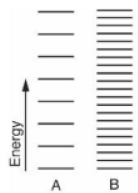
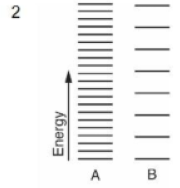
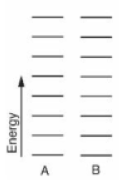
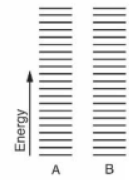
Given K>1 then lnK>1 and ΔG°<0
This indicates that the reaction is spontaneous in the forward direction under standard conditions. It means that at equilibrium , B is more favored than A, indicating that the product (B) is more stable than the reactant (A). The equilibrium constant K >1 implies a lower energy state for B compared to A.


