

arrow
arrow
arrow
​The change in chemical potential (in J) of one mole of an ideal gas, when it is compressed isothermally at 300 K from 1.0 atm to 2.0 atm, is closest
Question


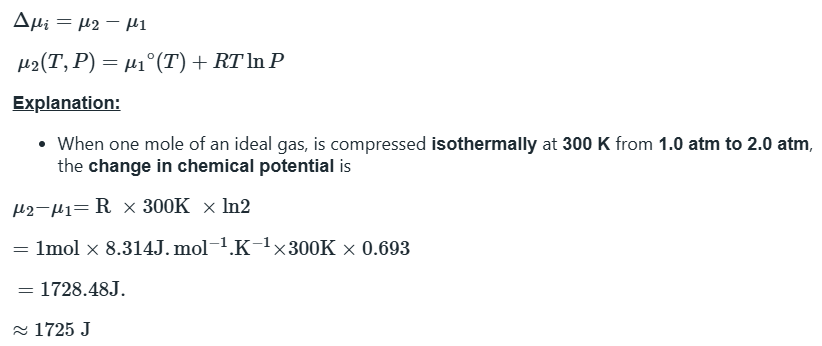
The change in chemical potential (in J) of one mole of an ideal gas, when it is compressed isothermally at 300 K from 1.0 atm to 2.0 atm, is closest to (ln2=0.69)

A.

1225

B.

1725

C.

2425

D.

2725

Correct option is B

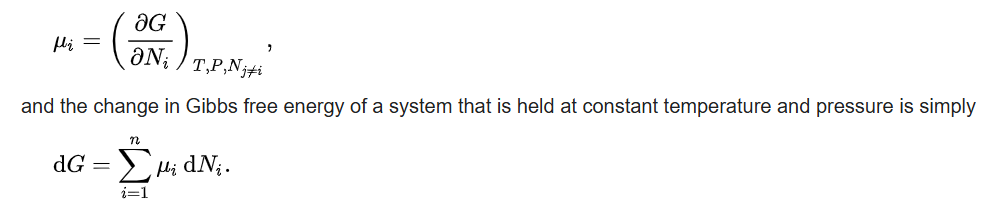
​ The chemical potential of a species is the energy that can be absorbed or released due to a change of the particle number of the given species, e.g. in a chemical reaction or phase transition. The chemical potential of a species in a mixture is defined as the rate of change of free energy of a thermodynamic system with respect to the change in the number of atoms or molecules of the species that are added to the system. Thus, it is the partial derivative of the free energy with respect to the amount of the species, all other species' concentrations in the mixture remaining constant. When both temperature and pressure are held constant, and the number of particles is expressed in moles, the chemical potential is the partial molar Gibbs free energy.
The change in chemical potential when the pressure of an ideal gas is changed from 1atm to P atm at constant temperature is given as:

Similar Questions

test-prime-package

Access ‘CSIR NET Chemical Sciences’ Mock Tests with

  • 60000+ Mocks and Previous Year Papers
  • Unlimited Re-Attempts
  • Personalised Report Card
  • 500% Refund on Final Selection
  • Largest Community
students-icon
368k+ students have already unlocked exclusive benefits with Test Prime!
test-prime-package

Access ‘CSIR NET Chemical Sciences’ Mock Tests with

  • 60000+ Mocks and Previous Year Papers
  • Unlimited Re-Attempts
  • Personalised Report Card
  • 500% Refund on Final Selection
  • Largest Community
students-icon
368k+ students have already unlocked exclusive benefits with Test Prime!
Our Plans
Monthsup-arrow
