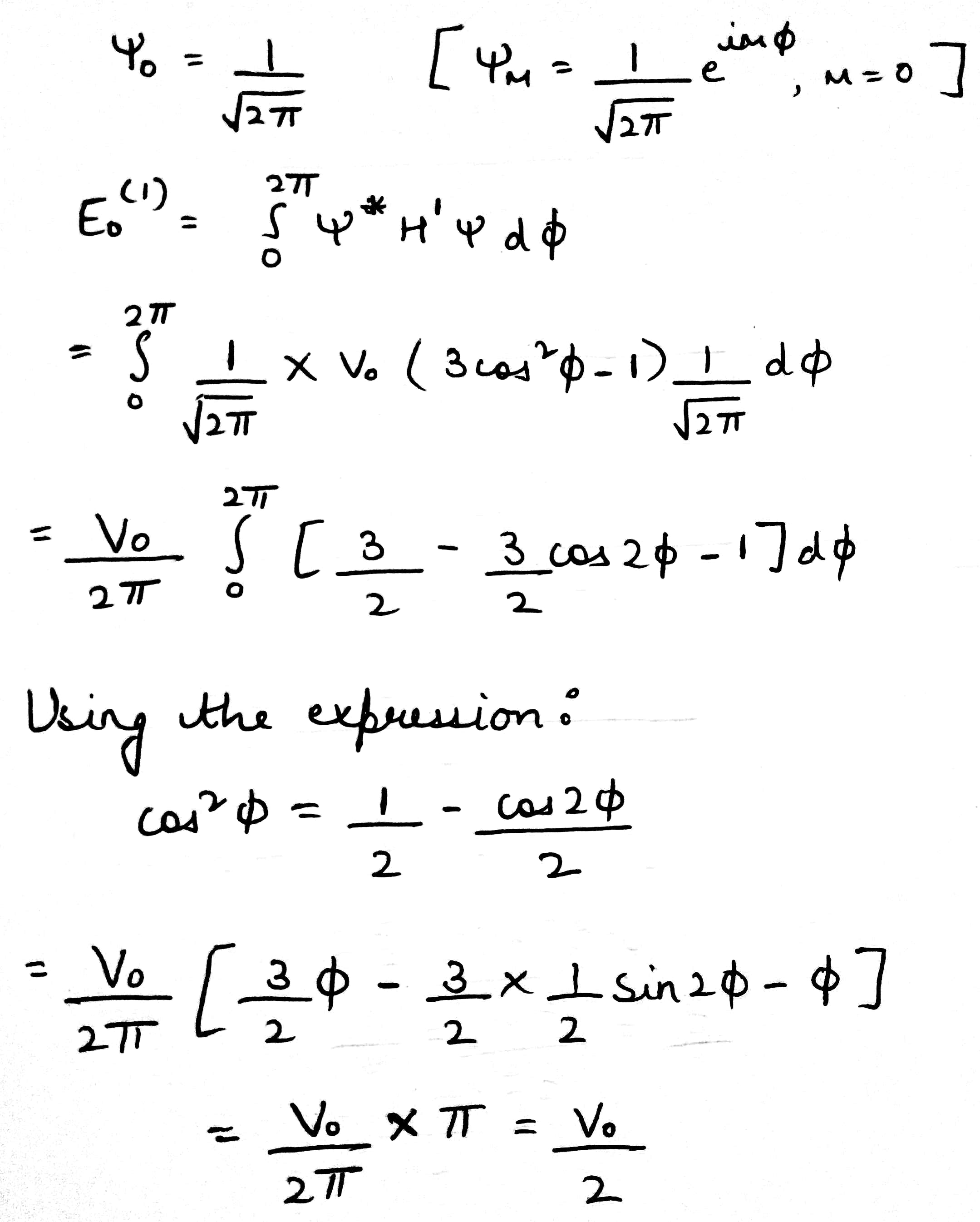
Correct option is C
Time-independent perturbation theory
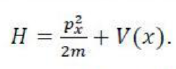
In perturbation theory, we suppose that the Hamiltonian for the problem we are trying to solve,

can be expressed as the sum of a simple Hamiltonian,

which has known eigenvalues and eigenfunctions, and a contribution,

which represents the extent to which the true Hamiltonian differs from the ‘model’ Hamiltonian:
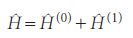
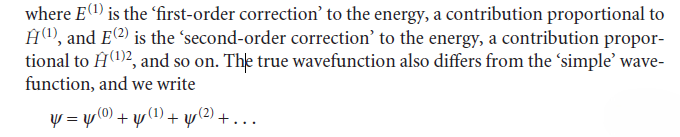
In time-independent perturbation theory, the perturbation is always present and unvarying. For example, it might represent a dip in the potential energy of a particle in a box in some region along the length of the box. In time-independent perturbation theory, we suppose that the true energy of the system differs from the energy of the simple system, and that we can write

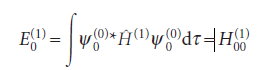
The first-order corrections to the energy of the ground state