
The RBI Grade B exam is the toughest of all bank exams. The selection of the candidates is based on a three-staged approach, comprising Prelims (Phase 1), Mains (Phase 2), and an Interview round. RBI Grade B Preparation Tips 2026 helps to prepare a well-structured strategy to successfully crack the RBI Grade B Exam 2026. In this article, we will provide a detailed preparation strategy, including the RBI Grade B syllabus and exam pattern insights, phase-wise strategy, preparation tips, common mistakes to avoid, and more.
RBI Grade B Preparation Tips 2026
Cracking RBI Grade B 2026 isn’t about studying everything; it’s about studying what matters, with focus and consistency. Stay disciplined, follow your plan, and don’t underestimate the power of regular practice and smart revision. So, having a proper preparation strategy is a must.
Understanding the RBI Grade B Exam
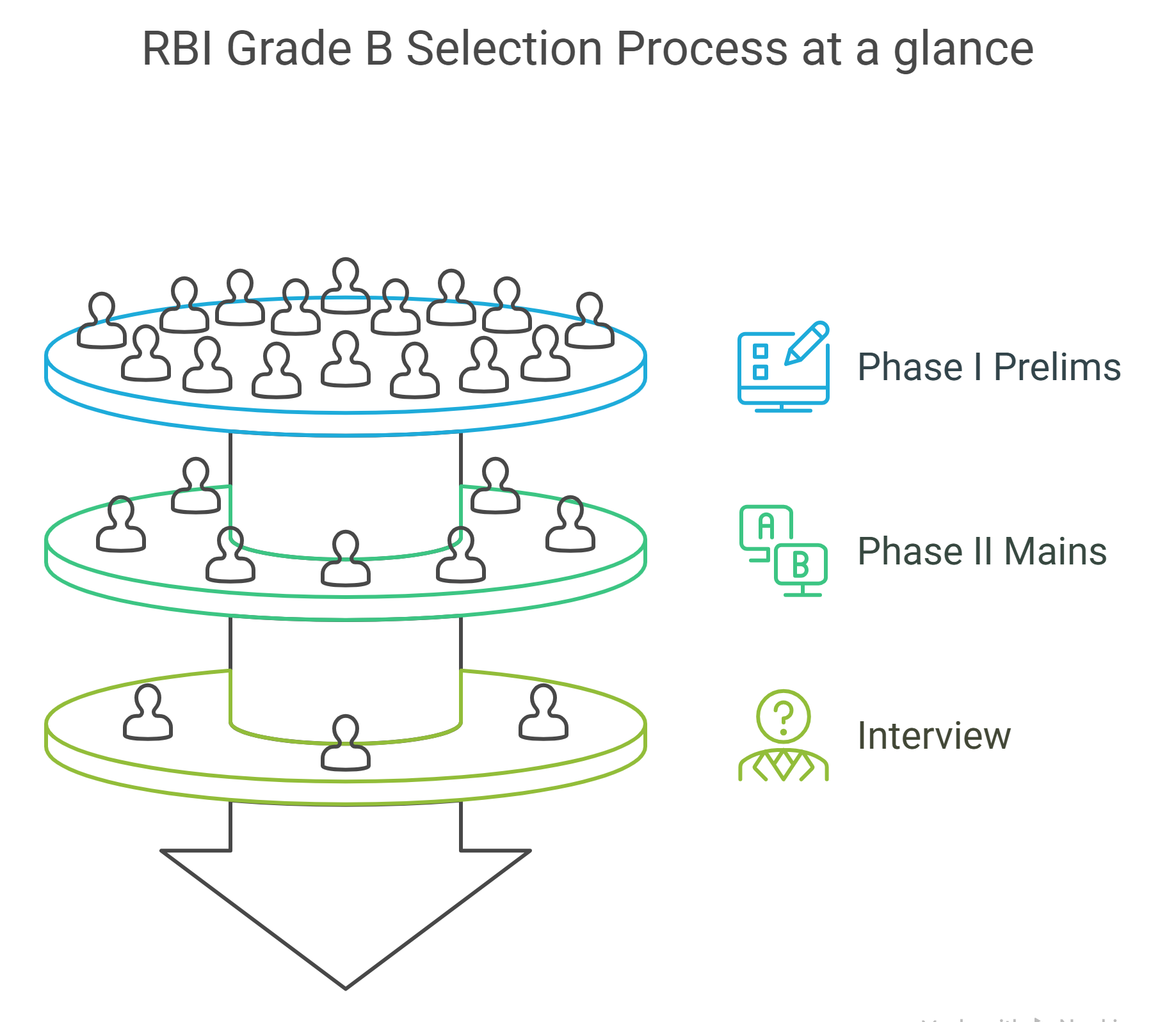
Before you dive into preparation, it’s important to understand the structure of the exam. RBI Grade B is conducted in three stages:
- Phase 1 (Prelims): Objective test
- Phase 2 (Mains): Objective + Descriptive papers
- Interview: Final stage based on Phase 2 performance
Each stage demands a different skillset and level of understanding — and the way you approach them can determine your overall success.
Phase 1: Prelims Exam Pattern
The Phase 1 exam is a 200-mark objective test covering General Awareness, English, Quantitative Aptitude, and Reasoning. You’ll get 2 hours in total, so speed and accuracy play a major role here.
| Sections | No. of Questions | Maximum Marks | Time Allotted |
|---|---|---|---|
| General Awareness | 80 | 80 | A total time of 2 hours is allotted |
| Quantitative Aptitude | 30 | 30 | |
| English Language | 30 | 30 | |
| Reasoning | 60 | 60 | |
| Total | 200 | 200 | 120 minutes |
Phase 2: Mains Exam Pattern
The Phase 2 exam is more conceptual and analytical. It checks your understanding of economics, finance and your ability to express ideas clearly through descriptive writing. There are a total 3 papers such as:
- Paper I: Economics & Social Issues (mix of objective and descriptive)
- Paper II: English Writing Skills (descriptive)
- Paper III: Finance & Management (mix of objective and descriptive)
| S No | Sections / Subjects | Paper Type | Maximum Marks | Duration (minutes) |
| 1. | Paper I: Economics and Social Issues | 50% Objective Type, | 50 | 30 minutes |
| 50% Descriptive (to be typed with the help of the keyboard) | 50 | 90 minutes | ||
| Total | 100 | 120 minutes | ||
| 2. | Paper II: English (Writing Skills) | Descriptive (3 questions) | 100 | 90 minutes |
| 3. | Paper III: Finance and Management | 50% Objective Type | 50 | 30 minutes |
| 50% Descriptive | 50 | 90 minutes | ||
| Total | 100 | 120 minutes | ||
| Grand Total | 300 | |||
RBI Grade B 2026 Syllabus
The syllabus of RBI Grade B is vast but predictable; most questions revolve around fundamental topics that repeat every year. Your goal should be to master core concepts and then strengthen your revision with mock tests. In the table below, you can check Phase 1 exam topics:
| English | Quantitative Aptitude | Reasoning | General Awareness |
| Grammar | Mensuration | Puzzles | Banking & Financial Awareness |
| Vocabulary | Time and Work | Seating Arrangement | Monetary Policies |
| Error Spotting | Average, Ratio, Percentages | Directions and Distance | Economic Terms |
| Comprehension | Speed, Distance, and Time | Data Sufficiency | Current Affairs |
| Passage Making | Mixture and Allegations | Blood Relations | Financial & Economics News |
| Jumble Words | Permutation and Combination | Syllogism | Static GK |
| Fill in the Blanks | Data Interpretation | Coding-Decoding | Government Schemes, Agreements & Deals |
| Sentence Framing | Probability | Inequality | Banking terms, rates, processes |
Subject-wise Preparation Strategy for RBI Grade B 2026 – Phase 1
Every aspirant’s journey is different, but success always follows structure and consistency. Let’s break your preparation into actionable parts:
General Awareness Subject
This section can make or break your score. Focus on the last 4-6 months of current affairs, RBI circulars, and major financial schemes. Make weekly revision notes. Some important sources for GA preparation are:
- Monthly Current Affairs Magazines: You can refer to Adda247’s Current Affairs booklets or any other popular source as per your need. (Last 4-6 months current affairs (recommended))
- Must Follow RBI website for new Notifications, reports, speeches, RBI circulars, committees, reports
- Annual Budget & Economic Survey
- Static: Banking, monetary policy, financial institutions, General Knowledge book
- Banking terms, monetary tools, Indices, reports, organisations
Important Tip: Candidates must set a target to solve around 3000-4000 MCQs before the exam
Quantitative Aptitude Subject
Solve past year papers to understand question trends. Focus on DI, profit-loss, puzzles, and seating arrangement, these topics carry weight. Don’t chase everything; master what matters:
| Topic | What to Study |
| Simplification/ Approximation | Tables, squares (1-35), cubes (1–20), fraction–% conversion, BODMAS |
| Data Interpretation (DI) | Table, Bar, Line, Caselet, Missing DI; % / ratio / average |
| Quadratic Equations | Fast factorisation, root comparison |
| Number Series | Square, cube, difference patterns |
| Arithmetic | You can choose topics from Arithmetic according your understanding and how well you can perform. |
Reasoning Subject
Reasoning subject can be tackled with common sense and the most scoring topics are puzzles, data sufficiency, syllogism. You can follow the topic-wise tips given here:
Topics to Prepare:
- Floor/Box/Scheduling Puzzles
- Seating Arrangement (linear & circular)
- Inequality
- Syllogism
- Blood Relation & Direction (basic level)
- Coding Decoding
- Statement–Assumption / Conclusion (rare)
Candidates must practive puzzles of all kind daily. It will not only help prepare the topic itself but it will help building common sense for other topics as well. However, do not get stuck on one puzzle. If puzzle looks lengthy, skip immediately. Remember that accuracy is more important than attempts
English Language:
Read editorials daily and practice RCs, para jumbles, and error spotting. Learn from your mistakes, analysing mock errors improves faster than memorising grammar rules.
- Practice 1 RC daily (editorial level)
- Learn to find tone, theme, and inference
- Read questions first, then the passage
- Don’t read line by line. Read the question first and scan for answers
- Attempt in the exam if the passage looks moderate
- Error Detection/Sentence Correction: Focus on: subject–verb, tenses, prepositions, article
- Para Jumbles: Learn to find opening sentence, Identify connectors
- Prepare a decent level of vocabulary
Strategy for Descriptive Papers (Phase 2)
Descriptive writing is about how well you think, how clearly you express, and how maturely you understand the concept. Aspirants lose marks because answers are unstructured, they are writing like students, not like future officers and they don’t connect theory with current situation.
Important areas to cover:
- Inflation, monetary policy
- Poverty, unemployment, inequality
- Social sectors (health, education, women)
- Climate change, sustainable development
- Digital economy, financial inclusion
Descriptive Paper Plan:
- First, go through the previous year’s question paper.
- Write at least 2 ESI and 2 FM questions daily
- Follow newspapers and magazines for Essay writing
- Write the answers in a more structured and comprehensive way, but within the number of words.
- Link answers with current scenarios.
- Regular typing speed practice
Practice Mock Tests: The Real Game-Changer
RBI Grade B Mock Tests are your best teachers. They tell you exactly where you stand and what to fix.
- For Phase 1, take sectional tests weekly to improve speed and time management.
- For Phase 2, attempt full-length mocks and descriptive writing practice.
- Most importantly, analyse every mock test. Understand why you got certain questions wrong and how to avoid those mistakes next time.
Revise as much as you Can: The Secret to Retention
The biggest mistake aspirants make is studying continuously without revising.
Create a weekly revision schedule to revisit current affairs, ESI & FM notes, and vocabulary.
Even 30 minutes of revision daily keeps topics fresh and prevents burnout during the final weeks.
RBI Grade B Preparation Tips for Working Professionals
Balancing a full-time job with RBI Grade B preparation can be tough, but not impossible. Here’s how you can do it effectively:
- Study 2-3 hours on weekdays and 6-7 hours on weekends.
- Follow a weekly subject rotation, e.g., Mon–Tue (Quant), Wed (GA), Thu (Reasoning), Fri (English).
- Use your commute or breaks for current affairs revision via mobile apps.
- Take one mock test every Sunday and analyse it completely.
Number of Attempts for RBI Grade B
One of the most common questions that comes up during preparation is: “How many attempts do I have?”
And honestly, it’s not just about the number of attempts allowed by RBI; it’s about how you make each attempt count.
As per RBI guidelines, the number of attempts for the RBI Grade B (General) post is limited, depending on the candidate’s category:
| Category | Number of Attempts |
|---|---|
| General / UR | 6 |
| OBC | 9 |
| SC / ST / PwBD | No restriction (till age limit) |
But here’s the truth: you don’t need all six.
You just need one good attempt with the right strategy, mindset, and consistency.
Even if you don’t clear in your first go, every mock test, every chapter revision, and every analysis you do is pushing you closer to that one successful attempt.
Your goal should be to make every attempt better than the last one, smarter, more disciplined, and more refined.
So, instead of worrying about how many attempts are left, focus on making this one your best one.
Common Mistakes to Avoid During Preparation
Keep these important points in mind to avoid making common mistakes when preparing for RBI Grade B 2026:
- Ignoring descriptive practice: Writing is half the battle in Phase 2.
- Skipping current affairs: It carries the highest weight in Phase 1.
- Overdependence on too many sources: Stick to 1–2 reliable ones.
- Not analysing mocks: Without analysis, mocks lose their purpose.
- Last-minute cramming: Revision is a marathon, not a sprint.

 TNPSC CTS Result 2026 Out, Check Merit L...
 NABARD DA Mains Admit Card 2026 Out, Dow...
 MP Police Constable Band Recruitment 202...

 Adda247 Job portal has complete information about all Sarkari Jobs and Naukri Alerts, its latest recruitment notifications, from all state and national level jobs and their updates.