
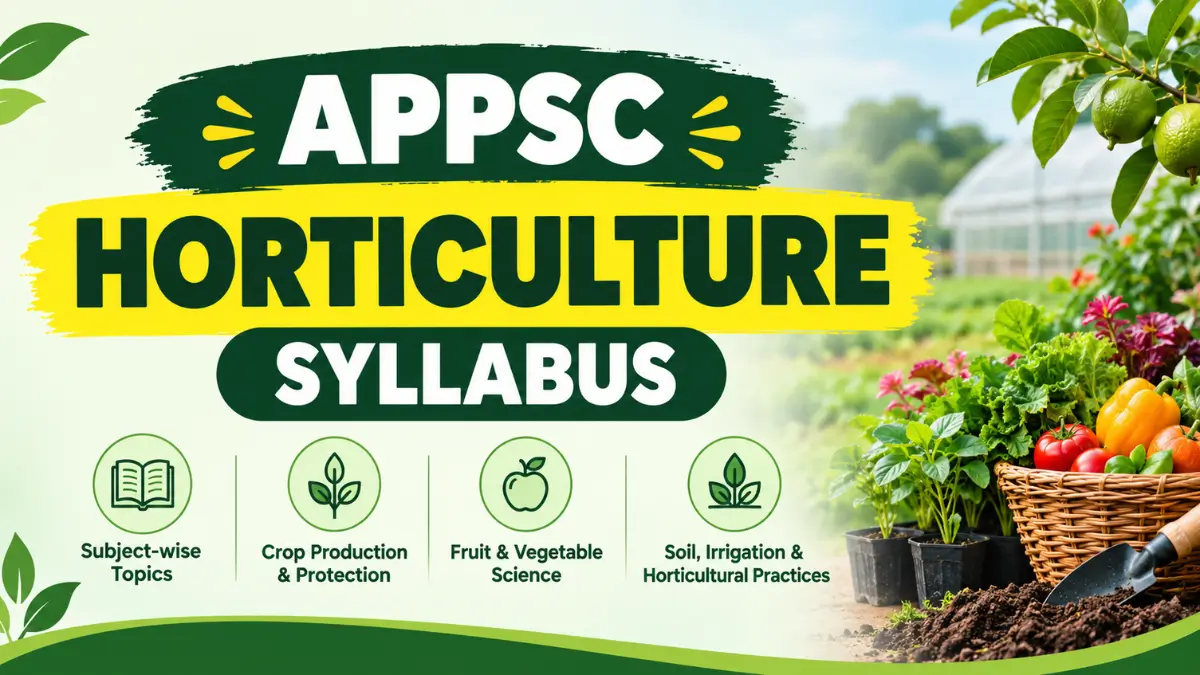
The APPSC Horticulture Officer Syllabus 2026 has been prescribed by the Andhra Pradesh Public Service Commission (APPSC) along with the official notification. Candidates preparing for the examination should understand the subject-wise syllabus and exam pattern to plan their preparation effectively. The written examination is conducted at Degree standard and includes a qualifying test in General English and General Telugu, followed by three merit papers covering General Studies & Mental Ability and Horticulture. The Commission has also prescribed a separate Computer Proficiency Test (CPT).
APPSC Horticulture Officer Syllabus: Overview
The APPSC Horticulture Officer Syllabus and Exam Pattern 2026 provides details about the papers, questions, marks, duration and marking scheme. The written examination is objective type and conducted in Computer Based Recruitment Test (CBRT) mode. There will be no Screening Test, irrespective of the number of applications received.
| Particulars | Details |
|---|---|
| Recruiting Body | Andhra Pradesh Public Service Commission (APPSC) |
| Post Name | Horticulture Officer |
| Exam Standard | Degree Standard |
| Exam Type | Objective Type |
| Exam Mode | Computer Based Recruitment Test (CBRT) |
| Screening Test | Not Conducted |
| Qualifying Test | General English and General Telugu |
| Merit Papers | General Studies & Mental Ability, Horticulture-I, Horticulture-II |
| Total Merit Marks | 450 |
| Negative Marking | 1/3rd marks for each wrong answer |
| CPT | Computer Proficiency Test |
| CPT Duration | 60 Minutes |
| CPT Maximum Marks | 100 |
Must Check: APPSC Horticulture Officer Recruitment 2026
APPSC Horticulture Officer Exam Pattern 2026
The APPSC Horticulture Officer written examination consists of a qualifying test followed by three merit papers. The qualifying test contains General English and General Telugu at SSC standard, while the three merit papers are conducted at Degree standard. Candidates have to qualify in English and Telugu individually.
Qualifying Language Tests (SSC Standard)
Before assessing the main merit papers, candidates must clear basic qualifying language papers individually:
- General English: 50 Marks for 50 Questions
- General Telugu: 50 Marks for 50 Questions
Merit Written Examination
The final selection list is prepared based on performance in three core objective-type papers:
| Paper | Subject | No. of Questions | Duration | Max Marks |
|---|---|---|---|---|
| Paper-I | General Studies & Mental Ability | 150 | 150 Minutes | 150 |
| Paper-II | Horticulture-I (Degree Standard) | 150 | 150 Minutes | 150 |
| Paper-III | Horticulture-II (Degree Standard) | 150 | 150 Minutes | 150 |
| Total | — | 450 | 450 Minutes | 450 |
APPSC Horticulture Officer Syllabus 2026: Subject-wise
The syllabus is divided into General English, General Telugu, General Studies & Mental Ability, Horticulture-I and Horticulture-II. The Horticulture papers are based on the degree standard.
General English
- Comprehension
- Usage and Idioms
- Vocabulary and Punctuation
- Logical Rearrangement of Sentences
General Telugu
- Synonyms and Vocabulary
- Grammar
- Telugu to English Meanings
- English to Telugu Meanings
The English and Telugu sections are part of the qualifying test, and candidates have to qualify in English and Telugu individually.
Paper-I: General Studies and Mental Ability
The general section may cover topics such as:
- Current Affairs
- Indian History and National Movement
- Geography of India and Andhra Pradesh
- Indian Polity and Economy
- General Science
- Mental Ability
- Reasoning and Analytical Ability
- Socio-economic and developmental issues of Andhra Pradesh
Paper-II: Horticulture-I
Paper II consists of the following major subjects:
1. General Horticulture
This section covers the agro-climatic zones of India and Arunachal Pradesh, nature and scope of horticulture, classification of horticultural plants, production and importance of horticulture, nutri-sensitive horticulture, export potential of horticultural crops from the NEH region, peri-urban horticulture and vertical farming.
2. Pomology
Candidates need to study the definition, scope and importance of fruit science along with the production and cultivation of important fruits such as Apple, Walnut, Citrus, Kiwi, Plum, Chestnut, Guava, Banana and Pineapple. Their varieties and cultural practices are also included.
3. Olericulture
This section deals with vegetable production, classification and importance. Important crops include Cabbage, Cauliflower, Potato, Okra, Brinjal, Beans, Pumpkin and Cucumber, along with vegetable seed production.
4. Floriculture
The topics include the scope of floriculture and landscaping in Arunachal Pradesh and cultural practices of flowers such as Rose, Begonia, Marigold, Calendula, Salvia, Chrysanthemum, Gladiolus, Orchids and Anthurium.
5. Medicinal, Aromatic and Spice Plants
Candidates should prepare the scope and opportunities in medicinal, aromatic, spice and condiment cultivation. The syllabus also includes nursery preparation, after-care and the therapeutic and pharmaceutical importance of these crops.
6. Propagation and Orchard Management
Important areas include methods and principles of plant propagation, orchard layout, nursery management, systems of cultivation and zone-wise cultivation of horticultural crops. Greenhouse production and protection are also covered.
7. Plant Physiology and Growth Regulators
This portion includes absorption and movement of water and nutrients, factors affecting photosynthesis, photorespiration, evaporation, enzymes and physiological processes in horticultural crops, with special reference to Arunachal Pradesh. Plant growth hormones, their effects, application methods, evaluation of responses and pre-harvest regulation are also included.
8. Genetics and Plant Breeding
The syllabus covers elementary genetics, principles of inheritance, gene interaction, linkage and crossing over, sources of resistance to biotic and abiotic stresses, and quality characters of fruits, vegetables, flowers, plantation crops, spices and medicinal and aromatic crops. Modern breeding methods and biotechnological tools are also included.
9.Soil Science, Plant Nutrition, Manure and Fertilizer
This section covers soil composition, texture, water, colloids, minerals, organic matter, soil pH, soil moisture, humus, soil profile, land capability, soil survey, microorganisms and soil acidity management.
Plant nutrition includes essential nutrients, mineral absorption, nutrient deficiency symptoms, organic farming and the use of organic manures.
Paper-III: Horticulture-II
Paper III consists of the following major subjects:
1. Plant Pathology
Candidates should study plant diseases, their importance and classification, parasites and non-parasites, causes and stages of disease development. Diseases of fruit, plantation, vegetable, tuber, spice, ornamental, medicinal and aromatic crops are included, along with their management.
The syllabus specifically mentions diseases of crops such as banana, citrus, grape, apple, peach, walnut, pineapple, pear and kiwi. Weed definition, classification, control measures and biological control are also covered.
2. Entomology
This section includes the classification of insects and nematodes, nature and extent of damage, insect life cycles, seasonal occurrence and management of important pests of fruits, vegetables, spices, aromatic medicinal plants and flowers.
Candidates should also prepare Integrated Pest Management (IPM), insecticides and pesticides, their properties and formulations, plant protection equipment, maintenance, field use and toxicology.
3. Extension Education and Rural Psychology
Important topics include the definition and objectives of extension education, its importance in horticulture and rural development, teaching and learning processes, classification and characteristics of extension, reading methods, audio-visual aids, programme planning and evaluation, teaching methods and rural psychology.
4. Agricultural Economics and Management
This section covers micro and macro economics, wants, goods, wealth, welfare, prices, consumption, exchange, factors of production, law of diminishing returns, farm business organisation, national income and per capita income.
Candidates should also study agricultural economics, horticultural economics, farm management, farm records and accounts, bookkeeping, labour management, cost of production, farm layout, irrigation, fencing and agricultural marketing cooperation.
5. Agricultural Engineering
The syllabus includes farm mechanisation, its benefits and limitations, sources of farm power, internal combustion engines, tractors, soil tillage implements, intercultural equipment, harvesting and threshing equipment.
It also covers the soil-plant-water relationship, drainage engineering, surveying and levelling, soil and water conservation and erosion control.
6. Post-Harvest Management and Marketing
This section focuses on post-harvest technology in horticultural crops, maturity indices, harvesting and grading of fruits, vegetables, cut flowers, plantation crops, medicinal crops and aromatic spices.
Candidates should prepare quality control, physiological and biochemical changes, pre-harvest treatments, storage systems, packaging, advanced packaging, processing and preservation. Marketing concepts, classification, marketing constraints in Arunachal Pradesh and the role of government in promoting horticultural marketing are also included.
7. Agro-Forestry and Agro-Technology
final section covers the definition, objectives and potential of agroforestry systems, Horti-Silviculture, Horti-Silvi-Pastoral systems, intercropping, home gardens, windbreaks, shelter belts and energy plantations.
Shifting cultivation, its alternatives and sustainable resource management are also included. Agro-meteorology, weather and climate, remote sensing technology, cloud types, precipitation, hail and frost and their effects on crop growth are part of this section.
APPSC Horticulture Officer Computer Proficiency Test 2026
The APPSC Horticulture Officer notification also provides a separate Computer Proficiency Test (CPT) scheme. The CPT is a practical-type examination designed to assess proficiency in Office Automation using computers and associated software. It carries 100 marks and has a duration of 60 minutes.
| Particulars | Details |
|---|---|
| Test Name | Computer Proficiency Test |
| Test Type | Practical |
| Duration | 60 Minutes |
| Maximum Marks | 100 |
| SC/ST Minimum Qualifying Marks | 30 |
| BC Minimum Qualifying Marks | 35 |
| OC Minimum Qualifying Marks | 40 |
| Main Area | Office Automation with Computers and Associated Software |
CPT Syllabus
The CPT syllabus is divided into Part-A and Part-B.
Part-A: Computer Fundamentals
- Introduction to Computers
- Components and peripheral devices
- Input and output devices
- Storage devices
- Data and information
- RAM and ROM
- Control Unit, Memory Unit and ALU
- Types of computer software
- Operating Systems
- Windows operating system
- Basic Linux and Mac OS concepts
- Internet concepts
- World Wide Web
Part-B: Office Applications
- Office Suite
- Getting Started with Office
- File Operations
- Office Application Tools
- Word Processing
- Spreadsheet applications
- Presentation software
The detailed CPT syllabus includes practical work in word processing, spreadsheets and presentation software.
CPT Assessment Pattern
The notification specifies the following assessment components:
| Assessment Component | Weightage |
|---|---|
| Part-A: MCQ-based Assessment | 20% |
| Typing Speed | 25% |
| Organising and Inserting Objects | 15% |
| Excel Sheet and Data Formatting | 20% |
| PowerPoint Presentation | 20% |
| Total | 100% |
The notification states that the typing-speed component may be made mandatory for qualifying based on the applicable norms.
How to Prepare for APPSC Horticulture Officer Exam 2026?
Candidates can follow the preparation strategy given below:
- Cover the technical syllabus first: Give adequate time to Horticulture-I and Horticulture-II.
- Prepare General Studies: Revise Andhra Pradesh-related topics along with national current affairs.
- Practise crop-based topics: Focus on cultivation practices, varieties, diseases, pests and management methods.
- Revise regularly: Prepare short notes for technical facts, definitions and important concepts.
- Practise objective questions: Solve previous papers and topic-wise questions to improve accuracy.
- Take mock tests: Attempt full-length tests to improve speed and time management.
- Prepare for CPT: Practise basic computer operations and office applications alongside written exam preparation.




 TNPSC Group 4 Syllabus 2026, Download Ex...
 UPSSSC PET Syllabus and Exam Pattern 202...
 Odisha Police Constable Syllabus & E...


 Adda247 Job portal has complete information about all Sarkari Jobs and Naukri Alerts, its latest recruitment notifications, from all state and national level jobs and their updates.