Correct option is C
In linkage mapping, the goal is to identify the genetic distance between different markers based on recombination frequencies. Here's why option 3 is correct:
- Option 3: An ideal mapping population for a self-pollinating species would indeed be generated by using polymorphic parents that are inbred lines. This is because inbred lines are homozygous at most loci, which simplifies the identification of recombination events. Polymorphic parents (with different alleles) will allow you to track the inheritance patterns and calculate the recombination frequencies between markers. Inbred lines ensure that the segregation of alleles is predictable, which is essential for accurate linkage mapping
Option 1: This statement is incorrect. While it is true that markers that are closer to each other tend to show lower recombination frequencies (because the likelihood of crossing over between them is lower), it is not always the case that they show "higher" recombination frequencies if they are farther apart. In fact, farther markers show higher recombination frequencies, and as the markers become even more distantly located on the chromosome, the recombination frequency approaches 50%, indicating independent assortment.
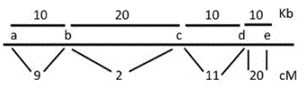
Option 2: This statement is incorrect. The genetic distance between two markers is not always a true representation of the physical distance between them. The genetic distance is determined by recombination frequencies, which can be influenced by factors like genetic interference or structural variation in the chromosome. Genetic distance is often measured in centimorgans (cM), while physical distance is measured in base pairs (bp), and these two are not perfectly correlated.
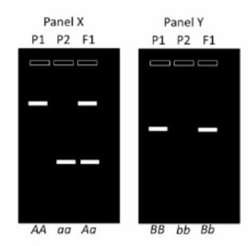
Option 4: This statement is incorrect. In an F₂ mapping population, the segregation ratio for a dominant marker is typically 3:1 (dominant: recessive). A 1:2:1 ratio is more commonly observed in cases involving codominant markers or for recessive traits in simple Mendelian inheritance patterns, but not for a dominant marker.
Information Booster:
Linkage Mapping: Linkage mapping is a technique used to determine the relative positions of genetic markers on a chromosome based on their recombination frequencies. The closer two markers are to each other, the lower the recombination frequency between them, and the higher their genetic linkage.
Self-Pollinating Species: For self-pollinating species (such as many plants like Arabidopsis or peas), the ideal mapping population often comes from inbred lines to maintain genetic uniformity. Using polymorphic parents ensures that you can observe clear segregation patterns in the progeny, which helps in accurate mapping of the markers.
Polymorphic Parents: Polymorphic parents have different alleles at the loci of interest, making them useful for identifying recombination events in the offspring. This is crucial for understanding the inheritance patterns and building a linkage map.