Correct option is B
The correct answer is: 2. Analysis of progeny beyond 2000 led to identification of new alleles of already identified genes rather than more new genes.
Explanation:
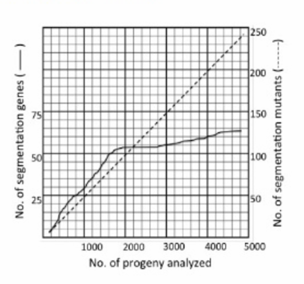
The graph shows two curves:
Solid line: Number of segmentation genes identified.
Dotted line: Number of segmentation mutants detected.
As the number of progeny analyzed increases, the number of segmentation mutants continues to rise steadily (dotted line). However, the number of segmentation genes identified (solid line) starts to plateau after analyzing about 2000 progeny.
This means that while mutations continued to be discovered, they were mostly in genes already identified, implying these were new alleles of known genes. Therefore, option 2 is correct.
Information Booster:
Christiane Nüsslein-Volhard and Eric Wieschaus won the Nobel Prize in 1995 for their work on genetic control of early embryonic development.
Their mutagenesis screen in Drosophila melanogaster was designed to identify all genes responsible for segmentation.
The plateauing of the gene curve reflects that most segmentation genes were already identified by around 2000 progeny.
The continued rise in the mutant curve indicates repeated hits on the same genes, i.e., new mutant alleles.
This technique helped in identifying critical developmental genes like bicoid, hunchback, and krüppel.
The method is an example of a saturation mutagenesis screen, which aims to identify all genes of a particular function.
Allelic series help in understanding gene function and domain-specific roles through different mutations in the same gene.
Additional Information:
Analyzing 10,000 progeny (Option 1):
Would increase the number of mutants, but not significantly increase the number of new genes.
More dominant mutations in first 1000 progeny (Option 3):
Dominant mutations are less frequent in mutagenesis screens; the graph does not support this claim.
Curves remain same irrespective of mutagen (Option 4):
Different mutagens like EMS or X-rays affect mutation types and rates differently, impacting curve patterns.