Correct option is C
Explanation:
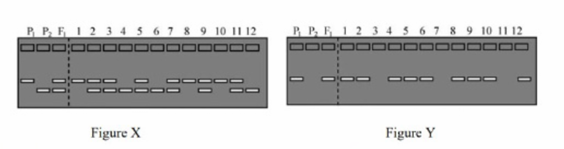
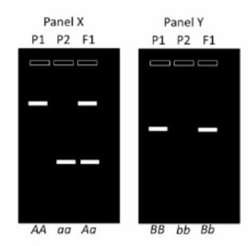
Panel X shows two bands for the heterozygous F1 progeny (Aa), and one band for each of the homozygous parental lines (AA and aa), which indicates that Panel X represents a codominant marker. This type of marker can differentiate between the two alleles in a heterozygous state.
Panel Y shows one band for both homozygous parental lines (BB and bb) and two bands for the heterozygous F1 progeny (Bb), which indicates a dominant marker. In this case, only one allele needs to be present to show the phenotype.
Statement A is correct because Panel X does indeed represent a codominant marker.
Statement B is incorrect because Panel Y does not represent a codominant marker. It represents a dominant marker.
Statement C is correct because Panel X could be an SSR marker, which is codominant, and Panel Y could be a RAPD marker, which is typically dominant.
Statement D is correct because Panel Y represents a dominant marker.
Thus, the combination of statements A, C, and D is correct.
Information Booster:
Codominant markers (like those seen in Panel X) allow detection of both alleles in a heterozygote, making them useful for gene mapping.
Dominant markers (like those seen in Panel Y) detect only the presence of one allele, which is sufficient to express the phenotype.
SSR markers (Simple Sequence Repeat markers) are codominant and allow the differentiation between the two alleles present in a heterozygote.
RAPD markers (Random Amplified Polymorphic DNA markers) are dominant markers, often used in genetic mapping for detecting polymorphisms.
SSR markers are widely used in plant and animal genetic research because of their ability to detect genetic variation.
RAPD markers can detect polymorphisms without the need for prior knowledge of the genomic sequence, making them valuable for gene identification in unknown genomes.