Correct option is B
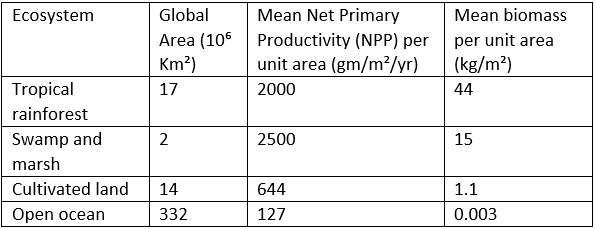
The net primary productivity (NPP) of ecosystems varies based on factors such as sunlight, water availability, and biodiversity. While tropical rain forests are highly productive, the open oceans are often considered to have the highest NPP globally due to the vast expanse of ocean surface and the high productivity of plankton and marine algae. Tropical rain forests, which have a high biodiversity and dense vegetation, are also highly productive, but open oceans cover a much larger area, contributing significantly to global NPP. Northern coniferous forests, though productive, have lower NPP compared to tropical rain forests and open oceans, while estuaries are productive but have the least NPP in this comparison.
Information Booster:
- Open Oceans rank first in terms of NPP due to their vast coverage and the large contribution of phytoplankton, which forms the base of the marine food chain.
- Tropical rain forests have high productivity due to their constant warm climate, high levels of sunlight, and ample water availability, making them extremely efficient at converting solar energy into organic matter.
- Northern coniferous forests are less productive than tropical rain forests due to shorter growing seasons, colder temperatures, and fewer plant species per unit area.
- Estuaries are highly productive due to the nutrient-rich waters from rivers meeting the sea, but they are generally less productive than the open oceans and tropical rain forests.
- Net Primary Production is a crucial measure as it helps in understanding ecosystem health, energy flow, and the capacity of ecosystems to support life, particularly through photosynthesis.
- Phytoplankton in the open oceans produce a significant amount of biomass and account for about 50% of the world's oxygen, playing a critical role in the Earth's carbon cycle.
Additional Information:
- Option 1: "Tropical rain forests > Northern coniferous forests > Open Oceans > Estuaries" is incorrect because open oceans typically have a higher NPP than northern coniferous forests.
- Option 3: "Tropical rain forests > Open Oceans > Northern coniferous forests > Estuaries" is incorrect because open oceans generally have a larger area and higher NPP than tropical rain forests.
- Option 4: "Open Oceans > Northern rain forests > Estuaries > Northern coniferous forests" is incorrect because there are no "Northern rain forests"; the term should be tropical rain forests.