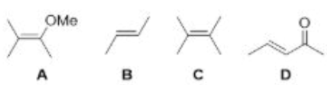


Correct option is A
The most stable conformer of 1,3-butadiene is the s-trans conformation, in which the molecule is planar, with the two pairs of double bonds facing opposite directions. This conformation is most stable because orbital overlap between double bonds is maximized, allowing for maximum conjugation, while steric effects are minimized. Conventionally, the s-trans conformation is considered to have a C2-C3 dihedral angle of 180°. In contrast, the s-cis conformation, in which the dihedral angle is 0°, with the pair of double bonds facing the same direction is approximately 16.5 kJ/mol (3.9 kcal/mol) higher in energy, due to steric hindrance.
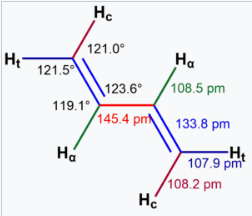
The gauche geometry, in which the double bonds of the s-cis geometry are twisted to give a dihedral angle of around 38°, is a second conformer that is around 12.0 kJ/mol (2.9 kcal/mol) higher in energy than the s-trans conformer. Overall, there is a barrier of 24.8 kJ/mol (5.9 kcal/mol) for isomerization between the two conformers. This increased rotational barrier and strong overall preference for a near-planar geometry is evidence for a delocalized π system and a small degree of partial double bond character in the C–C single bond, in accord with resonance theory.
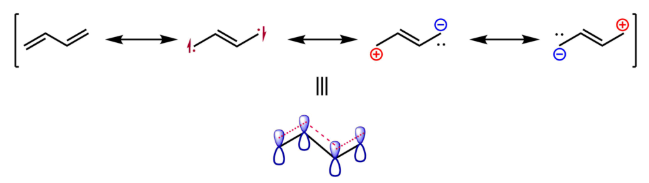
The ratio of electron density on all atoms is: 1:1:1:1.